
Some of the year’s new marine species were pulled from water more than six kilometres deep. Others were already sitting on land, preserved in collections and waiting for the right specialist to recognise what they were.
Between 1 April 2025 and 31 March 2026, the Ocean Census network documented 1,121 marine species it considered previously unknown to science. In its 19 May 2026 announcement, the programme said that output increased the normal annual rate of marine identification by 54 per cent.
The total is impressive, but the machinery behind it is the more revealing result. It did not come from one ship returning with 1,121 new animals. It came from 13 expeditions, nine specialist workshops, targeted grants, museum and laboratory backlogs, and a network of 1,433 scientists at 660 institutions in 85 countries.
It also relies on a distinction that Ocean Census has made central to its work. A species can enter its open database as “discovered” before receiving a formal scientific name in a peer-reviewed taxonomic description.
That makes 1,121 a measure of a discovery pipeline, not a stack of 1,121 finished nomenclatural papers.
A census assembled at sea and on shore
The programme’s third year ran from April 2025 through March 2026. Its expeditions ranged across remote deep ocean, volcanic seamounts, tropical reefs and coastal caves. Specimens were collected by divers, research vessels, remotely operated equipment and crewed submersibles.
Collection was only the opening step. Species Discovery Workshops brought specialists together with microscopes, imaging systems, genetic tools and access to reference material. Grants supported the less visible work of preparing specimens, visiting collections, comparing old descriptions and turning suspicions into documented candidates.
Ocean Census reported that its Species Discovery Awards helped bring 728 previously unknown species to light from recent expeditions and legacy backlogs. That is nearly two-thirds of the year’s total.
The wording matters. It does not mean every one of those 728 specimens had been forgotten in a museum drawer. It means much of the output depended on funded taxonomic work performed after collection, whether the material was recent or old.
The unknown ocean is therefore not found only by travelling farther. Part of it is already in jars, freezers and specimen cabinets, separated from a name by scarce expertise and time.
Finding an organism is not yet finding a species
A camera can record an unfamiliar animal in seconds. Establishing that it represents a new species is harder.
A taxonomist has to rule out familiar alternatives. Differences can arise from sex, age, diet, injury, preservation, geography or ordinary variation within one species. A juvenile may look unlike an adult. A damaged deep-sea specimen may be missing precisely the structure needed to identify it.
The investigator may need to dissect the animal, examine tiny structures, sequence DNA and compare it with specimens held in several countries. Old scientific descriptions may be brief, illustrated imperfectly or written under names that later changed.
ScienceBlog’s earlier analysis found that less than 0.001 per cent of the deep seafloor has been visually observed. That tiny and geographically biased record helps explain why every retrieved specimen carries so much weight, and why no expedition can make the discovery process representative by itself.
Ocean Census is trying to turn that painstaking one-species pathway into shared infrastructure without pretending the hard comparisons have disappeared.
“Discovered” and “described” mark different thresholds
Under the programme’s published NOVA criteria, a species can be recorded as discovered when experts determine from morphology, ecological context and, when needed, genetic evidence that it is new to science.
A submission needs a unique specimen identifier, a temporary name, collection coordinates and depth, at least one full-specimen image, and taxonomic remarks explaining why the organism is distinct. The main specimen must be traceable to a collection.
Formal description comes later. It ordinarily requires a published diagnosis or description, a valid scientific name and a holotype deposited in a recognised museum or taxonomic repository. Other specialists can then evaluate the claim under the rules governing zoological or botanical names.
Ocean Census says the historical interval between collecting a candidate and completing that formal process averages 13.5 years. NOVA is designed to expose the candidate record during that gap rather than leaving it invisible on one researcher’s computer.
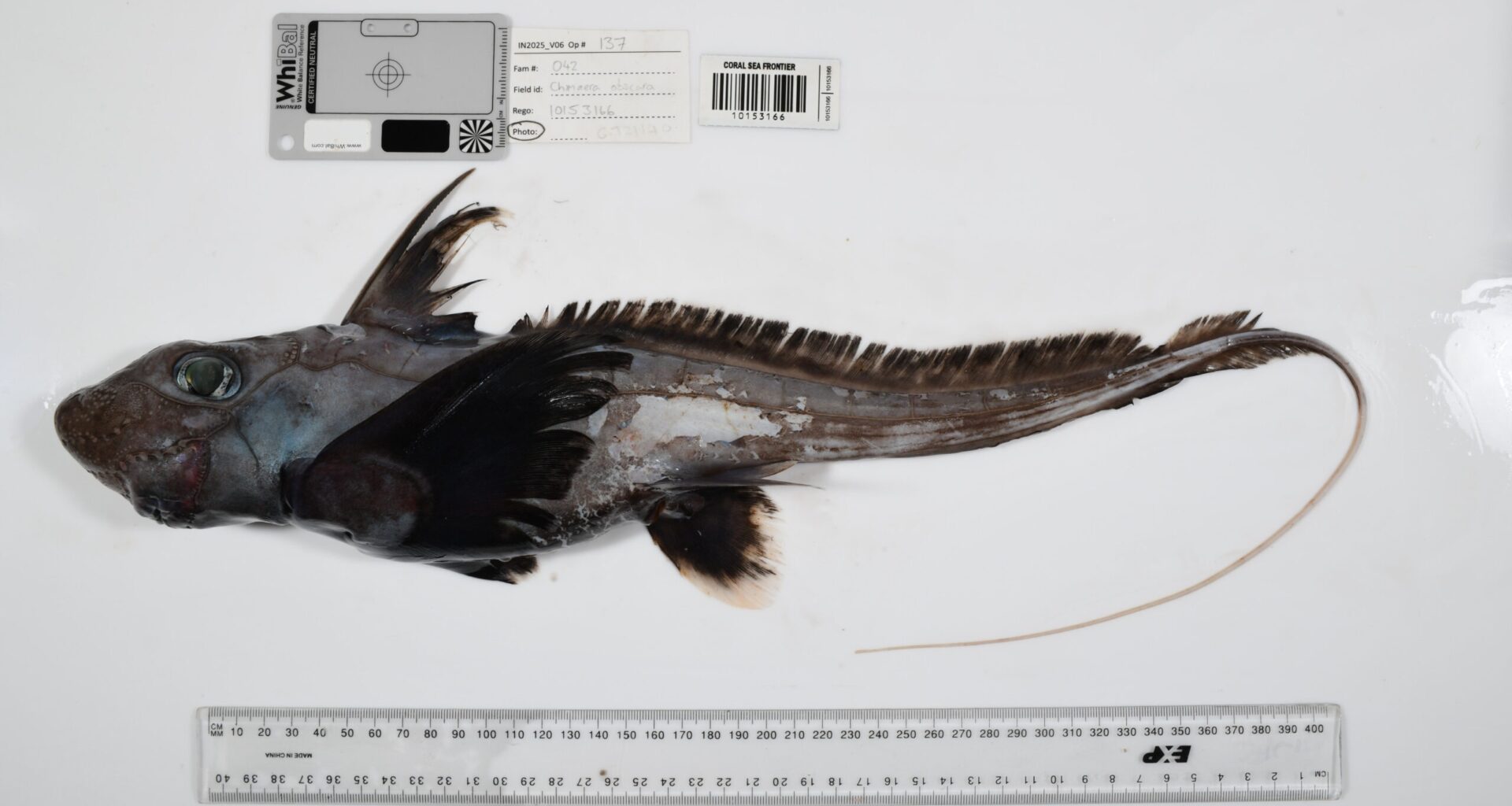
The distinction is visible among the programme’s showcase animals. The Coral Sea ghost shark is still listed as Chimaera sp. 1, a working designation. The striped cave shrimp from Marseille is Caridion sp. 1. By contrast, the glass-sponge worm Dalhousiella yabukii has already been formally named and published.
Our earlier ScienceBlog examination of the Ocean Census tally explored this boundary in detail. The useful shorthand is that “discovered” signals a supported candidate; “described” signals that the nomenclatural and publication process has been completed.
The year’s animals crossed an enormous range
The ghost shark candidate shown with this article came from Australia’s Coral Sea Marine Park at depths of 802 to 838 metres. Chimaeras are relatives of sharks and rays, but belong to a lineage that separated from them hundreds of millions of years ago.
At the other end of the depth range, a vividly banded shrimp was found in a sea cave near Marseille at 15 to 35 metres. A ribbon worm less than three centimetres long came from water only one to five metres deep off Timor-Leste.
On Japan’s Shichiyo Seamount Chain, researchers found D. yabukii at 791 metres inside the chambers of a glass sponge. The host’s silica skeleton gives the worm’s home the appearance of a transparent castle.
The wider tally included corals, crabs, sea urchins, anemones, sponges and other worms. The deepest candidates came from 6,575 metres.
This spread undercuts the idea that unknown species survive only in abyssal places humans have never visited. Extreme depth remains productive, but so do pressured coastal waters near major cities and collections assembled decades ago.
The 54 per cent claim is about pace
The percentage in the headline does not mean the known marine catalogue grew by 54 per cent. Nor does it mean the ocean became 54 per cent more diverse during the year.
Ocean Census presents its 1,121 candidates as additional output large enough to raise the normal global annual identification rate by 54 per cent. The World Register of Marine Species says roughly 2,000 marine species are described in an average year, which gives a sense of the comparison’s scale.
There is still an accounting boundary to keep in view. The usual global figure refers to formally described species added through conventional publication. Ocean Census includes supported candidates at its earlier discovery threshold. A candidate may later be formally named, revised or, in principle, merged with an already known species after more evidence appears.
The 54 per cent is therefore best read as the project’s estimate of how much its network expanded the active identification pipeline. It is not an independently audited revision of the total number of accepted marine species.
That does not make the acceleration cosmetic. Bringing a specimen into a transparent record with images, coordinates, expert reasoning and a collection identifier is a real step. It simply is not the final step.
The 90 per cent unknown is not a literal count
The upper estimate in the headline is generally traced to a 2011 PLOS Biology analysis. Camilo Mora and colleagues modelled patterns in higher taxonomic ranks and estimated about 2.2 million marine eukaryotic species, with a standard error of roughly 180,000. Against the catalogue available then, they calculated that about 91 per cent awaited description.
That was an extrapolation, not a count of organisms hiding in unsampled water. It focused on eukaryotes, whose cells contain nuclei, and did not solve the more difficult problem of defining and counting microbial species.
Other approaches have produced lower totals. A 2012 Current Biology analysis built from the World Register of Marine Species estimated 0.7 to 1 million marine eukaryotic species. Its authors concluded that between one-third and two-thirds might remain undescribed.
Those ranges differ by more than a statistical footnote. They reflect different data, definitions and modelling assumptions. “As much as 90 per cent” is defensible as the upper result of a prominent model. It should not be presented as though researchers have surveyed the whole ocean and counted nine blank spaces for every named species.
The less dramatic estimates still leave hundreds of thousands of possible species unaccounted for. Uncertainty about the size of the gap does not make the gap small.
Taxonomic capacity is part of ocean exploration
Research ships are visible and expensive, so exploration is often described as a problem of reaching new places. The 728 award-supported discoveries point to another constraint: the number of people able to interpret what ships bring back.
Taxonomic expertise is narrow by necessity. A specialist who can distinguish closely related ribbon worms cannot automatically settle a difficult group of sponges, shrimps or microscopic crustaceans. When only a few people know a group, specimens can wait for years.
Workshops reduce that delay by putting the specimens, experts and equipment in one place. Grants can pay for imaging, sequencing, collection visits and the unglamorous labour of preparing a publication. Shared data lets another specialist discover that a puzzling specimen in one museum resembles material held elsewhere.
Speed should not come from lowering the bar for a valid name. It can come from shortening the dead time between steps and making the evidence visible sooner.
A provisional record is useful only if it can mature
An unnamed species is not less alive than a named one. Yet environmental monitoring and conservation decisions depend on records stable enough to compare across places and years.
If every unusual sponge is stored merely as “sponge,” a population with a tiny range may disappear without anyone recognising that several surveys recorded the same distinct organism. A candidate record can connect those observations earlier.
Its long-term value depends on what happens next. Specimens must remain accessible. Evidence and uncertainty must be clear. Records must accept correction. A provisional label should connect cleanly to the eventual published name rather than becoming a parallel catalogue that never resolves.
The 1,121 tally is therefore neither the final census Ocean Census’s name might suggest nor just a publicity number. It is an annual output from a deliberately constructed discovery system.
Ships found new material, collections preserved older material, experts recognised differences, workshops concentrated scarce skills and NOVA made the first records public. The figure shows that the opening stages of taxonomy can move faster when treated as infrastructure. The competing estimates of what remains show how far that infrastructure may still have to go.