
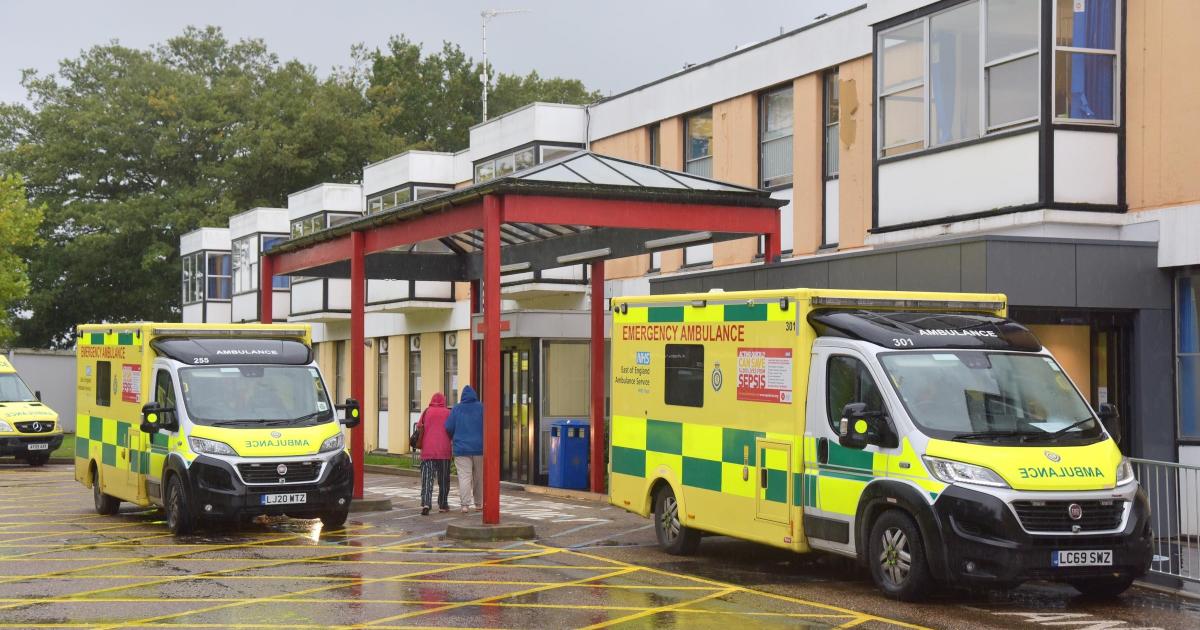
Senior sources at the Queen Elizabeth Hospital (QEH) in King’s Lynn say that officials there have been holding discussions over the possible closure of all three departments.
The troubled facility has been rated the worst-performing hospital in the country and health bosses believe that by closing some struggling services to focus on others they can improve its fortunes, while patients needing those services will be better served by being sent elsewhere.
The QEH was rated the worst-performing hospital in the country last year (Image: Supplied)
However, the revelation is likely to spark alarm in west Norfolk, where patients requiring life-saving care could face trips of more than an hour to Norwich, Cambridge or Peterborough.
The news of the talks has also thrown into doubt the £1.4 billion plans to rebuild the current site, much of which is propped up by scaffolding poles to prevent its roof from falling in.
The possible closures have been discussed by senior leaders at the Norfolk and Waveney University Hospitals Group – formed last year to run the QEH alongside the Norfolk and Norwich and James Paget hospitals.
The group has been developing a long-term combined strategy for the county’s three flagship hospitals.
The hospital is one of three managed by the Norfolk and Waveney University Hospitals Group (Image: QEH)
It has insisted no decision has yet been made on the future of the QEH’s A&E unit and said patients in west Norfolk will continue to have access to “urgent and emergency care” at the QEH.
However, this could mean scaled-down alternatives such as a nurse-led minor injuries unit, a GP-staffed urgent treatment centre or a smaller emergency department unable to handle trauma, cardiac arrest or stroke cases.
A&E ON THE LINE
Under a new blueprint drawn up by the Norfolk and Waveney University Hospitals Group, the QEH would stop being the automatic place for patients in west Norfolk to go for A&E, intensive care and maternity care.
Instead, the group is looking for ways to co-ordinate services more efficiently between the QEH, the Norfolk and Norwich, and the James Paget.
The Norfolk and Norwich University Hopsital (Image: Archant)
The new scheme would see anyone with a less severe emergency steered towards new “urgent response” centres, designed specifically to keep patients away from hospital altogether.
Parts of the plan were set out in the group’s presentation to Norfolk County Council’s health overview and scrutiny committee in July.
Another report, due to be shown to the same committee in November, will further set out the case for making the changes.
As well as A&E, maternity services at the QEH are also understood to be under threat.
The QEH currently employs 3,700 full-time staff (Image: QEH)
Senior sources at the hospital say it is no longer delivering enough babies to sustain a viable unit, with too few births to justify the team of doctors, nurses and midwives a safe consultant-led service requires.
Earlier this summer, the hospital’s maternity ward was found to have “cramped layouts”, “visibly stretched staff” and “busy wards” following a national review.
However the group has said any move to axe any units would first require “robust clinical evidence” and would be “subject to governance, public engagement and formal consultation before any decisions could be taken”.
WHAT DO THE POLITICIANS SAY?
The two MPs who cover west Norfolk have taken a different tone on the revelations.
James Wild, the Conservative MP for North West Norfolk who has long campaigned to get the QEH rebuilt, said he would be asking for “urgent reassurance” from the group.
James Wild has served as the Conservative MP for North West Norfolk since 2019 (Image: Chris Bishop)
He said: “Any suggestion key services will be permanently moved from the QEH will rightly cause significant concern among patients and staff and has not been raised in the regular discussions I have with QEH and the Norfolk and Waveney University Hospitals Group.
“Any such proposals would be strongly opposed by our community which campaigned strongly for a new hospital and state of the art facilities and care locally.
“Therefore I have asked the group to provide urgent reassurance that there is no intention to downgrade QEH’s status as a district general hospital providing A&E, general surgery, and other specialist care.”
However, Terry Jermy, the Labour MP for South West Norfolk, who highlighted the issues facing the QEH in his maiden speech in the House of Commons, struck a more supportive note.
Terry Jermy was elected in 2024 (Image: Roger Harris)
He said: “The commitment both from this Labour government and the Norfolk and Waveney University Hospitals Group to maintain services on-site is clear, and a commitment that I strongly share.
“We need to ensure the care and services delivered to people in West Norfolk are of the highest quality, which inevitably in a hospitals group model like this, will see conversations had about what services are best delivered at the Queen Elizabeth Hospital and what services may be best delivered at the two other acute hospitals in the model.
“I am determined that within those conversations, west Norfolk’s specific health needs, rurality and the impact of health inequalities are properly reflected in the services to be delivered.”
A HOSPITAL ALREADY UNDER STRAIN
The news comes amid a long-awaited £1.4 billion rebuild of the QEH under the government’s New Hospital Programme.
The hospital, which was built from lightweight concrete planks with an expected 30-year lifespan in the late 1970s, needs thousands of supports to prevent its roof from collapsing.
While work on a new hospital is now under way, it is not expected to open until 2032.
An example of one of the props in place around the QEH (Image: QEH)
Land has already been bought for a contractor’s compound and work has begun on a new multi-storey car park, with a construction firm confirmed as building partner in July.
Under current designs, drawn up by architects BDP, the new hospital includes A&E, maternity and intensive care units.
As well as the dilapidated state of the building, there have been long-standing worries about standards at the facility.
In May, general surgery at the QEH was placed into a 12-month “stabilisation programme” following concerns over staffing and patient safety.
An artist’s impression of the new hospital (Image: QEH)
Clinical leadership of the department was handed to the N&N, with more than 120 patients treated there since February.
The group insists thousands more continue to be treated at the QEH itself.
Meanwhile, Cambridge and UEA medical schools have suspended student placements at the hospital, and resident doctors in general surgery have raised concerns about racism from colleagues and patients, a matter now referred to national training regulators.
NO DECISIONS… YET
Professor Lesley Dwyer, the group chief executive said: “No decisions have been made about future service configuration.
“We are determined to make the very best of the £2.8 billion investment through the two New Hospital Programmes to improve healthcare for people across Norfolk and Waveney, both now and for future generations.
Prof Lesley Dwyer, chief executive of the Norfolk and Waveney University Hospitals Group (Image: NNUH)
“We know demand for healthcare is growing, people are living longer and many are living with more complex health needs.
“That is why clinical experts from across our three hospitals are working together to develop a shared strategy focused on providing the safest, highest-quality and most sustainable care for local communities over the next 10 to 20 years.
“This work builds on closer ways of working across many of our services since the formation of the group and remains at an early stage.
“One of the principles underpinning this work is that people in West Norfolk will continue to have access to urgent and emergency care at the QEH 24 hours a day, seven days a week.”