
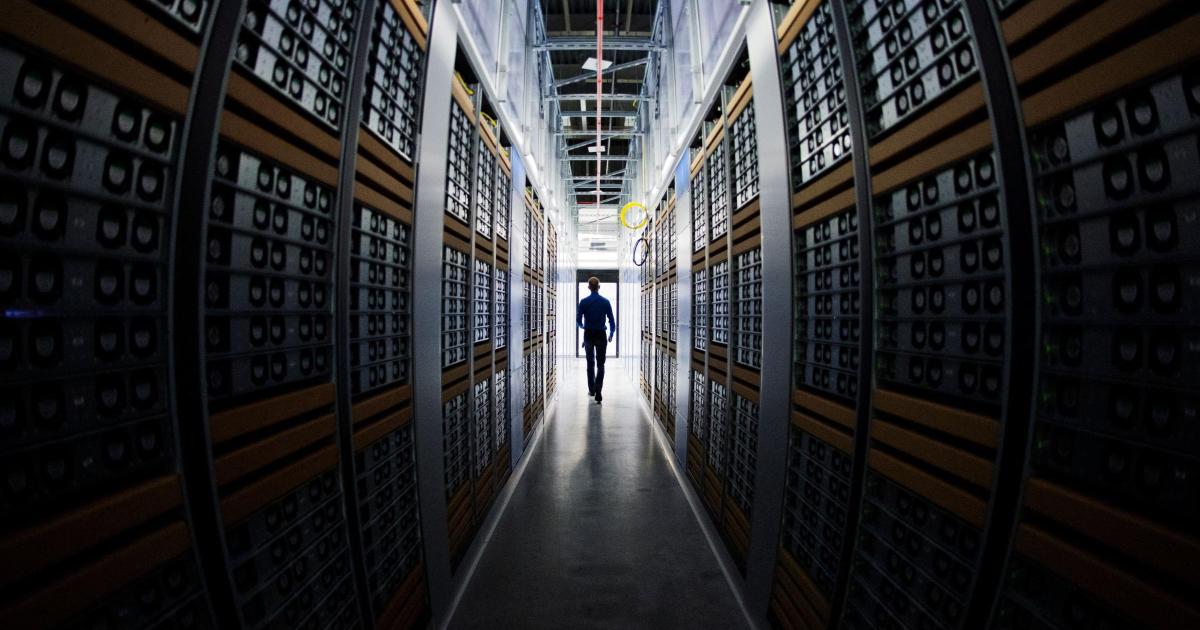
DataVita has submitted proposals for a 120MW “green data centre” in Chapelhall, North Lanarkshire, south of the junction between Lancaster Avenue and Bellside Road.
The company already runs another data centre in Chapelhall – the DV1 site – which, at a capacity of 24MW, makes it the largest data centre in Scotland currently in operation.
The DV1 site at Chapelhall (Image: Google Maps)
The DV1 data centre provides server networks to nearby businesses, with expansion work planned to increase its capacity to around 40MW.
The new site, which is called DV4, is classed as a “hyperscale” data centre due to the large number of megawatts required to run it.
READ MORE: Environmental warnings emerge over huge £2bn AI data centre linked to Scottish Duke
“Hyperscale” sites are where hardware is stored and operated to train and roll out AI models at scale, requiring huge amounts of computing capacity.
The latest plans would fall inside Scotland’s first AI Growth Zone, which was announced would be in Lanarkshire earlier this year.
The DV4 site would be on 9.67 hectares of open grassland land which is currently vacant.
According to documents submitted to North Lanarkshire Council, the proposal includes a data centre, along with other infrastructure including access roads and parking.
The proposed DV4 site in Chapelhall (Image: North Lanarkshire Council)
The council has said that the proposed development does not require an environmental impact assessment, drawing criticism from campaigners.
Dr Kat Jones, director of Action to Protect Rural Scotland (APRS), told The National: “Even the Scottish Government must realise that a moratorium is getting extremely urgent now. Here is yet another application for a hyperscale AI data centre that has not even been required to do an environmental impact assessment.
“The minister, Hannah Mary Goodlad, must give a screening direction to the local authority to require that this development, and the one in Greenock, applied for planning permission came in last week, should do an environmental impact assessment.”
READ MORE: Number of Scottish AI data centres could TRIPLE, new figures suggest
Jones said that “the hyperscale data centre applications are coming in thick and fast”.
“There is now 1.2GW of data centre power demand in live planning applications,” she continued.
“If the Scottish Government wants a strategic approach, as they announced in the programme for government, they need to put a pause on applications immediately.”
Jones added: “The pace of developers putting in planning applications is completely eclipsing the power of the Scottish Government to take any control of the situation.”
Diane Davidson, secretary of the Woodhall, Faskine and Palacecraig Conservation Group, which is campaigning against the development said: “The AI growth zone will be made up of multiple applications for different developments including data centres and energy developments yet the environmental and planning impacts are still being considered application by application.
“We need to see the overall plan to assess the impact on our community. Locals can’t find out what is going on. We have written to the council and the UK and Scottish Governments to ask for transparency and got nowhere.”
Davidson added: “We are demanding that there is an immediate pause put on this application, which has extremely scant information about the environmental and health impacts, so that a proper investigation can be done.”
Commenting on the proposals, DataVita managing director Danny Quinn said: “We have seen a lot of data centre speculation in Scotland recently, and the vast majority of it will never be built.
“DataVita has been operating in Scotland for more than ten years, and we already underpin a lot of the critical services used day in, day out across Scotland.
“We built DV1 at Chapelhall, we are building DV3, and we run them ourselves with a Scottish team. DV4 is the next stage of that campus.”
Quinn continued: “Not all data centres are the same, and we are keen to change the public perception. Scotland has an opportunity not only to become a data centre location but an exporter of intelligence via low-carbon data centres. We don’t think of exporting barley when we talk about the success of our whisky industry, and data centres should be no different.
“The application is now with the council and open for comment, and I would encourage people to look at the detail.”