
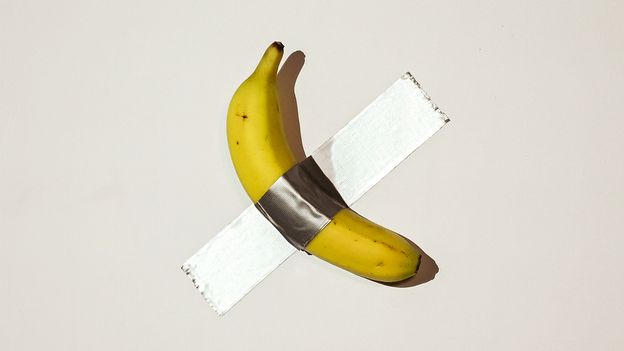
Throughout the duration of Art Basel Miami Beach, hundreds of other visitors photographed the artwork and posted their reactions online. Within just a few days of its unveiling, Comedian had become a viral sensation, attracting scorn, amazement, laughter and a new subcategory of copycat meme involving duct tape and bananas. In the mainstream press, as well as blogs and YouTube videos, people battled over its aesthetic and intellectual value: those who most hated Comedian loved writing about it the most.
If it was Cattelan’s intention to attract attention to himself, Comedian was a blistering success. Few other works of contemporary art have done what Comedian achieved in just a few hours: gaining fame beyond the art world citadel and becoming globally recognisable. Its renown helped bump up its market value even more. In 2024, the second of the three editions of Comedian was resold at auction for $6.24m (£4.88m). This once again triggered opinion writers, who raged at the wasteful sums of money now being thrown at Cattelan’s artwork.
Yet the irony about Comedian is that everything that shocked people about it had been done before. And when you unpeel the artwork, it reveals the hidden tactics of a master mischief-maker and a dedicated student of the dark arts of notoriety.
A 400-year-old tradition of satire
One of his strategies is provocation. Cattelan clearly realised long ago that in the competitive creative industries, just being skilled or intelligent doesn’t guarantee success. But sparking controversy attracts attention, which means a bigger audience and more potential commissions.
Art history proves the point. More than 400 years ago, Caravaggio split the opinions of his contemporaries with the groundbreaking levels of violence, sexual tension and darkness of his religious paintings, factors that brought him to international prominence. The artists of the 19th Century who are nowadays most valorised, such as JMW Turner, John Constable, Manet, Monet, Gauguin, Whistler and Cézanne, had pioneered new approaches to art-making, which reaped public ridicule from critics. As a result, by the dawn of the 20th Century, artistic innovation and mainstream scorn were increasingly seen as two sides of the same coin.