
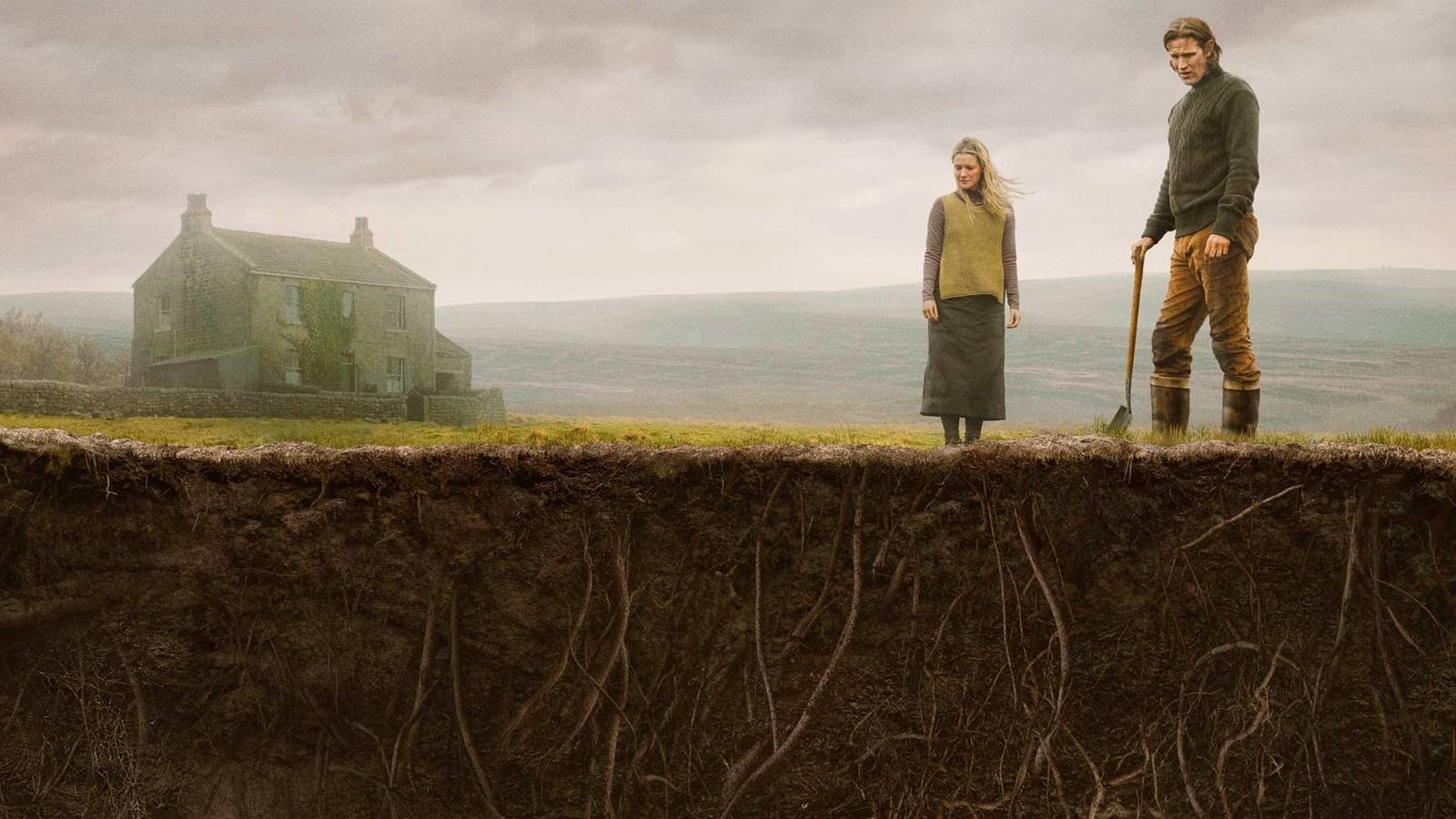
With its 1970s setting, Starve Acre is a modern folk horror that leans into its inevitable comparisons with films like The Wicker Man and Don’t Look Now. Even so, Starve Acre becomes more a litmus test of dread – for audiences and characters alike – than a formulaic folk horror. Where folk horror films like Midsommar invoke a kind of thrill in piecing together what tapestries and paintings will come to mean, Starve Acre forces viewers to see it coming and to sit in that unease. Director Daniel Kokotajlo supports his environment of disquietude with still shots of Yorkshire’s beautiful, but oppressive landscapes between the slow, deliberate camerawork that punctuates the story.
Streaming on Shudder, Starve Acre features Richard (House of the Dragon’s Matt Smith) and Juliette (Morfydd Clark, Rings of Power and Saint Maud) as a couple. They move back to Richard’s childhood home in the countryside of Yorkshire to give their son, Owen, fresh country air to help with his severe asthma. But two years into their move, Owen still hasn’t adjusted to country life and his behavior takes a turn for the worse. This culminates with stabbing the eye out of a horse. In a visit with a child psychologist, Juliette reveals that lately, Jack has mentioned an imaginary friend named Jack Grey. This unsettles Richard, who is no stranger to Jack Grey. It’s a name from his childhood, featured in the opening poem that sets the course of the film, written by none other than Richard’s father, Neil. Soon, the family experiences death, and the film makes grief a central character and spins Richard’s archaeological position at a university as a vessel for exploring his own childhood abuse.
‘Starve Acre’ Makes Symbolism Unsettling
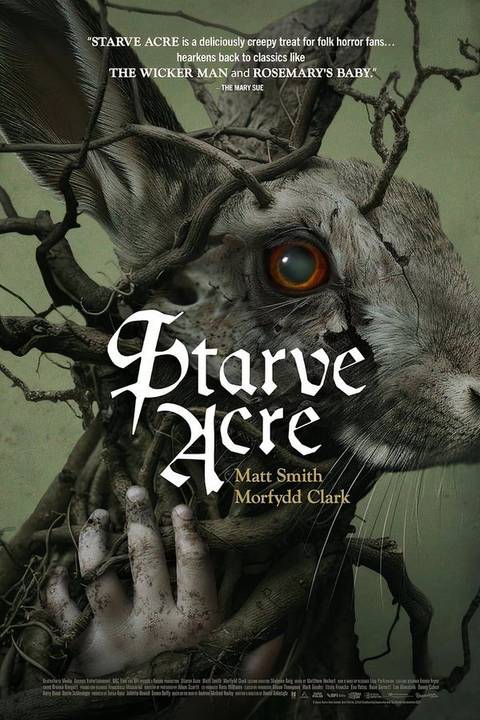
Where other modern folk horror presents symbols or the whole of folklore up front with a nod and a wink, Starve Acre jumps straight to tragedy, then spends the last hour of its runtime with a twisting ambiance that doesn’t shy away from the disturbing. Everything – from hidden bones to long-buried tree roots, and of folk horror’s favorite trope, an ominous animal, this time a menacing hare – becomes a tangible presentation of Richard’s childhood abuse and the resulting grief. Perhaps the greatest of these is a cut-down oak tree on the Starve Acre property. Owen is drawn to the remains of the tree, much to Richard’s dismay. What is a mystery to Owen is an immense trigger for Richard. To Richard, it represents the superstitions that his cruel father believed justified the ways he brutalized him from a young age. It was a popular meeting place for Neil and his friends, making it a painful reminder of the many ways his community failed to protect him from his father and, at times, even encouraged him.
The film twists Richard’s own work against him, forcing his comforting, mundane relationship to archaeological research to become a kind of liability that prevents him from walking away from these childhood emotional wounds and the beliefs that his father attached to them. As he finds himself drawn to the bones of a hare among his father’s things, Juliette takes a chance on a medium who uses meditation to navigate her dwindling mental health. Through this contrasting framework – a professional life and a spiritual need – both Richard and Juliette are moved closer to folk tragedy in ominous baby steps.
Collider Exclusive · Horror Survival Quiz
Which Horror Villain Do You Have the Best Chance of Surviving?
Jason Voorhees · Michael Myers · Freddy Krueger · Pennywise · Chucky
Five killers. Five completely different ways to die — if you’re not smart enough, fast enough, or self-aware enough to avoid it. Only one of them is the villain your particular set of instincts gives you a fighting chance against. Eight questions will figure out which one.
🏕️Jason
🔪Michael
💤Freddy
🎈Pennywise
🪆Chucky
TEST YOUR SURVIVAL →
01
Something feels wrong. You can’t explain it — you just know. What do you do?
First instincts are the difference between the survivor and the first act casualty.
ALeave immediately. I don’t need to understand a threat to respect it.
BStay quiet and observe. If I can see it, I can understand it. If I can understand it, I can avoid it.
CStay awake. Whatever this is, I am not going to sleep until I feel safe again.
DConfront it directly. Fear grows in the dark — I’d rather know what I’m dealing with.
ECheck everything, trust nothing. The threat might be closer than I think — and smaller.
NEXT QUESTION →
02
Where are you most likely to find yourself when things go wrong?
Setting is everything in horror. Where you are determines which rules apply.
ASomewhere remote — a cabin, a campsite, off the grid and away from people.
BA quiet suburban neighbourhood where nothing ever happens. Except tonight.
CIn my own head — the most dangerous place of all, depending on what’s already in there.
DWherever children are — because something about this place attracts the worst things.
ESomewhere ordinary — a house, a toy store, a place where the last thing you’d expect is a threat.
NEXT QUESTION →
03
What is your most reliable survival asset?
Every survivor has a quality the villain didn’t account for. What’s yours?
APhysical fitness — I can run, I can swim, I can outlast something that relies on brute persistence.
BSpatial awareness — I always know the exits, the hiding spots, the fastest route out.
CPsychological resilience — I’ve faced my worst fears before. They don’t have the same power over me.
DEmotional steadiness — I don’t panic. Panic is what gets you caught.
EScepticism — I don’t underestimate threats because of how they look. Size is irrelevant.
NEXT QUESTION →
04
What kind of fear is hardest for you to fight through?
Knowing your weakness is the first step to not dying because of it.
AThe unstoppable — something that will not stop, cannot be reasoned with, and is always getting closer.
BThe invisible — a threat I can feel but can’t locate, watching from somewhere I can’t see.
CThe psychological — something that uses my own mind and memories against me.
DThe unknowable — something ancient, shapeless, that feeds on the fear itself.
EThe mundane — a threat so ordinary-looking that no one will believe me until it’s too late.
NEXT QUESTION →
05
You’re with a group when things start going wrong. What’s your role?
Horror movies are brutally clear about who survives group situations and who doesn’t.
AThe one who says “we need to leave” first — and means it, even when no one listens.
BThe one who stays quiet, watches the others, and figures out the pattern before anyone else does.
CThe one who holds the group together when panic sets in — because someone has to.
DThe one who asks the questions nobody wants to ask — because ignoring them gets people killed.
EThe one who takes the threat seriously when everyone else is laughing it off.
NEXT QUESTION →
06
What’s the horror movie mistake you’re most likely to make?
Honest self-assessment is a survival skill. Denial is not.
AGoing back for someone — I know I shouldn’t, but I can’t leave them behind.
BAssuming I’m safe once I’ve found a hiding spot. That’s when it finds me.
CFalling asleep when I absolutely cannot afford to. Exhaustion is its own enemy.
DLetting my curiosity override my instincts — I always need to understand what I’m dealing with.
EDismissing the threat because of how it looks. That’s exactly what it wants.
NEXT QUESTION →
07
What’s your best weapon against something that can’t be stopped by conventional means?
Every horror villain has a weakness. The survivors are always the ones who find it.
AThe environment itself — I use the terrain, the water, the geography against it.
BPatience — I wait, I watch, and I strike at the one moment it doesn’t expect.
CLucidity — if I can stay in control of my own mind, it loses its primary weapon.
DCourage — facing it directly, refusing to run, taking away the fear it feeds on.
EImprovisation — I use whatever’s at hand, however unconventional. Creativity over brute force.
NEXT QUESTION →
08
It’s the final scene. You’re the last one standing. How did you make it?
The final survivor always has a reason. What’s yours?
AI kept moving. I never stopped, never hid for too long, never let it corner me.
BI figured out the pattern before anyone else did — and I used it against the thing following it.
CI stayed awake, stayed lucid, and refused to give it the one thing it needed most.
DI stopped being afraid of it. And the moment I did, everything changed.
EI took it seriously from the start — and I never once made the mistake of underestimating it.
REVEAL MY VILLAIN →
Your Survival Odds Have Been Calculated
Your Best Chance Is Against…
Your instincts, your strengths, and your particular way of thinking under pressure point to one villain you actually have a fighting chance against. Everyone else — good luck.
Camp Crystal Lake · Friday the 13th
Jason Voorhees
Jason is relentless, but he is also predictable — and that is the gap you would exploit.
He moves in straight lines toward his target. He doesn’t strategise, doesn’t adapt, doesn’t outsmart. He simply pursues.
Your ability to keep moving, use the environment, and resist the panic that freezes most victims gives you a genuine edge.
The Crystal Lake survivors were always the ones who stopped running in circles and started thinking about terrain, water, and distance.
You think like that. Which means Jason, for all his indestructibility, would face someone who simply refused to be where he expected.
Haddonfield, Illinois · Halloween
Michael Myers
Michael watches before he moves. He is patient, methodical, and almost impossible to detect — until it’s too late for anyone who isn’t paying close enough attention.
But you are paying attention. You notice the shape in the window, the car parked slightly wrong, the silence where there should be sound.
Michael’s power lies in the invisibility of ordinary suburbia — the fact that nothing ever looks wrong until it already is.
Your spatial awareness and instinct to map every room, every exit, and every shadow before you need them is precisely the quality Laurie Strode had.
You are not a victim waiting to happen. You are someone who already suspects something is wrong — and acts on it.
Elm Street · A Nightmare on Elm Street
Freddy Krueger
Freddy wins by getting inside your head — using your own fears, your own memories, your own subconscious as weapons against you. That strategy requires a target who can be destabilised.
You are harder to destabilise than most. You’ve faced uncomfortable truths about yourself and you haven’t looked away.
The survivors on Elm Street were always the ones who understood what was happening and chose to face it rather than flee from it.
Freddy’s greatest weakness is that his power evaporates in the presence of someone who refuses to give him the fear he feeds on.
Your psychological resilience — the ability to stay grounded when reality itself becomes unreliable — is exactly the quality that keeps you alive here.
Derry, Maine · It
Pennywise
Pennywise is ancient, shapeshifting, and feeds on terror — but it has one critical vulnerability: it cannot function against someone who genuinely stops being afraid of it.
The Losers Club didn’t survive because they were braver than everyone else. They survived because they faced their fears together, and faced them honestly.
You ask the questions others avoid. You look directly at what frightens you rather than turning away.
That directness — the refusal to let fear fester in the dark — is Pennywise’s worst nightmare.
It chose the wrong target when it chose you. You are exactly the kind of person whose fear tastes like nothing at all.
Chicago · Child’s Play
Chucky
Chucky’s greatest advantage is that nobody takes him seriously until it’s already too late. He exploits the gap between how something looks and what it actually is.
You don’t have that gap. You take threats seriously regardless of how they present — and you never make the mistake of underestimating something because of its size or appearance.
Chucky relies on surprise, on the delay between recognition and response. You close that delay faster than almost anyone.
Your instinct to treat every unfamiliar thing with appropriate scepticism — rather than dismissing it because it seems absurd — is the exact quality that keeps you breathing.
Against Chucky, not laughing is already winning. You are very good at not laughing.
↻ RETAKE THE QUIZ
Matt Smith and Morfydd Clark Sell the Atmosphere of Fear
Richard’s revelations about his past are brought to life by Matt Smith with a quiet and stubborn resistance. When memories of his past finally break him, and he opens up about his father’s pagan ramblings and superstitious cruelty, it offers only enough breath to sustain the sinister atmosphere. His unfurling dismay works in harmonious contrast with Morfydd Clark’s transparent portrayal of his wife, Juliette. Similarly to Sissy Spacek in Carrie or Mia Farrow in Rosemary’s Baby, Clark makes an unavoidable breakdown painfully watchable. The few moments of comfort they offer one another are well-calculated by director Daniel Kokotajlo. As their exploration of the mystery and tragedy of Starve Acre becomes more and more disjointed, it’s clear that togetherness might have been a way out. With revelations about the nature of parenthood and the ways any individual can justify cruelty in the past and the present, Starve Acre makes folk horror and pagan fears as human as emotion.
Release Date
July 26, 2024
Runtime
98 Minutes