
The footage, recorded at Chester Zoo, shows the calf making its entrance into the world before taking its first unsteady steps.
Born to mother Ada and father Stomp in the early hours of May 6, the male calf has been named Miloli, meaning “joy” in Bantu, a language family spoken in central Africa.
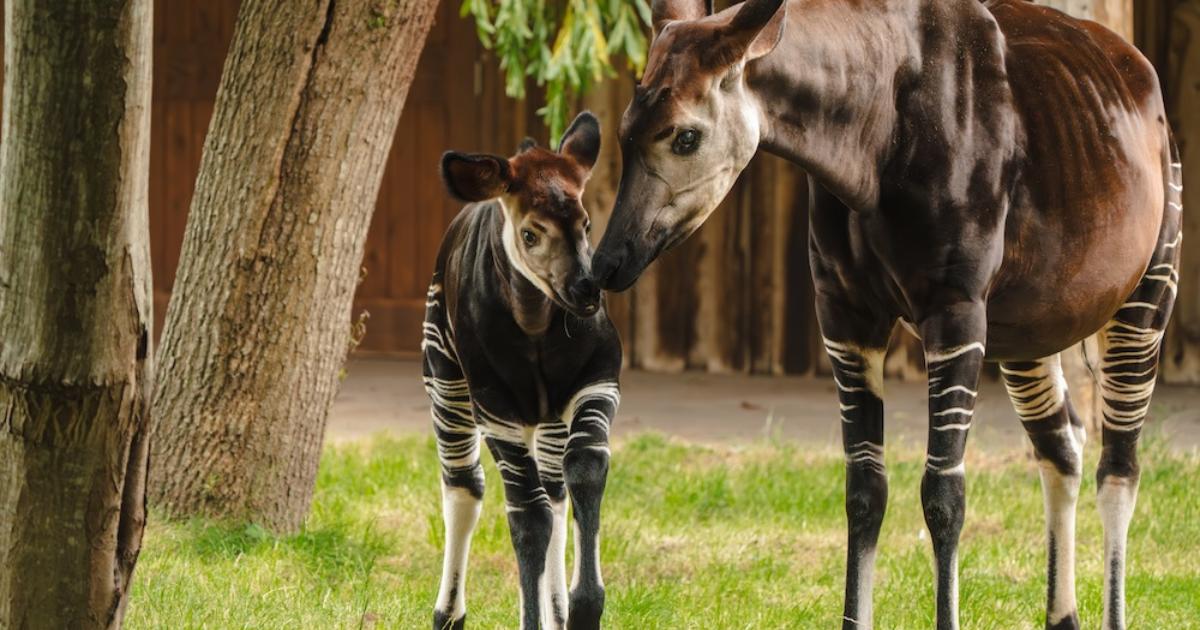
Miloli spent his early weeks in a quiet nest, but has now ventured outdoors for the first time.
Fiona Howe, lead keeper at Chester Zoo, said: “The birth of an okapi is always a very special occasion and cause for celebration, but to watch as mum Ada calmly welcomes her new baby into the world and gently encourages him to his feet was nothing short of magical and offers a special insight into one of nature’s most elusive and secretive species.”
Miloli is an okapi, a rare mammal found only in the rainforests of the Democratic Republic of Congo (DRC) and sometimes called the “African unicorn.”
Miloli is enjoying his time outdoors (Image: Chester Zoo) Okapis are listed as Endangered on the IUCN Red List, with populations declining by more than 50 per cent in the past 20 years due to hunting, habitat loss, and conflict.
Ms Howe said: “Miloli has spent the first few weeks of life tucked away in a quiet nest area, bonding with mum Ada as she forages for food nearby, periodically returning to feed her new youngster with milk.
“She’s a doting mum and is doing everything perfectly so far, which is just great to see.”
Okapi calf Miloli spent the first few weeks of life in a quiet, hidden nest at Chester Zoo (Image: Chester Zoo) Sue Walker, head of science at Chester Zoo, said: “Our scientists have been supporting okapi reproduction for more than 15 years.
“By using the latest technologies to test hormones in okapi faecal samples, we can confirm the observations and behavioural changes recognised by zookeepers, and in the process learn more about the species and their biology.
“These findings have already been used to support the wider international conservation breeding programme that’s safeguarding okapi populations from extinction.”
Chester Zoo also supports field surveys and conservation projects in Uganda and the DRC, working to protect okapis in the wild.