
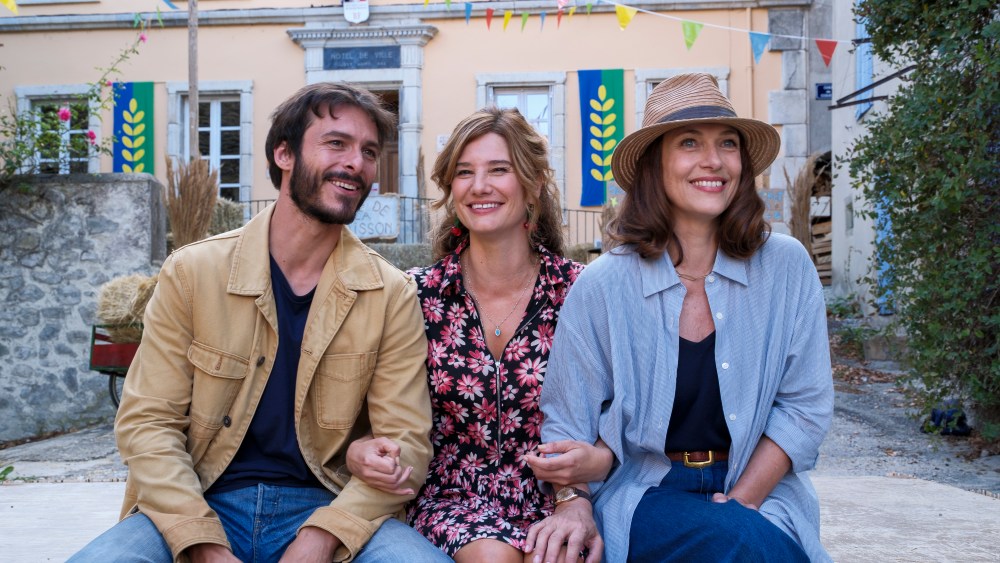
Studio TF1 is launching its medical drama “Dr. Seylan & Cindy” at Unifrance Rendez-Vous in Le Havre. Filmed in Drôme in the Auvergne-Rhône-Alpes region of Southeastern France, the series stars Natacha Lindinger (“Hard,” “Coco Chanel & Igor Stravinsky”) and Alice Pol (“Sirènes,” “Tricky Old Dogs”).
Directed by Cathy Verney (“Hard,” “Vernon Subutex”) and Edouard Deluc (“Pétaouchnok,” “Gauguin: Voyage to Tahiti”), the six-episode series introduces us to Louise Seylan (Natacha Lindinger), a neurosurgeon from Paris who returns to her village after her physician father passes away. At the funeral, she meets the wild and irreverent Cindy (Alice Pol), the longtime nurse who helped her father run the only medical facility in town.
Through a series of unexpected events, Louise begrudgingly decides to take over her father’s medical practice with the help of Cindy and deal with the medical emergencies of the local citizens and the craziness that comes with living in a rural town.
“From the producers of ‘HIP’ comes a feel-good medical series built around an unlikely duo, the meeting of a female ‘Dr. House’ and Phoebe from ‘Friends,’ whose chemistry is impossible to resist. With one case per episode and the warm backdrop of the French countryside, ‘Dr. Seylan & Cindy’ has all the ingredients of TF1’s next breakout hit: exactly the kind of comforting, entertaining show audiences are looking for right now,” said Camille Dupeuble, EVP International TV and Digital Distribution at Studio TF1.
“Dr. Seylan & Cindy” was created and written by Camélia Acef & Mathilde Pol. It was produced by Itinéraire Productions (“HIP,” “Soleil Noir”) in co-production with TF1, and its producers are Juliette Lassalle, Anthony Lancret and Pierre Laugier.

Cathy Verney and Edouard Deluc. Courtesy of Studio TF1.
Variety interviewed Cathy Verney and Edouard Deluc before its screening in Le Havre.
How did the idea for the series come about?
Cathy Verney: Juliette [Lassalle] came to talk to me about the series while she was still in the middle of writing it. If I remember right, two episodes were written and already very polished. I loved the mix of comedy and medical procedural. I was won over right away by Mathilde and Camélia’s writing, sharp, modern, fresh and daring. There was a lot of work on the medical cases to make the investigations complex and realistic, but there was also an entry point built around a strong, funny, unpleasant character, completely at odds with her return to her roots. A genre mashup, sort of a “Connasse” meets “Dr. House,” and that’s what really drew me in.
Since we met well before production got underway, the promise of being brought into the writing process was also a deciding factor. Being able to bring directing ideas into the writing itself, and getting a handle on the complex psychological stakes the writers had built in, so they could be properly showcased later, saves a lot of time and usually pays off.
Edouard Deluc: As director of block 2, I come on board once the writing is finished, or close to it. Reading the scripts, which combined rare depth with a light touch, was a genuine pleasure. The quality of the project, the writing, the way the subject was handled, the importance of the subject, the production, and the idea of working in Cathy’s wake, every sign pointed to yes.
Could you talk about the casting for the series?
Verney: I met Natacha on “Hard” 17 years ago. It was my first series and we made it together! She was in every scene, we worked hard and laughed a lot. I’d really been looking forward to the chance to work together again. I thought of her almost immediately, and so did our producers. It was a no-brainer, we brought it up with TF1, they were thrilled. I called Natacha, and that was it.
For Cindy, we needed an actress who was rock-solid in comedy, with a rhythm that played off Natacha’s, someone who could handle digression without losing the audience. We all really wanted Alice, who has that gift, that flair, and that knack for talking a mile a minute. We met to talk through the character and the script, and we knew right away we wanted to do this together.
Medical dramas seem to have unlimited popularity with audiences. Why do you think that is?
Deluc: The life-or-death stakes, a mirror of our own fragility, the constant tension.
Verney: The mystery: a diagnosis plays out like an investigation, you search alongside the doctor, you go down the wrong path, you get it wrong. The emotion: recovery, death, birth, you can’t help but identify with it. The intimacy: a consultation drops you straight into a character’s complexity at moments of real vulnerability.
What were some of the challenges in shooting the series?
Deluc: First and foremost, it was a pleasure, even a joy, to direct two wonderful actresses, a terrific supporting cast, and a crew that was completely in sync and fully committed, all in service of a story that’s as sharp as it is necessary.
Verney: The main challenge was finding the right balance between realism and comedy. I wanted the medical desert to feel credible, for people to really feel what it means to live far from a hospital or a doctor, through our characters who work on farms, sometimes very isolated. That sense of scarcity had to feel real for Louise Seylan’s presence to actually matter, without tipping into a grim realism that would have thrown the show off balance.
That’s why we shot in the Drôme. It has that rural, remote feel, but without being bleak, it’s a sun-drenched region, with hills and gorgeous landscapes. It matched the show’s balance perfectly.
The other challenge was the medical procedures. We had doctors and ER physicians from the hospital in Montélimar backing us up, and they helped enormously. They coached the crew and the actresses, who trained hard. I found it fascinating to understand the mechanics of a consultation, how a diagnosis takes shape, the precision of every move. I always dreamed of being a doctor, so this immersion meant something extra to me. The neurosurgery scenes were some of the toughest to shoot, but also some of the most exciting; we had to juggle medical accuracy, dramatic pacing, and the very real constraints of a shoot.