
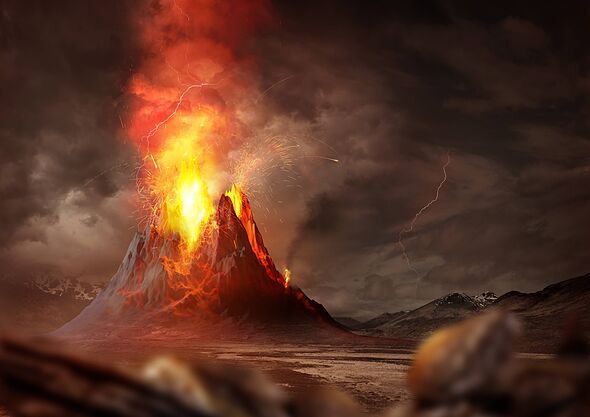
An ancient ‘supervolcano’ has been discovered beneath English soil, boasting a destructive force thousands of times greater than Mount Etna, Europe’s highest and most active volcano.
Buried deep beneath England’s east coast, this monumental find is said to fundamentally change and explain ‘our understanding of England’s deep geological past’, shedding new light on the country’s dramatic subterranean history.
The supervolcano’s eruption ranks amongst the most powerful in history, having occurred approximately 454 million years ago – a staggering 200 million years before dinosaurs roamed the planet.
The breakthrough was achieved by researchers at the British Geological Survey (BGS) and the University of Oslo, working in collaboration to re-examine microscopic zircon crystals – smaller than the width of a human hair – extracted over 80 years ago from boreholes located 65 kilometres apart in Norfolk and Lincolnshire.
Live Science reports that the volcano lurking beneath England’s east coast is so severely eroded that scientists spent nearly 30 years piecing together its explosive history and vast scale, reports the Daily Star.
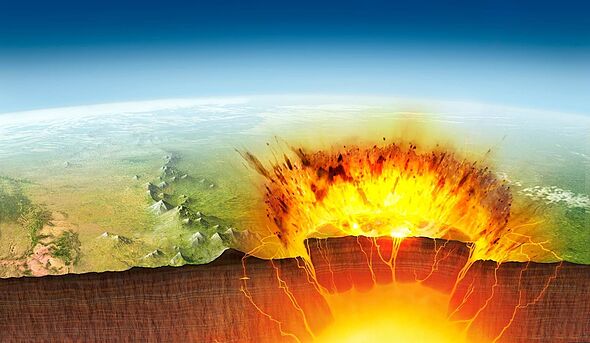
Around 20 supervolcanoes are thought to exist on Earth (Image: Getty Images/Science Photo Library RF)
The findings revealed the existence of a 454 million year old supervolcano, now concealed beneath The Wash on England’s east coast – one of the country’s flattest stretches of land – spreading across the counties of Lincolnshire and Norfolk.
Scientists report this volcano unleashed a ferociously explosive ‘super-Plinian’-type eruption, generating the force of ‘several thousand hydrogen bombs’, according to the BBC.
Dubbed ‘The Wash supervolcano’, the research findings were recently outlined in a study published in the Geological Society of America Bulletin titled ‘The Wash Igneous Complex of eastern England: a candidate Avalonian source for Sandbian tephra in Baltoscandia and implications for closure of the Tornquist Sea’.
Notably, scientists at BGS believe the volcano’s discovery finally accounts for the enormous volcanic ash layer distributed across Sweden, Norway, Belarus, Poland, and the Baltic region – a geographical puzzle that had been baffling scientists for some time.
BGS’s Dr Tim Pharaoh, the principal author of the research paper detailing the discovery, described The Wash supervolcano’s discovery as a ‘fantastic result’ and said it changed ‘our understanding of England’s deep geological past’.
What is a supervolcano?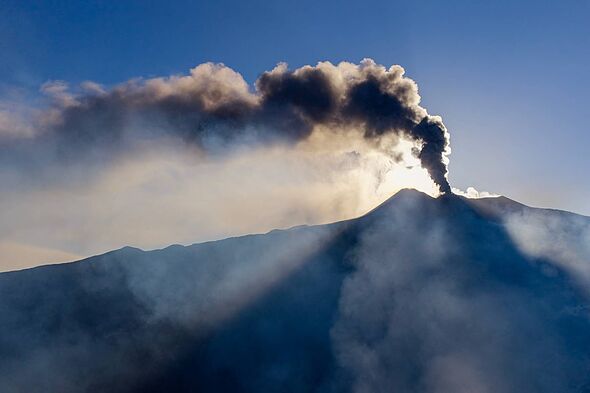
England’s newly discovered supervolcano is not expected to erupt ever again (Image: Etna Walk/AFP via Getty Images)
Supervolcanoes are defined as those which have expelled more than 1,000 cubic km (240 cubic miles) of material, and while an exact figure remains unknown, roughly 20 such volcanoes are thought to exist according to the Natural History Museum. These include Yellowstone in the United States and Lake Toba in Indonesia.
The most recent known supervolcano eruption on Earth was the Oruanui eruption of the Taup volcano in New Zealand, which occurred approximately 26,500 years ago, and formed what exists today as Lake Taup. The Taup supervolcano remains active and is believed to be at least 800 years overdue for its next eruption.
Were The Wash supervolcano to erupt today, it would pose an existential threat to mankind – fortunately, scientists confirm this is no longer a possibility. Dr Pharaoh reassures: “Unlike faults, which can be seismically reactivated, a volcano can’t. Once it’s gone extinct, that’s it. Nobody needs to worry about the supervolcano erupting again.”
The eruption of The Wash supervolcano has been regarded as one of the largest in history, with the volcano believed to have hurled hundreds of cubic kilometres of the Earth’s crust into the stratosphere.
How The Wash supervolcano was discovered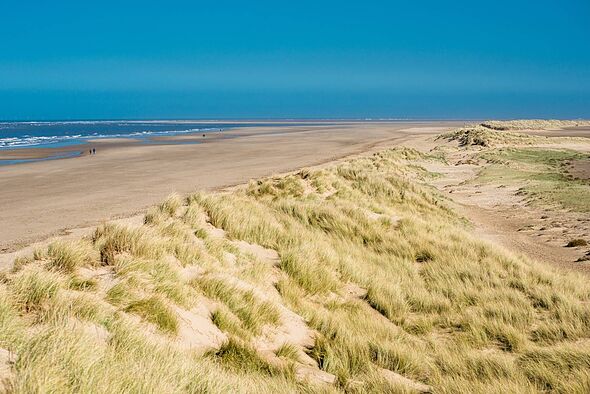
The supervolcano is centred under The Wash and extends beneath Norfolk and Lincolnshire (Image: Getty Images/iStockphoto)
The remnants of the caldera system were discovered following fresh analysis of rock samples extracted eight decades ago from boreholes stretching hundreds of metres deep in Claxby, near Horncastle, Lincolnshire, and North Creake in Norfolk.
These samples had been preserved by the BGS at its archives in Keyworth, Nottinghamshire, and during the Covid lockdown, scientists seized the opportunity to re-examine these existing samples using cutting-edge equipment and modern techniques.
Researchers meticulously studied tiny zircon crystals – roughly the width of a human hair, which form within molten magma underground prior to a volcanic eruption – and established that both the Lincolnshire and Norfolk samples had been formed simultaneously, approximately 454.4 million years ago, originating from the very same volcano.
Live Science explains it simply: “They [zircon crystals] contain uranium that decays into lead isotopes at a known rate, enabling researchers to precisely date eruptions.”
Remarkably, the age of the samples matched corresponding material retrieved from the Kinnekulle tephra, which was analysed by the University of Oslo. The Kinnekulle tephra is ‘a thick layer of volcanic ash covering Scandinavia and the Baltic region’.
This indicates that ash from The Wash supervolcano’s colossal eruption drifted across to what is now Scandinavia, eventually settling on the seabed.
Dr Pharaoh shared there was no visible trace of the supervolcano above ground, noting that it is only through modern techniques and cutting-edge equipment that scientists have been able to make these ‘bold statements’ and conclusively crack the mystery.
He said: “It’s only now that we’ve got these precise ages we can make these bold statements and assertions. It’s extremely satisfying to come up with this very precise result.”
The BBC quotes University of Bristol volcanologist Professor Jenni Barclay as saying: “This work is an important step forward in piecing together the geological history of the UK, and understanding that subsurface is important for lots of reasons linked to our sustainable use of resources, like water and minerals.”
According to Live Science: “It’s not surprising to find traces of big, ancient volcanoes in England. The recently identified volcano is part of a wider volcanic system that was active 450 million years ago and includes Eryri National Park in Wales and the Lake District in northwestern England, Rowley said.”