

UK reporting riddles
 Source: Getty
It is understandable that the UK government’s consultation on modernising corporate reporting may have generated a certain level of anxiety among sustainability professionals.
Language such as “administrative burden”, “competitiveness” and “proportionate” – which figure in the document along with a restatement of the goal to cut reporting by 25 percent – will resonate all too well with those familiar with the EU’s Sustainability Omnibus.
Commentators on LinkedIn have warned that the EU’s roll-backs may have become a “blueprint” for jurisdictions such as the UK, which is proposing to strike off a number of pay-related reporting requirements and allow fully virtual AGMs.
There is also the matter of the vague, “very large” category, which has been proposed as the new threshold for non-financial reporting requirements.
Given the unpredictability around sustainability disclosure in recent years, only a brave soul would attempt to make predictions – but there is reason to hope that a retreat is not (necessarily) on the cards in the UK.
For one, plans to modernise non-financial corporate reporting pre-date the government’s endorsement of the ISSB standards under the UK Sustainability Reporting Standards (UK SRS), so the two would presumably not be in conflict with each other.
Second, the investors we reached out to for comment are still assessing the proposals, but do not – at least for now – seem to be panicking.
All this to say, let’s keep calm and carry on.
BRIDGE-ing the gap
Nothing goes together better than climate COPs and unwieldy acronyms.
GFANZ was, of course, created ahead of COP26 in Glasgow, and last year in Belém saw the birth of the Tropical Forest Forever Facility (TFFF).
Progress on TFFF has been relatively slow compared to the fanfare with which the project was announced, with the facility a fair way from hitting its $25 billion government fundraising target.
The latest funding announcement came from the UK, which recently said it would commit £400 million ($541 million; €466 million) as part of a switch from grant funding to public investments in order to fund a cap on bus fares in the country.
A spokesperson for the Department for Energy Security and Net Zero did not respond when asked where the £400 million in cut grant funding would have been going.
To its credit, the Turkish presidency of COP31 has come up with a slightly more palatable shorthand for one of their flagship initiatives, the Climate Implementation Bridge (BRIDGE).
At the Istanbul Climate Finance Summit last week, the UN Development Programme was announced as a delivery partner for BRIDGE, which aims to help countries turn their climate and development priorities into financing-ready project portfolios.
President-designate and environment minister Murat Kurum described the financing gap as a “chasm”, and called for countries to show levels of ambition on climate security similar to those seen on defence in recent years.
“Defence spending is considered an investment made today to protect against the threats of tomorrow,” Kurum said. “Climate investment must be viewed through precisely the same strategic lens.”
Previous COPs have had a similar focus on closing the financing gap, warning of the missing trillions for energy transition projects, but it is encouraging to see a mechanism designed to provide a concrete solution to the issue of getting projects in front of institutional investors.
Current announcements are light on details of how BRIDGE will work, but this will definitely be one to keep an eye on for finance sector COP-watchers.
Quote of the week
“Companies are well aware that some investors are willing to go to court to protect their rights to file resolutions and will factor that into their decisions. We will have to see how companies respond in this risky environment”
ICCR CEO Josh Zinner on the uncertainties created by shareholder proposals’ return to the states
The week in RI
Asian asset owners this week upped their investment ambitions, with Taiwan’s giant Bureau of Labor Funds aiming to pump $20 billion into overseas sustainability mandates and Hong Kong investors also committing to increase their climate solutions investments.
Other announcements coming out of Hong Kong Green Week included the launch of a draft framework for adaptation activities under a new phase of the city’s taxonomy.
In other climate news, the Spanish government called on the European Commission to expand the Do No Significant Harm principle to cover resilience, and a Capgemini survey found that firms are failing to address climate losses due to data shortfalls.
This week also saw other developments across the EU regulatory sphere, with the European Parliament’s ECON committee voting on its SFDR position, and news that more than 100 ESG ratings firms are seeking EU authorisation.
Elsewhere, investors warned that the US Securities and Exchange Commission’s move to rescind rule 14a-8 “could cause fragmentation and confusion”, and we reported on how new UK sanctions on illegal settlements in the West Bank may impact pension portfolios.
For a longer read, make sure to take a look at senior reporter Gina Gambetta’s piece on how investors are looking at the impact of extreme heat on workers.
Last but not least, deputy editor Jack Graham makes his RI podcast debut, speaking to UK climate envoy Rachel Kyte about her role under the UK’s new prime minister Andy Burnham, how she interacts with investors, and what the world must do to respond to climate extremes.
EmpCo adventures
The EU’s Directive on Empowering Consumers for the Green Transition (known as EmpCo) applies from 27 September, aiming to address potentially misleading green, social and circularity claims made to consumers.
While the regime applies to consumer goods and other products, Europe’s national sustainability fund labels are also captured, as they meet the definition of voluntary labels set out by EmpCo.
For Germany’s FNG Seal, this has proved somewhat problematic.
According to a webinar this week, the team behind the label sought to align with ISO standard 17065 in order to comply with rules for objective monitoring by an independent third party. However, they ran into trouble when looking to find a body to certify compliance.
The first port of call was the Deutsche Akkreditierungsstelle, Germany’s national accreditation body. However, it said the financial sector is not named in its responsibilities and suggested taking it up with financial regulator BaFin.
Enquiries to BaFin were equally fruitless, with the supervisor noting that it does not see itself as responsible for accreditation and in any case does not examine whether a certifier is independent and competent in the sense of EmpCo.
Last but not least, enquiries at the EU level to the European Securities and Markets Authority saw the FNG team referred back to national authorities, which ESMA said are responsible for consumer protection issues.
Fortunately for the FNG, accreditation is not an absolute requirement. However, one German insurer tells RI that it has stopped all public statements on sustainable investments while it works through EmpCo implementation.
The directive might be to the benefit of consumers, but we suspect that compliance teams might be more frustrated than empowered.
Out and about in Prague
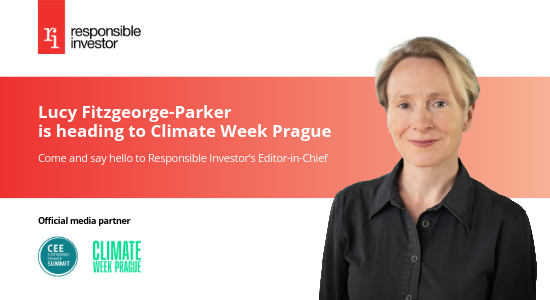
Our editor-in-chief Lucy Fitzgeorge-Parker will be in Prague next week for the fifth CEE Sustainable Finance Summit, which RI is delighted to support as exclusive media partner.
Lucy will be leading panels on competitiveness and sustainability leadership, geopolitical shifts and the energy transition, and the future of non-financial reporting.
She will also interview Connie Hedegaard, one of the leading architects of the EU’s green agenda, at the opening of Climate Week Prague on Monday.
If you would like to connect with Lucy, drop her a line.
Today’s letter was prepared by the RI editorial team.