
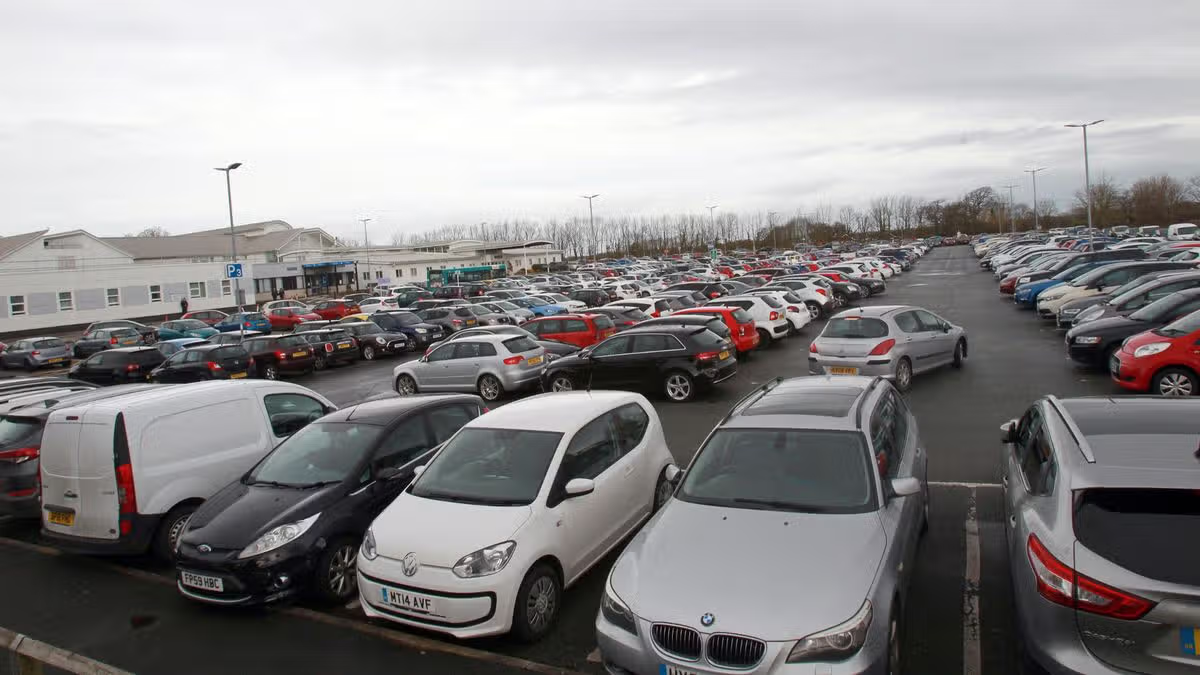
It’s an experience all too familiar to hospital patients in North Wales: arriving earlier than necessary and playing parking-space poker with other, equally frustrated drivers.
Often, desperate measures are needed: double yellow lines might be ignored or cars parked where they shouldn’t – on verges, drop-off spaces and nearby streets. It creates so much stress that some patients wonder if it’s healthier not going ro hospital at all.
Online, a departing hospital visitor from Coedpoeth described how she was followed back to her vehicle by drivers eyeing up an elusive space. “We were leaving at 10am and it was awful,” she said. “About 25 cars just circling constantly. I was stalked back to my car.”
That was at Wrexham Maelor Hospital but it might have been at the region’s other main hospitals. Patients visiting Ysbyty Gwynedd, Bangor, say parking is “atrocious”; those competing for spaces at Ysbyty Glan Clwyd, Bodelwyddan, look back wistfully at a park-and-ride scheme that operated until 2019.
Almost everyone agrees the arrangements are “chaotic”. Appointments are frequently missed. Frustration boils over and routine trips to hospital are filled with dread. Sign up for the North Wales Live newsletter sent twice daily to your inbox
“I don’t bother going anymore,” sighed a Bangor patient on social media. Others look enviously at paid-for parking provision across the border where there’s “never a struggle to find anywhere to park”.
Each year, the situation gets a little bit worse. Demand keeps rising for healthcare, while hospital patient lists are swollen by the extra work needed to cut waiting times. So patients arrive ever earlier, scared of missing appointments.
Those lucky enough to find spaces add to the problem: instead of parking for two hours, they might stay for three, reducing overall capacity. It’s a viscous dog-eat-dog cycle where everyone loses.
By and large, the problem cannot be addressed by increasing parking capacity, as land adjacent to hospitals is generally not available. There are “no easy solutions”, said Dyfed Edwards, chair of Betsi Cadwaladr, the North Wales health board, previously.
Increasingly desperate, under-fire hospital bosses have resorted to asking patients not to use their car parks at all – to catch a bus instead or be dropped off by a friend. Some do, most don’t.
In the absence of visible moves to address the problem, patients have been suggesting their own solutions on social media. Some are sensible but are unlikely to happen. Others are hamstrung by the country’s free hospital parking policy.
Multi-storey car parks
This is a solution commonly put forward. A recent AI image of a multi-story at Ysbyty Gwynedd, posted online, stirred plenty of debate. On paper, it seemed plausible. In practice, there are major obstacles.
If existing hospital parking land is earmarked, it would be hugely disruptive as parking capacity would be reduced in the time it took to build it. And then there is the expense. Multi-storey car parks cost between £15,000 and £36,000 per parking space, equating to £8m-£16m for a typical 400-space council facility.
Hospital multi-storeys tend to be more expensive still: a 2026 hospital car park project in Norfolk was budgeted at £36m. Making them compliant with latest electric vehicle charging policies might add a further 10%-15% in electrical costs alone.
Cost was the reason why an approved multi-storey scheme was shelved at Ysbyty Glan Clwyd. This would have been located on an existing parking area as part of a wider campus redevelopment. Expense also ruled out a proposed ANPR-controlled multi-storey in Wrexham.
Wrexham Maelor Hospital already has a multi-storey car park – a barrier-controlled facility across Watery Road. This is for staff only.
Patients at all three hospitals accept the difficulties of building on site, but believe adjacent fields could be utilised at Ysbyty Gwynedd and Ysbyty Glan Clwyd. As Wrexham Maelor is land-bound, commentators have instead suggested a field with good access opposite Moneypenny. If linked to park-and-ride, this could serve both the hospital and the Cae Ras football stadium.
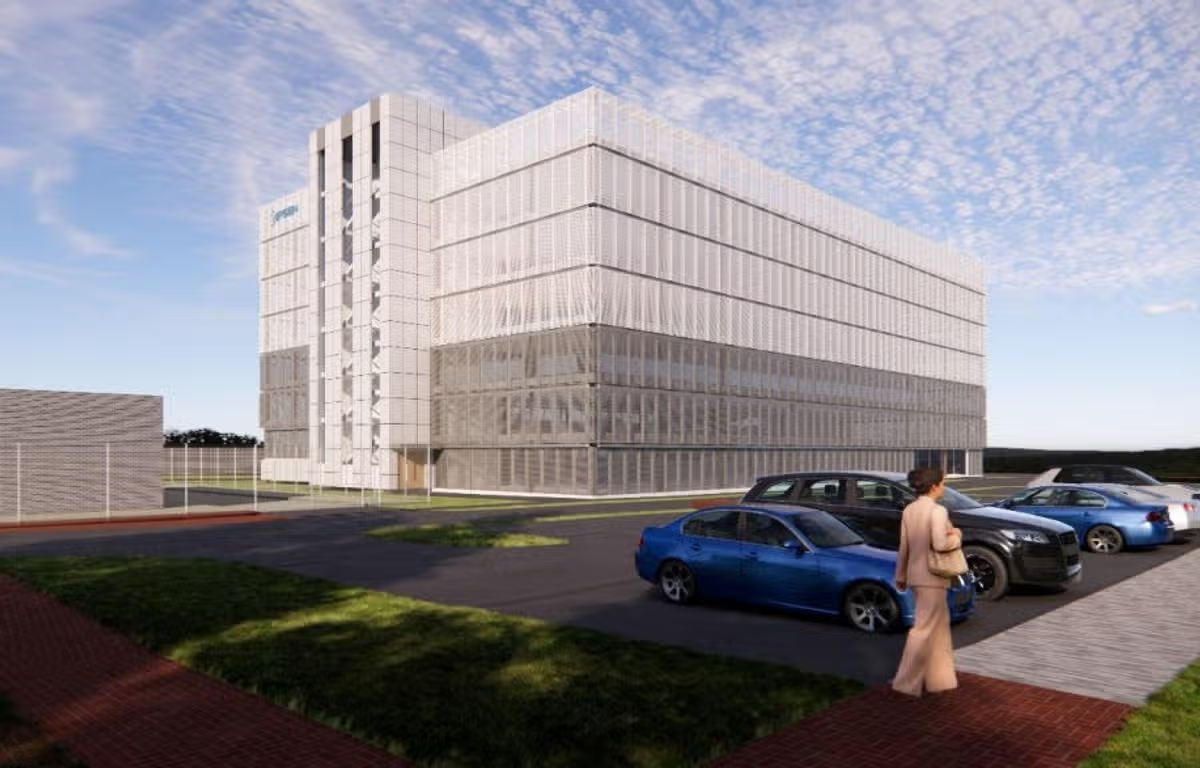
A large multi-storey car park is planned by lobal pharma company Ipsen at its manufacturing site on Wrexham Industrial Estate. The facility, for the company’s staff, would be seven storeys tall and have 14 levels of parking (Image: Lovelock Mitchell Architects)
Online, a man insisted a multi-storey was the way forward at Bodelwyddan. “There’s plenty of open land to the north and west of Glan Clwyd,” he said. “Build a big multi-storey there, using compulsory purchase powers if necessary, and then the existing car parks can all stay open while the new one is being built. Pay for it by using the Welsh Government’s powers to vary income tax rates in Wales.”
As is the case at some English hospitals, on-site shuttle buses might needed to ferry less mobile patients from edge-of-site multi-storeys. It’s costly but it’s a system that works well across the border.
Health boards in Wales might find it hard to justify the expense, especially if funding is diverted from healthcare services. In England, modular multi-storey providers offer no-cost, revenue sharing solutions, passing the cost to patients. In Wales, where hospital parking is free, this isn’t an option.
A Bangor woman reckons free parking should be suspended temporarily. “Even if they charge everyone until it (a multi-storey) was paid for, it would be better than the current chaos,” she said. Agreeing, another said: “We need a change and if it were a profit-generating build, I’m sure they’d find a way.”
Pay for parking
Parking became free at all NHS hospitals in Wales on September 1, 2008. It was a blessing that became a curse, with unfettered parking quickly outpacing provision.
Patients might begrudge the idea of paying for something that was previously free, and some groups might struggle to afford it, especially if visiting regularly. But hospital parking has become so bad that some people are starting to think that paid parking is the only solution.
Online, a man said: “What really makes parking easier at English hospitals is that you have to pay for it. People only park if they really need to, and only for as long as they need to.”
It’s an idea that has traction in some online petitions. Suggesting it might work at Ysbyty Gwynedd, a woman said: “If people are dumping their cars to go work in Bangor or wherever, charge everyone for parking except Blue Badge holders. Let’s see how many spaces it clears.”
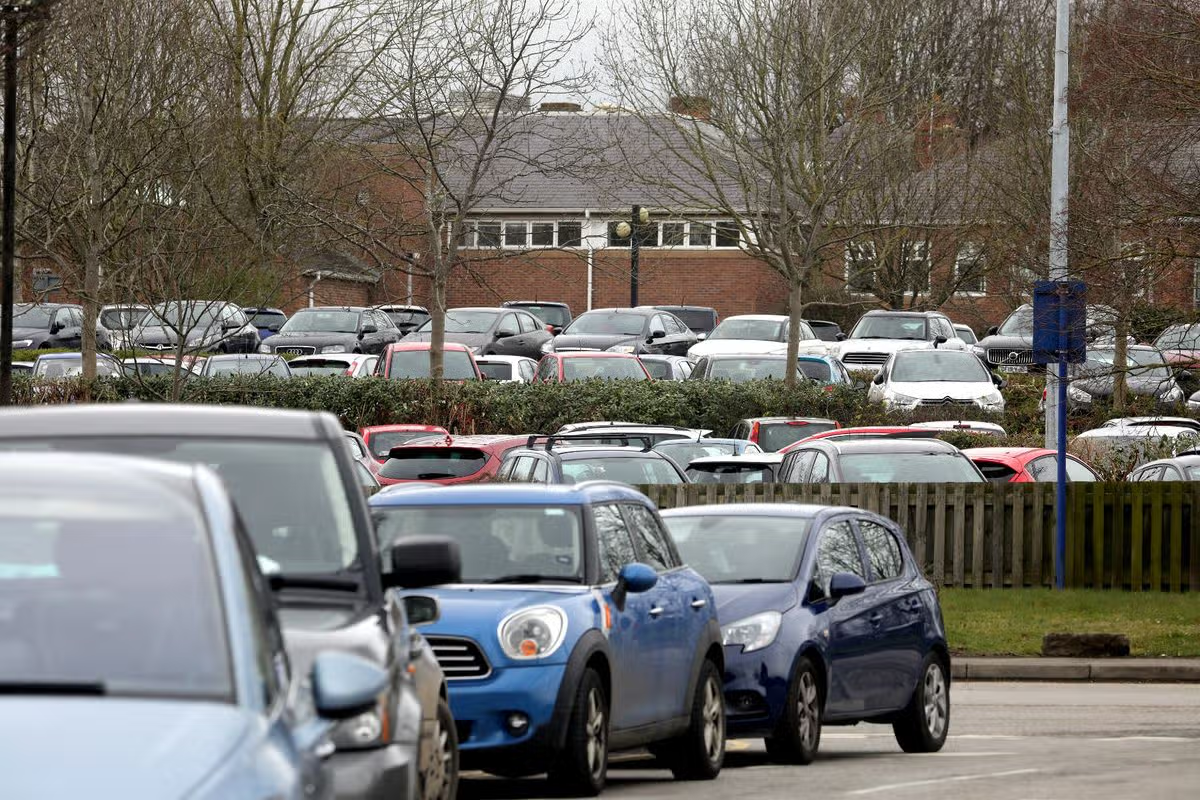
Wrexham Maelor is sometimes turned into a one-way system by cars parked illegally (Image: Ian Cooper/North Wales Live)
Angered by the impasse in Wrexham, a woman said: “When we paid for parking, we could park. Immediately it was scrapped we have parking problems. Amazing isn’t it?”
Betsi used to charge for parking and a Denbighshire man believes this should be restored. “They are deep in debt and can’t afford to give free parking to everyone,” he said.
“We have been brainwashed to believe anything to do with the NHS should be free, even when the service provided is rubbish, like car parking. When we visited a sick grandchild in Cardiff we had to pay and did not begrudge it.
“Car parks cost money to build and maintain, so what is wrong with patients and visitors contributing to the expense?”
Park-and-ride
For five years, until June 30, 2015, a hospital park-and-ride scheme operated between Glan Clwyd and Bodelwyddan’s former Hotpoint factory site. It was used by thousands of patients.
This was only every intended as a temporary measure while a major hospital redevelopment took place, reducing parking capacity. Amid political pressure, the scheme was extended several times but it ended when a land lease terminated. Parking chaos quickly returned.
Now the idea is back on the agenda. A Traffic Management Group has been established to assess the feasibility of re-establishing a park-and-ride – or park-and-walk – scheme at the hospital. Local land availability is the key constraint.
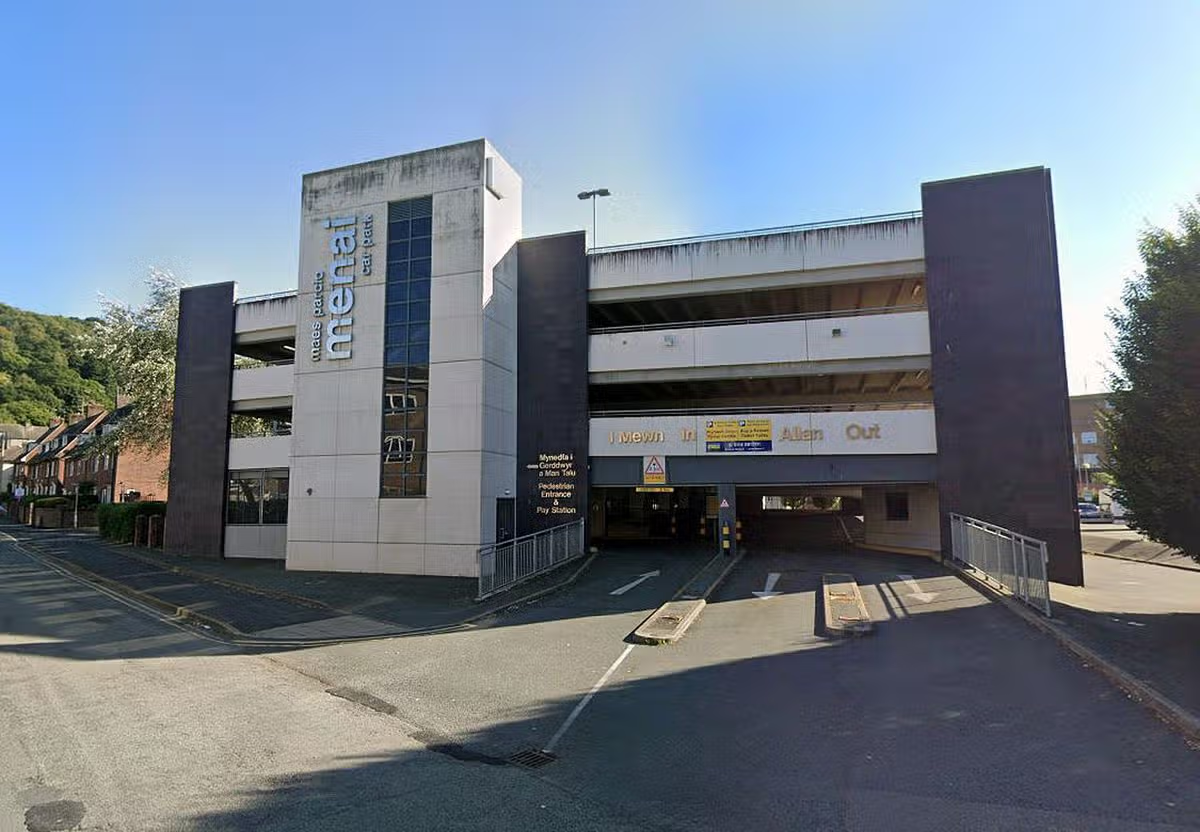
Ysbyty Gwynedd users suggest Bangor’s Menai Centre multi-storey could be a park-and-ride hub(Image: Google)
Some Ysbyty Gwynedd patients also feel park-and-ride is the way forward. Commonly suggested is a system operating from the council-owned Menai Centre multi-storey, at least on a temporary basis while a permanent facility is constructed nearer the hospital.
It’s an idea deemed worthy of investigation by Bangor Aberconwy MP Claire Hughes, who sees it as a way of simultaneously boosting city centre footfall. A sticking point might be the potential loss of council revenue. But Ms Hughes said: “We need some more joined-up thinking and the council has to stop thinking of parking just as a cash cow.”
Wrexham Council owns a multi-storey at Tŷ Pawb. In March, the local authority also acquired the long-closed St Mark’s multi-storey next to Island Green. St Mark’s lies a 14-minute walk from the hospital but is currently earmarked for redevelopment as tourist parking rather than for patients.
Online, a more favoured site is vacant council-owned land next to Moneypenny – the idea being that it could cater for football fans as well as hospital visitors. However this is a core part of the Western Gateway site earmarked for a high-quality business park.
Despite the myriad land-availability obstacles, park-and-ride remains a likely option for the North Wales health board at one or more sites.
Pre-booking
Pre-booking is used on Yr Wyddfa’s Pen-y-Pass car park (for a fee), to manage demand, so why not hospitals?
Several private parking companies claim to offer pre-booking for hospitals in North Wales. By default, all locations are off-site as hospital parking is free and operates only on a first-come, first-served basis.
Spaces are offered on private driveways and even supermarket car parks. By and large, many options are unrealistic: for example, JustPark offers bookable driveway parking for Ysbyty Glan Clwyd, starting at £4.60 – this is in Tan-y-Fron, a 157-minute walk from the hospital.
Closer options are available. But not many – and they’re expensive. Could it work? Patients may resist the idea of private firms capitalising on a health service that’s meant to be universally free.
However it’s not impossible to imagine pre-booking being harnessed by health boards, allocating spaces with appointments for specific demographics or treatment types.
Shuttle buses
In England, shuttle buses are used help older and less mobile patients who park in multi-storeys and perimeter locations at NHS hospitals. By facilitating long-distance parking, this frees up valuable central spaces for emergency vehicles and Blue Badge holders.
Hospital shuttles usually have lift ramps for disabled and wheelchair users. As well as convenience, buses speed up patient transit times and so improve parking turnover.
It’s an idea that would be embraced by plenty of people. The lack of a shuttle scheme for Ysbyty Gwynedd workers has long been a bone of contention. One woman said: “Something like that would be ideal at the Bangor hospital from the very bottom car park as it’s a long walk from there.
“If you have limited time to visit it would be a godsend, especially if you have wasted half an hour or more looking for a space. It’s the same with Glan Clwyd – if you have to park by A&E it’s a long walk to the lifts, especially if you have difficulty walking.
“I know it’s all down to money but surely something can be done. I have been visiting a relative in Glan Clwyd for six months and I find it disgusting that people are parking on the zebra crossing, in the yellow box, on junctions and on double yellow lines – and its not policed at all.”
A shuttle bus service linking Wrexham’s city centre car parks with the hospital is being explored by the health board and its partners.
Fines, clamping and double red lines
A common perception is that shoppers, workers and other non-hospital users swamp car parks and reduce overall capacity. The scale of the problem is difficult to determine, but a Wrexham Maelor visitor is adamant it is an issue.
“They’ve been seen doing it,” she said. “Either leaving cars there and all piling into one (vehicle), or going straight into town on the bus.”
At Ysbyty Glan Clwyd, it’s claimed that people working in Rhyl park at the hospital and take a bus into town. One man said: “It is a strange situation. If you park in a town or city centre to spend money in shops and businesses – which brings in taxes – you have to pay to park. However to use our NHS just up the road, which is paid for through taxation, you get free parking.”
If hospitals cannot use paid parking as a deterrent, what other options do they have? Like many, the woman who was “stalked” back to her car believes parking enforcement is needed.
One man said: “I’m sure an awful lot of people are parking on the Maelor and then walking into town. Getting rid of them will free up a lot of parking for patients and staff. Unfortunately, it will need someone to put a ticket on illegally parked cars.
“I think it’s the cheapest and most effective way of dealing with this situation without breaking the bond that patients attending the hospital are not charged for parking in Wales.”

Packed in like sardines at Ysbyty Glan Clwyd(Image: Ian Cooper/North Wales Live)
In North Wales, Ysbyty Gwynedd is alone in having formal parking enforcement – this is managed by Cyngor Gwynedd, with revenue used to improve road markings. Elsewhere it’s more sporadic: occasionally polite notices are plastered on cars.
One issue is the enforceability of double yellow lines, as these allow for cars to stop briefly to pick up, or set down, patients. An idea discussed with the health board earlier this year was the use of double red lines instead: as this prohibits stopping entirely, it would give the health board the legal basis to enforce against any driver who ignores them.
At the time, the First Minister was Eluned Morgan. In response to the idea, she expressed scepticism about whether the colour of the lines would change driver behaviour. Instead, the more immediate priority should be enforcement of existing rules, via health board or council staff, or even private enforcement companies, she said.
“That is a decision for the health board,” added the former First Minister, adding that relevant funding requests would be considered “against other competing priorities”.
ANPR and ‘smart solutions’
If parking expansion is off the agenda, many people wonder why the health board is lagging behind with tech solutions. It’s not uncommon for hospitals elsewhere to use technology to optimise vehicle turnover in their car parks.
It’s an idea favoured by a woman who has petitioned for parking improvements at Wrexham Maelor Hospital. Vivienne Party wants to see barriers installed which can be opened by QR codes issued with appointment letters. She also favours a “reasonable fee” to prevent free access for non-hospital users.
Ms Party said Maelor parking was usually full by 9am. “I’ve had to go into the town centre and pay to park in an empty council car park,” she said. “Then walk 15 or 20 minutes back up to the hospital.
“I have arthritis and a heart condition and I think it is very selfish and disrespectful to expect everyone – including pensioners and young families – to have to do this. It causes a lot of pain and stress. It has been going on for years. Something must be done.”
Fflint Wrecsam Senedd Members Marc Jones and Carrie Harper have pledged to set up a taskforce to tackle hospital parking. Mr Jones said: “Heath Hospital in Cardiff (University Hospital of Wales) has ANPR and four hours free parking. [It’s] one of many options we need to explore urgently.”

Drivers hunt for parking spaces at Wrexham Maelor Hospital(Image: North Wales Live)
A UHW worker pointed out the hospital’s free parking can be extended by a further four hours via tablets at reception and on each ward. “Works quite well,” he added.
The use of Automatic Number Plate Recognition (ANPR) cameras obviates the need for barriers. But without parking revenue, it is expensive, one reason why it hasn’t yet been harnessed.
Other tech solutions include digital signage at hospital entrances: when combined with integrated mobile apps, these can indicate real-time space availability, steering drivers toward vacant spots.
QR code validations would add an extra tier of parking management. To prevent queues at reception desks, modern smart systems can automatically validate Blue Badge holders at exit points, as well as frequent outpatients, and long-term visitors.
This may have prevented what happened to a mum-of-two who was fined while having cancer treatment at Ysbyty Gwynedd hospital. In January 2023, Mandy Williams drove from Blaenau Ffestiniog for a round of chemotherapy.
Although parking at the hospital is free, people using its two top car parks must obtain and display a ticket, giving them four hours for free. Having struggled to find a space, Mandy spotted a space in a top car park not knowing she needed a ticket. When returning to her car five hours later, she was devastated to find she had been issued with a £50 parking fine.
Staff parking
Betsi Cadwaladr University Health Board employs around 21,100 staff across North Wales. Many commute to hospitals from rural areas for which cars are the only realistic form of transport.
Accommodating them all requires significant parking capacity during peak hours. Staff parking permits are issued but increasingly these are being limited to encourage a switch to public transport, car sharing and cycling. Permits are awarded based on shift patterns, distance travelled and availability of local buses.
Some sites, such as the University Hospital of Wales, Cardiff, provide staff-specific park-and-ride services to free up hospital parking capacity. Homeworking and flexible shift patterns for admin roles has further eased peak-time demand for parking.
Despite this, parking for hospital workers can still be a daily nightmare. Healthcare staff often report having to arrive early just to hunt for a space, and dumping cars in unauthorised spots if they can’t find one. Failing to find a space can mean missing the start of a shift.
Plenty of staff do use public transport, others car-share to work. But a Wrexham man claimed more needs to be done to free up parking capacity for patients. “I walk through the car park every morning,” he said.
“The amount of staff pouring in between 7am and 7.30am is horrendous. All of them one person to a car. When I walk back through at 5pm and 5.30pm, they are all leaving again.”
A 2018 survey by UNISON, involving over 3,500 health workers, revealed that 54% of NHS staff had arrived late for work due to parking issues. Some reported spending up to an hour searching for a space.
Worryingly, 64% said they had received fines when attempting to park at work. As shifts often start early, or end late, public transport is often limited or not running at all.
A lack of reliable parking can affect staff retention rates. A Wrexham woman blamed a lack of planning, saying provision hasn’t kept pace with demand.
“There aren’t enough spaces to cope with both staff and visitors,” she said. “They’re not the problem, it’s the hospital’s expansion over the last 10 years – the (number of) parking spaces hasn’t been increased.”
More hospitals and virtual care
Some people think the solution is simple: build more hospitals to ease parking pressures at existing ones.
Given the capital outlays involved, large new facilities are unlikely. However, the principle has been adopted by some trusts, which are relocating minor services away from main hospital sites.
If community clinics host minor outpatient procedures or non-urgent diagnostics, parking spaces should be freed up at acute healthcare hubs.
An allied idea is alternative clinical delivery. Hospitals are increasingly promoting online video consultations for routine or follow-up appointments, removing the need for patients to drive to hospitals.
Do nothing
At face value, this approach wouldn’t impress patients driven to distraction by current parking arrangements. However, a Wrexham man suggested that, over time, parking demand may decline as medical advances reduce treatments times, especially for cancer.
He said: “This has a knock-on of reducing parking demand – if a patient needs 30 minutes instead of three hours for a treatment, that frees up lots of parking spaces.
“Point being we may be at ‘peak demand’ for hospital parking right now, so expanding hospital parking may not be as big an issue as it currently appears.”
Doing nothing also has merit for Net Zero proponents who want to see a transition to active travel and public transport. Limiting parking provision is a useful tool for driving the switch.
What Betsi Cadwaladr University Health Board said
Stuart Keen, director of environment and estates, said: “We fully acknowledge how challenging car parking can be on all three of our acute hospital sites, and do not underestimate the frustration this can cause. This is a challenge we share with other Health Boards across the country.
“There are no quick or easy solutions to increase capacity, due to funding constraints, and the lack of available land adjacent to these hospitals upon which additional car parking provision could be introduced. The Health Board is currently reviewing a range of options to address the problem, including consideration of park-and-ride solutions and other measures to improve access to our sites.
“We continue to encourage people to allow plenty of time when travelling to our hospital sites to find a parking space and where possible consider other options, such as using public transport or asking a friends or loved one to take you.”