
Return of the wild?
Outside of Ireland, ancient place names are also drawing attention for their ecological potential. Researchers have looked to Old English place names in Britain in the hope of gaining a better understanding of locations at risk of flooding. That could in turn prompt solutions around flood resilience planning.
Rewilding projects in Scotland have taken note of Scots Gaelic place names mentioning trees, citing them as potential cues for where tree-planting efforts could occur.
But one shouldn’t take place names too literally. “Just because a place name mentions a tree or an animal doesn’t necessarily mean that that tree or animal was actually there – it might have been a metaphor, it might have been a symbol,” says Nic Craith.
There is a place I sometimes go sea swimming, not far from Belfast, called Portmuck. It sounds a little off-putting in English, but muc in Irish means pig and some say this was most likely a port that people brought pigs to. Having said that, the nearby Isle of Muck (Oileán na Muc), now a bird sanctuary, looks to me a bit like a pig lying on its front with part of its body submerged. Is that the reason for the name? There’s another Isle of Muck in Scotland, in that case apparently named after muc-mara, sea-pigs or whales. Sometimes “muck” has nothing to do with (land-roaming) pigs at all.
More like this:
• The true story of Germany’s rampant raccoons
• The shark that lives for 400 years
• The wildlife pioneer that inspired Attenborough
Ray Ó Foghlú, head of partnerships and development at Hometree, a nature restoration charity in Ireland, says place names are not “instructions” to recreate the past: “Their real value is in showing us what a landscape has been capable of.” Ecologists can then test locations for their rewilding potential. Equally, somewhere with no hint of trees or woods in its name could actually be a perfect site, today, for a tree-planting project, for example. Nic Craith describes place names as “a starting point”.
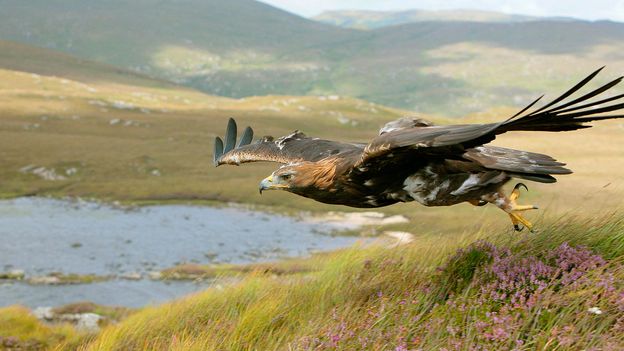
And who knows where they will lead you. Although Peig Sayers never lived to see it, white-tailed eagles were reintroduced to County Kerry in 2007, at Killarney National Park, roughly 52 miles (83km) from Sliabh an Iolair. There are now roughly 150 white-tailed eagles in the wild in Ireland. They are breeding, and sustaining their own population. Golden eagle reintroductions are also underway elsewhere on the island.
Tantalisingly, some of the white-tailed eagles have even found their way back to the area around Sliabh an Iolair.
Perhaps eagles will one day build a new nest on that famous mountain. A place that, once again, is named after animals living in this part of the world – memories reborn.
—
If you liked this story, sign up for The Essential List newsletter – a handpicked selection of features, videos and can’t-miss news, delivered to your inbox twice a week.
For more science, technology, environment and health stories from the BBC, follow us on Facebook and Instagram.