
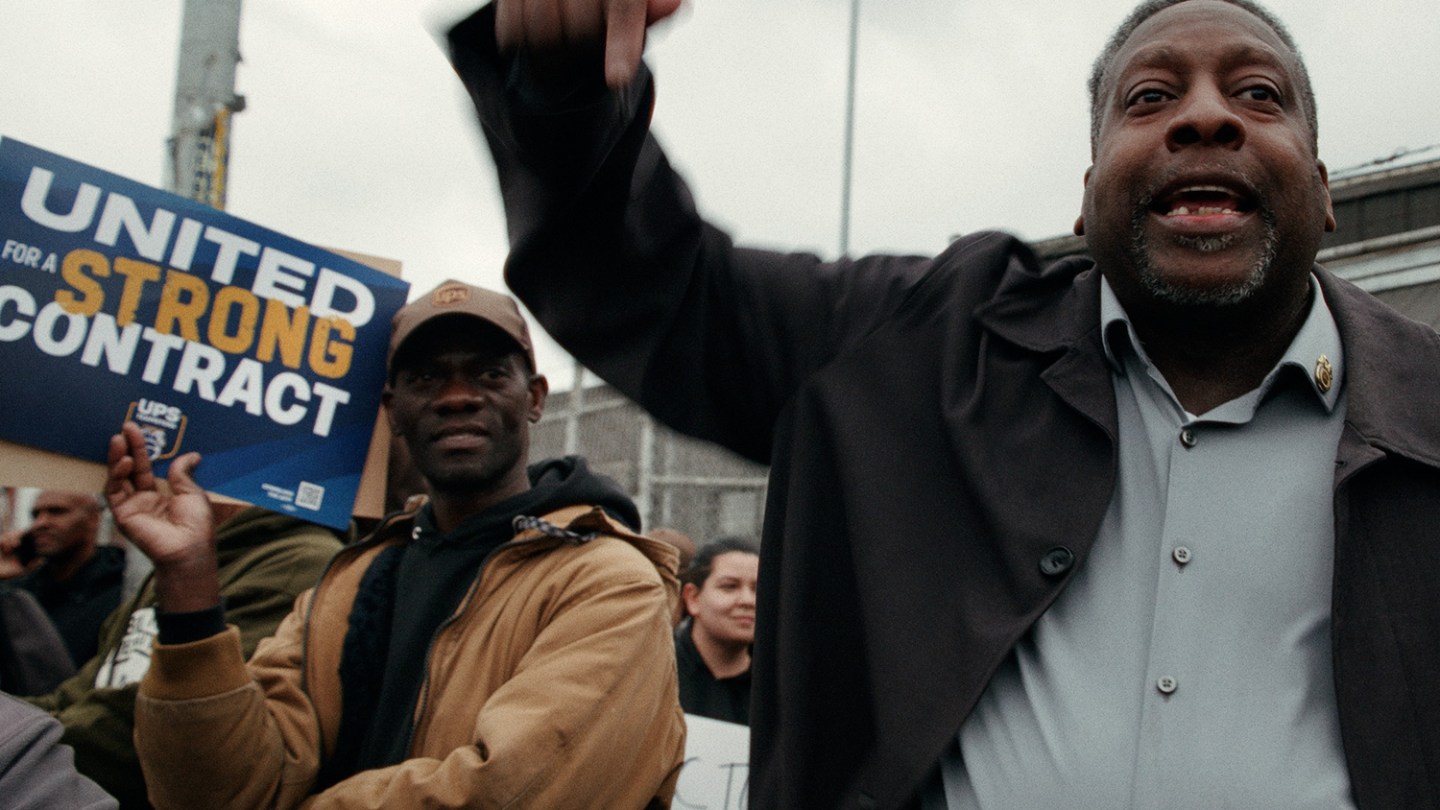
There’s something fitting about the fact that Barbara Kopple’s latest documentary, Union Town, premiered at the Venice Film Festival. Though the title refers to labor organizing in and around New York City, unionized workers in Italy just signed a first-of-its-kind labor contract with Amazon. Winning a first contract is a goal that Amazon warehouse employees documented by Kopple in the film are working toward as they face aggressive opposition and legal challenges from the tech giant.
In Union Town, which makes its North American premiere at TIFF on Sept. 11, Kopple trains her camera on these Amazon workers as well as two other labor groups that power New York City’s delivery ecosystem. There are delivery drivers and warehouse workers for UPS, who in 2023 made their first real strike threat in years under the Sean O’Brien-led Teamsters union. And there are the “deliveristas,” delivery workers for apps like DoorDash and Uber Eats, often immigrants who navigate busy city streets on mopeds and bicycles.
Kopple spoke to THR about the doc’s focus on female workers, its footage of Amazon and UPS warehouses, and its distribution prospects at a difficult time for social-issue documentaries.
How did this documentary get started for you?
Well, I had been in Kentucky [for 1976’s Harlan County, U.S.A.] and I’ve been in Austin, Minnesota [for 1990’s American Dream], and I really wanted to see what was happening in my hometown about unions. One of our producers, Peter [Palandjian], called up one day and he just said, “Listen, why don’t you make a film about unions in New York?” And I said, “I was just thinking about doing that.” And that’s how it started. We knew that UPS was about to do their contract [negotiations] and weren’t very far away from doing it. They opened their doors for us and let us film as much as we could. But as you heard in the beginning of the film, [Teamsters Local 804 president] Vinnie Perrone saying, “My wife asked about the negotiations and I tell her just as much as I tell you,” which is nothing. We got to know enough so that we could tell the story.
The Teamsters were very interested in Amazon, and after they got their contract, they went over and they started organizing Amazon. And so it went from there. And then I met Ligia [Guallpa], who is a woman who was the co-founder of Worker’s Justice Project and has put deliveristas together. Here were sort of the haves and the have-nots, and they [the deliveristas] had nothing.
Were some participants more difficult than others to convince to go on camera and do interviews?
Of course, because they didn’t want to lose their jobs. With Harlan County and American Dream, people weren’t like that at all. They just wanted to tell you everything. Yes, it was much more difficult. And also too, from the higher ups at [the Teamsters union], they didn’t consider making a film different from the press. So they thought what we were doing might come out tomorrow or something and didn’t realize it would be three years before we’d be lucky enough to have it come out. So yeah, they said, “Don’t tell them anything.”

Barbara Kopple, courtesy of Getty Images
Were there any moments that were particularly challenging to capture for you?
Well, yes. The death of [app delivery worker] Victor Hidalgo. [Hidalgo was struck by a fire truck while riding his bike on Oct. 30, 2024.] He was 24 years old. He actually had permission to work here and he had a wife and a child and his parents in Mexico, and his aunt who totally loved and cared for him here, but he had to come here to try to make a living. And that was very difficult to film and to be there. I mean, I wasn’t there when the car hit him, but shortly thereafter.
You had access to footage inside warehouses moving packages for UPS and Amazon. How did you get access to that? Did workers film for you?
No, workers didn’t film for us. We went in. It was a time when Sean O’Brien was visiting, and so we were right with him. And when they said at the door, “Who are you?” the cameraperson just said, “We’re supposed to be following them.” And we all just walked in.
There are quite a few moments where the film focuses on the female workers in these groups. What was the thinking behind incorporating those scenes in the film?
Those, for me, are the important [scenes] in the film because usually you’re accustomed to seeing the men as union organizers — tough, brawny guys — and not the women. And the women just spoke from their hearts and said the things that they believed in. They weren’t afraid to talk; they wanted to talk. I mean, the woman who said, for example, “You have to work faster even if you hurt yourself,” and the camera pans down and you see a big brace on her leg where she hurt herself. Or Shelly [Elliston], who’s our incredible [UPS] driver, going up and down the stairs and saying, “Everything hurts. My back hurts, my arms hurt, everything.” And that one woman who really needed her medication and was very scared if they [the UPS drivers] strike, what would happen to her? And always seeing [Elliston would] wait for her to come to the door and make sure she gave her the package. These are the things that we as women, I think, do for each other. We try to help each other and have each other’s backs. And that’s what these women were about for me.
What emotions did you leave this filmmaking process with?
Extremely hopeful. I found that these are people who are not going to lay down or allow people to walk all over them from UPS, from Amazon and from the deliveristas. They were strong, they were going to fight the best fight that they could, whether they won or they lost certain things. But yes, I found it very, very hopeful, very strong and [I was] excited by that.
Do you have any kind of impact campaign scheduled for the film?
We’re going to try. It’s been hard since funding has dissipated for these kinds of films, but we had some really wonderful people who were donors. I mean, we still count every penny and [are] this far from drowning.
What do you think the distribution prospects look like for this film at the moment?
I’m just hoping that it’ll have marvelous distribution and people will really want to see it, but one never knows. It’s been incredible showing a film that’s not even finished to a very few film festivals that really wanted to show it, particularly Venice, for example, and Toronto.