
Developers are no longer focused solely on minimising environmental impacts. Regulators, policymakers and stakeholders are increasingly looking for projects that can deliver positive ecological outcomes alongside renewable energy generation.
That shift is driving interest in nature-inclusive design – an approach that aims to build biodiversity benefits into offshore infrastructure from the outset.
READ MORE: How artificial reefs support marine life in wind farms
Exo Engineering specialises in designing and manufacturing bespoke infrastructure that delivers ecological benefits alongside functionality in coastal and marine settings, such as artificial reefs and habitat structures.
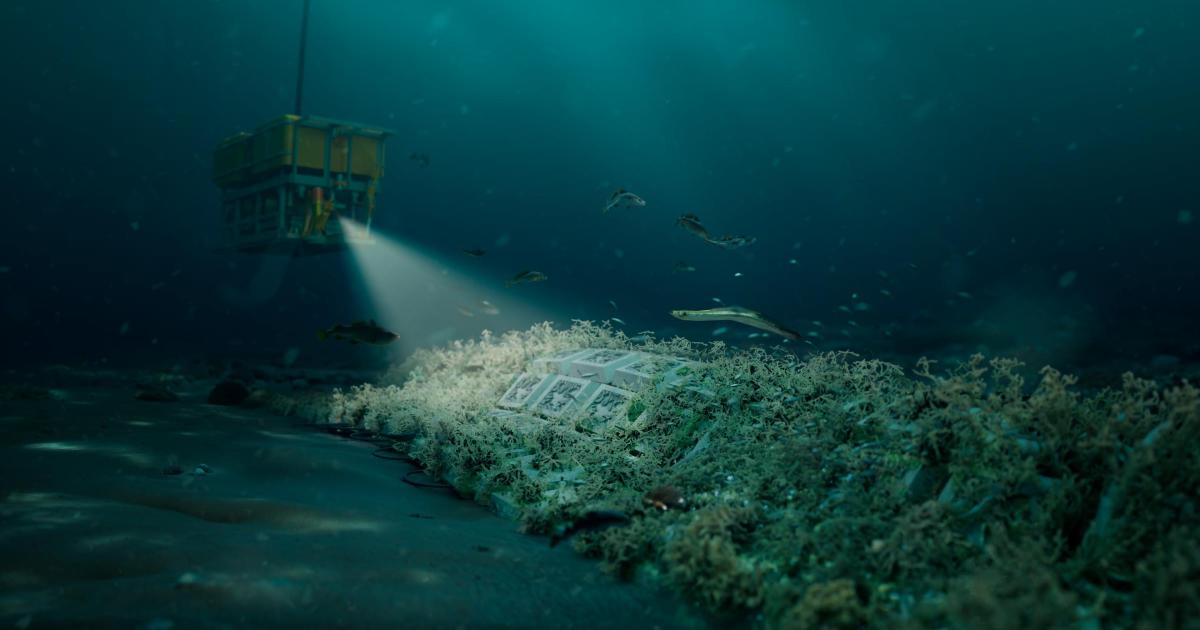
The company is applying the same thinking to articulated concrete mattresses, a widely used form of seabed protection employed across offshore energy projects. Concrete mattresses are commonly installed over subsea cables, pipelines and crossings to prevent scour and stabilise the seabed. They form a proven solution that has been used throughout the offshore sector for decades.
William Coulet, Exo Engineering managing director. (Image: COOKED PHOTOGRAPHY)
Rather than replace that technology, Exo Engineering is exploring how it can be improved.
“There is a beautiful opportunity for developers to achieve positive contribution to the seabed by enhancing offshore infrastructure,” said managing director William Coulet.
“We recognise that disturbing the seabed anywhere and everywhere is not desired. If we are putting down offshore infrastructure like scour protection or cable protection, it might as well be of a nature-inclusive type.”
Working with marine biologists, the company’s engineers have developed a series of surface textures and habitat features that can be incorporated into traditional concrete mattress designs without affecting their primary function.
Historically, seabed protection systems have been designed almost exclusively around engineering performance. Resilience, strength and stability have taken precedence.
William said that Exo Engineering’s challenge has been finding ways to “offer benefits to marine life without compromising the product’s performance or durability”.
The solution lies in increasing what ecologists refer to as “surface complexity”.
Smooth concrete surfaces provide relatively few opportunities for marine organisms to establish themselves. By introducing carefully designed textures, grooves and cavities, those same surfaces can become more attractive to a wider range of species.
“We want to maximise the complexity for minimal effort and as such, remaining cost competitive,” said operations manager Jack Cattermole.
The company has developed several concepts, including hexagonal patterns, rock-inspired textures and a distinctive surface finish influenced by the appearance of brain coral. These features increase the available surface area and create sheltered spaces where marine organisms can attach, grow and take refuge.
Jack Cattermole, Exo Engineering operations manager. (Image: Exo Engineering)
Jack explained that, in ecological terms, the approach increases the “rugosity” of the structure, creating a more varied habitat than standard concrete alone.
The potential benefits extend across multiple species groups commonly found in the North Sea.
Mobile species such as brown crabs and European lobsters can use cavities and crevices for shelter, while mussels and oysters may colonise textured surfaces more readily than smooth concrete.
Those species can generate wider ecological gains over time.
Natural reef-forming organisms create additional habitat for other marine life, supporting increasingly complex communities as they become established.
While much attention has been given to species such as Atlantic cod in recent years, Exo Engineering views nature-inclusive infrastructure as part of a broader effort to restore ecological function across depleted seabed habitats.
“It’s so important for us as a company to create these habitats to encourage that restoration because it’s in such a degraded state,” Jack said.
Nature-inclusive design is attracting growing attention from developers.
In the Netherlands, ecological enhancement measures are already an established part of offshore wind development, with many in the sector expecting similar trends elsewhere.
Nature-inclusive articulated concrete mattresses are designed to enhance seabed biodiversity alongside cable and scour protection. (Image: Exo Engineering)
One reason the concept appeals to developers is its practicality.
Unlike entirely new technologies, it builds on an established product already trusted by the industry.
“It’s not a completely new product, which would require extensive testing,” Jack said. “It’s taking a proven technology and tweaking the design to benefit nature.”
That means installation requirements remain largely unchanged.
Existing deployment methods can still be used, reducing concerns around construction schedules, vessel availability and operational risk.
The company is currently partnering with concrete mattress manufacturer Subsea Protection Systems Ltd., based in Great Yarmouth, to trial aspects of the design and refine production techniques.
The objective is to demonstrate that biodiversity enhancements can be integrated into manufacturing processes without creating significant additional cost.
Monitoring will also play an important role. Exo Engineering already offers a range of ecological monitoring services, including ROV inspections, seabed video surveys and environmental DNA analysis.
These techniques can help developers understand how marine communities establish themselves over time and assess the effectiveness of nature-inclusive interventions.
As offshore wind continues to expand, nature-inclusive articulated concrete mattresses could offer developers a straightforward way to generate environmental benefits from infrastructure that would be installed regardless.
“Just that simple tweak could provide a much greater amount of biodiversity uplift compared to a regular mattress,” Jack said.
In a sector searching for ways to balance energy generation with environmental recovery, the fine tuning of concrete mattresses could prove increasingly valuable.
For more information, visit exo-engineering.co.uk
This story is also published in Insight Energy magazine, covering the latest news from the UK’s energy sector. Read the latest edition here.