

Andy Murray has swapped tennis for golf – and he’s already down to a 1 handicap after less than two years. The three-time Grand Slam champion reveals how he’s improved so quickly, the equipment changes that have helped, and why putting remains his biggest frustration.
Andy Murray has spent much of his life trying to find ways to get better at sport.
From becoming world No.1 and winning three Grand Slam tennis titles to claiming two Olympic gold medals, the Scot built his career on relentless practice, an ability to analyse his weaknesses, and a refusal to settle for anything less than progress.
Now 39 and having hung up his racket two years ago, he’s now applying that same approach to golf, with hugely impressive results.
In less than 24 months, Murray has already reached a 1 handicap. It’s a remarkable achievement, even if he’s the first to admit that his journey has been rather different to that of the average amateur golfer.
“I’m quite different to most amateurs in that I don’t have a job,” Murray tells TG. “So sometimes, during the week, I’ll go to the range and practise for four or five hours a day.
“It’s not like most people’s 20 months of playing where they’re playing maybe once a week or every couple of weeks, and maybe not playing through the winter. I’ll play in all weather as well, so no breaks during the winter.”
For Murray, it’s no chore.
“I love practising, I love having lessons, and just trying to improve.”
That dedication has helped Murray make rapid progress, but he admits that his initial approach to practice was not necessarily the most effective.
“When I started, I would just go to the range and smash balls around,” he says. “And after four months of doing that, I wasn’t really getting much better.
“I realised, ‘OK, if you’re going to be here for a few hours, let’s have a bit of structure to it, let’s get some lessons, and let’s actually work on things.’ And then quickly I started to improve a lot.”
It’s a familiar lesson for golfers of all abilities. Hitting hundreds of balls might feel productive, but without a clear purpose, it’s easy to reinforce the same mistakes.
Murray’s improvement has come from combining his enthusiasm for practice with a better understanding of what he needs to work on. And the more golf he has played, the more he has realised that the game is about considerably more than hitting the ball as far as possible.
“The more rounds I played, the more I started to understand the things that are actually really important in golf,” he says. “And it’s not always just smashing driver as far as you can.”
 From a slice to a draw
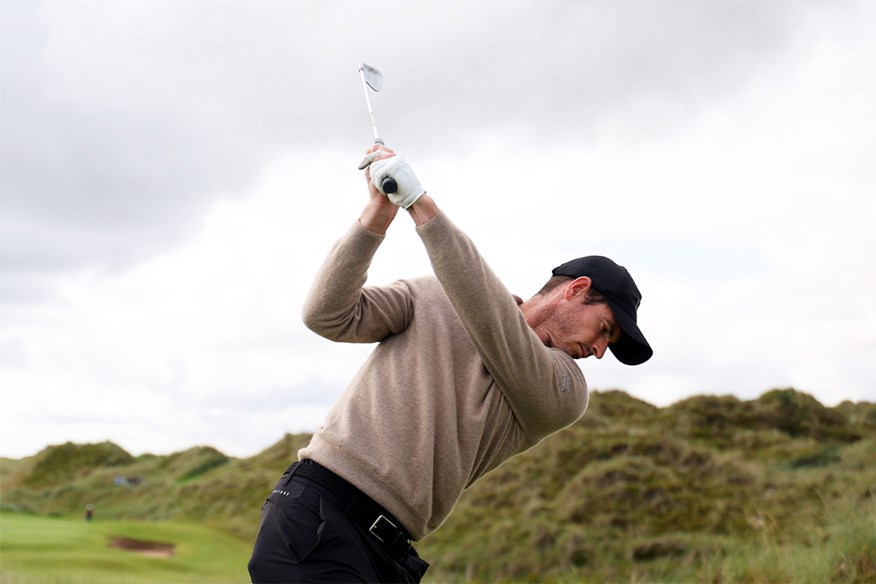
Like many beginners, Murray battled an unwanted shot shape – particularly with driver.
He says he traditionally played with a fade that could sometimes turn into a slice, largely because of an over-the-top move in his downswing.
“Generally, I would have played with a bit more of a – let’s call it a cut, but it can turn into a slice,” he says.
“One of the problems with my swing was that I would always swing over the top, which would make the ball go left to right, generally.
“But recently I think my swing has improved a bit and that’s not happening quite as much, so it’s going a bit straighter and sometimes a bit of a draw.”
That change has been particularly useful when playing in the wind.
“I think for me, particularly if I’m playing into the wind, because I don’t always hit the ball well, if I cut or slice it too much, I just lose a lot of distance,” Murray explains.
“Whereas when I draw the ball, I feel it stays under the wind; it doesn’t shoot up as high, and it maintains my distance a bit better.”
Murray is still trying to find a reliable shot shape with his driver, though.
“When I’m hitting my driver well, I hit it quite straight, but I actually don’t love that because I can miss both ways,” he says. “I actually want to start having a bit more of a shot shape with the driver because sometimes I stand on the tee, it might be a narrow fairway, and I could miss it either side. I end up trying to control my swing and swing slower, and then because of the over-the-top move, I can hit it straight left sometimes.
Like all golfers, Murray is on an endless journey to improve.
“I have many issues in my game, but I’m trying to work on them.”
That last sentence sums up Murray’s approach to golf. He’s already achieved a handicap that many amateurs spend decades chasing, but he’s still focused on the next improvement.
 The equipment changes helping Murray improve
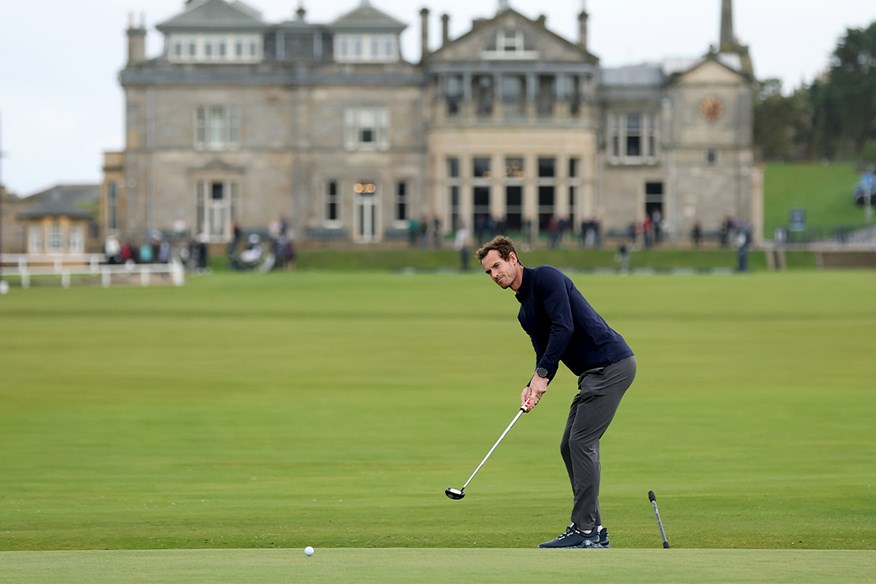
Murray’s equipment has evolved alongside his swing.
“I feel quite embarrassed to say this, but I had four different sets of irons in my first 18 months of playing golf,” he says. “But, like I say, my 18 months is not like the average first 18 months of playing golf.
“And I’ve loved that whole process of doing all the different fittings, but because I’ve improved in that time, I’ve had to change the clubs to go with that.
“Originally I had much more forgiving clubs and that helped me a lot, but as I’ve improved I’ve needed something a bit different.”
His current irons are Callaway Apex TCB with S400 shafts, a change he says has really helped.
“I had the X100 shafts before that, but I was finding it at times just a little bit hard to swing, whereas that just feels easier for me.”
But it’s not just his irons that have changed.
Murray’s favourite club is the 7-wood. “I don’t know why, I just seem to hit that club well,” he says. “I feel like I make fewer mistakes with it. I feel like it gains me shots. When I’m hitting into par-5s for my second shot, that club just seems to work for me.”
A driver tweak has also made a difference.
“I used to have 9° of loft on my driver,” he says. “I’m now at 10.5°, and I much prefer it.
“Because I was slicing, with the 9° loft I felt like it would sometimes go quite low and right; it was just not nice.
“Whereas with the 10.5°, at least when I hit it badly, I feel like it doesn’t look bad.”
The tweak hasn’t eliminated Murray’s slice, but it has given him a ball flight that instils more confidence, even when his swing isn’t quite right.
That’s a useful reminder that equipment changes don’t always need to produce dramatic improvements in launch monitor numbers to make a difference on the course.
Putting remains one of Murray’s biggest frustrations.
“I practise my short game more than anything else, but I feel like it’s something I could do better. My putting is very inconsistent, and that really irritates me. I’ve found putting probably the hardest thing, just because of my alignment. I do not know where I’m aiming. And I’ve been in the putting labs, but what looks straight to me is like a foot left of the hole, and it makes putting problematic.
A putter change has helped.
“I had a slightly longer putter before, and I wasn’t standing properly,” he says. “And the more upright I was, the more I was aiming left.
“My new one is a little bit shorter than what I had before, so I’m more over the ball and I feel like I see the line slightly better than I used to.”
It’s another example of equipment helping to improve technique, rather than just covering flaws in it.
 What tennis taught Murray about golf nerves
Murray has experienced the pressure of elite-level sport throughout his career, but even he isn’t immune to first tee nerves, particularly when playing in the Alfred Dunhill Links Championship, an event that combines professional golfers with amateurs.
“I was nervous, particularly when I played in the Dunhill, because there were quite a lot of people there,” he says.
“And you’re playing with professional golfers who are in the middle of a competition; you don’t want to be ruining their round by hacking the whole way round.”
It’s a situation in which his tennis experience has helped.
“I think from years of playing sport, nerves are generally a positive thing,” he says. “If I don’t feel anything, that is not usually a good sign.
“I like to feel a bit of nerves and a bit of pressure. Yes, it makes it a bit harder on the first tee, but it helps me to concentrate better and focus a bit more.”
Murray says the mental skills he developed during his tennis career have helped him deal with the negative thoughts that can arise before and during a round.
“Everyone has negative thoughts and worries about what’s about to happen,” he says. “But from playing professional sport for a long time and using sports psychology and stuff, you can work your way through that a little bit.”
Why golf is easier than tennis
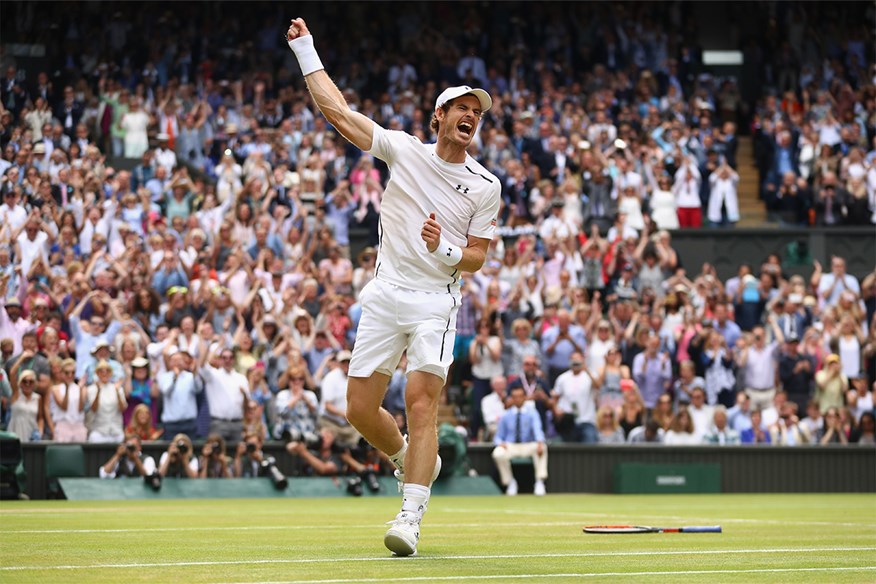
Murray was known throughout his tennis career for wearing his emotions on his sleeve.
Golf, he says, has given him more time to manage those emotions.
“Not as much as I did when I played tennis,” he says when asked if he’s as expressive on the golf course.
“It’s one of the hard things about golf, that you have a long time between shots to think about situations, but it also allows you – well, for me, anyway – to calm myself down.
“You might have two or three minutes between shots, so you get an opportunity.
“With tennis you get a really high heart rate at the end of a hard point, sometimes it’s baking hot, and you’re frustrated, and you need to then play a point 15 or 20 seconds later,” he explains.
“It’s hard to bring your heart rate down and calm yourself, whereas with golf, yes, I hate hitting a terrible drive or a duff chip or whatever – it’s frustrating, but at least you have a bit more time to calm down.
“I’m not saying I’m perfect at it, but I do think that that’s something… I probably do that better in golf than I did in tennis, just because you have more time to calm yourself down and then focus on the next shot.”
Murray’s biggest lesson for amateur golfers
For all his progress, Murray knows that golf can be a frustrating game.
And he believes one of the biggest problems for amateurs is the expectations they place on themselves.
“The problem with golf is that we set our expectations way too high,” he says.
“I have to remember I’m not a very good golfer. Just commit to every shot, and deal with the consequences of that.”
It’s a suitably honest assessment from someone who always tells it like it is.
Murray might have the time, resources, and sporting experience to make rapid progress, but he’s still learning the same lessons as every other golfer: practise with a purpose, understand your weaknesses, find equipment that works for you, and accept that even the best-laid plans can go wrong.
For a man who spent his tennis career chasing perfection, golf has offered a different kind of challenge. The handicap might already be impressive, but Murray is still enjoying the process – and that may be the most important thing.