
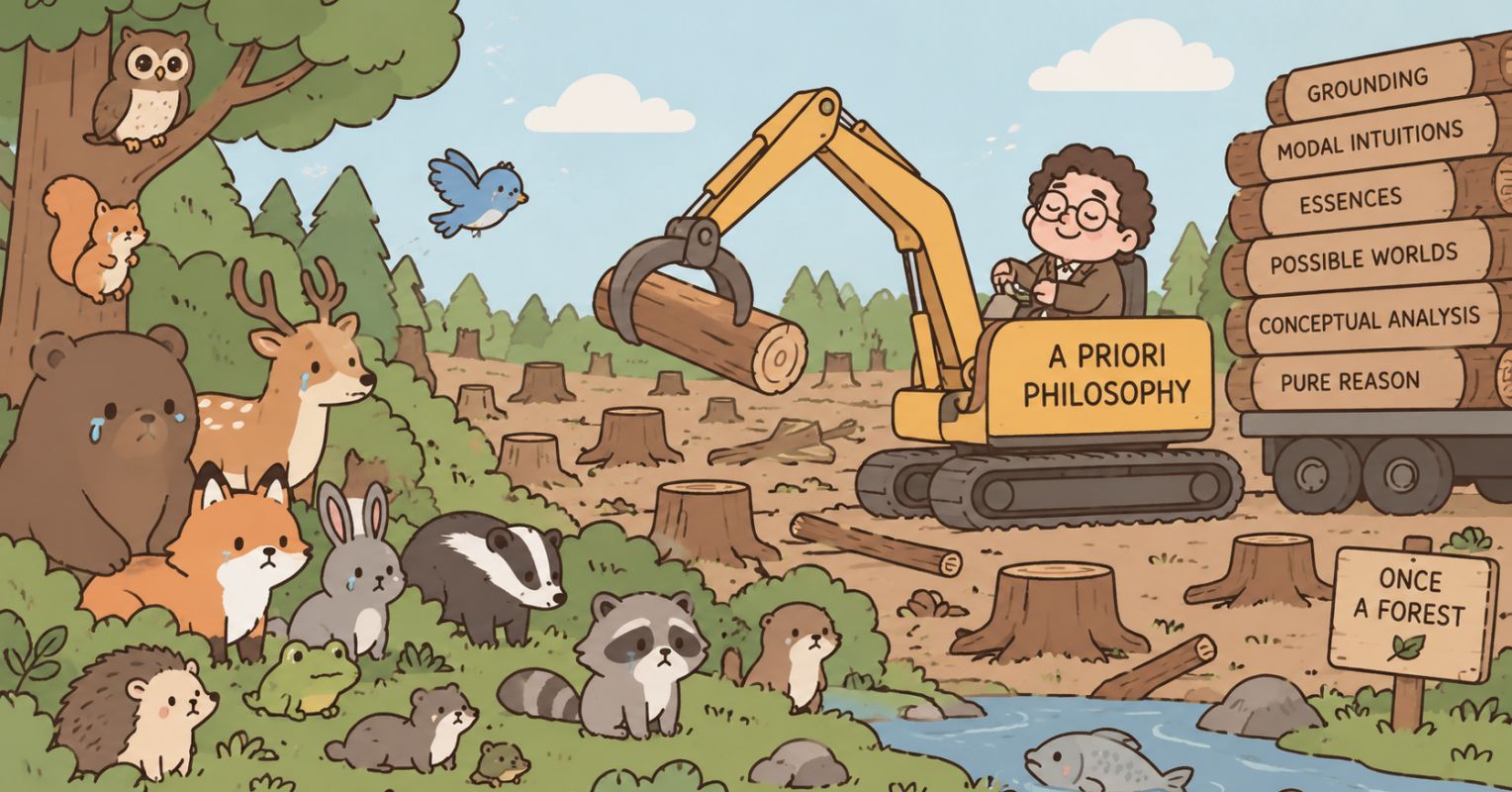
In an interview for the Undergraduate Philosophy Journal of Australasia in 2022, Australian philosopher Kim Sterelny (my wife’s PhD advisor and one of my PhD supervisors) was asked about his most controversial view. His answer:
“Probably the view that most a priori philosophy is a complete waste of time. Take all the metaphysical stuff on the nature of grounding—that is just killing trees for no good reason. Complete and utter f*****g waste of time. A good deal of a priori philosophy is like that, and in my view, a waste of space. Does that do for controversial?”
Is Sterelny right?
Yes.
Nevertheless, his comments will certainly strike some readers as quite radical. So let’s look at how he justifies his position in response to the interviewer:
What do you think separates philosophy and the sciences? Do you think that there are questions currently considered to be in the realm of philosophy that in fact need to be addressed by people from other disciplines as well?
Well, I’m a radical on this. I don’t think there’s a sharp distinction between philosophy and science.
Now the title of my blog on Psychology Today is “Science and Philosophy,” but as it happens, I agree with Sterelny. Philosophers of science since in the tradition of Quine realized that the common division drawn between the two rests on a mistake.
Sterelny continues:
There’s a kind of standard, conventional view that there are conceptual structures we can investigate a priori, and there’s the nature of the world we can investigate empirically. According to this view, the job of philosophy is to investigate conceptual structures in an a priori way, and the job of the sciences is to investigate the world and say what does or does not satisfy the conceptual structures that are identified in philosophy. I’m very sceptical about this division of labour. I don’t think there’s a sharp dividing line at any point that separates the wholly empirical questions from the wholly conceptual questions.
Exactly. Almost any significant philosophical question involves empirical data to some extent. And science itself isn’t reducible to a simplistic vision of the experimental method without any attention to concepts. If we draw that distinction between science and philosophy, scientists are engaged in philosophy all the time.
Take the example of biology that Sterelny mentions:
If you read philosophical or biological literature, there’s no clean segmentation of conceptual issues, like ‘What is the nature of a gene?’ and empirical questions, like ‘What counts as a species?’ Because what you’re trying to come up with is for the purposes of trying to understand the biological world. The question, ‘What’s our most useful concept of species?’ can’t be answered without thinking about what the biological world is and what the phenomenon is that we need to explain. There isn’t a question that you can ask and answer independently of thinking about what your environment is. So I don’t think of there being any realm of ‘wholly philosophical questions’ or ‘wholly empirical questions.’ For me, the question of what knowledge is has an empirical dimension—questions about the nature of mind, cognition, consciousness, and so on. So, I think philosophical questions should be answered with an eye to the empirical world. I think all important questions have an empirical dimension.
Most professional philosophers who engage in a priori philosophy don’t just waste their time, space (and trees); they produce pseudo-philosophy, no longer meeting academic standards, damaging the reputation of philosophy, and harming our collective pursuit of objective truths. Philosophy must be deeply intertwined with science, since there is no independent foundation from which we could make philosophical judgements or judge science itself.
To use a metaphor by Otto Neurath, it’s better to think of our attempts to build knowledge, science and philosophy, as something like a large ship that we are improving at sea. Science and philosophy are best served by merging into a unified field. Or as it used to be called: natural philosophy.