
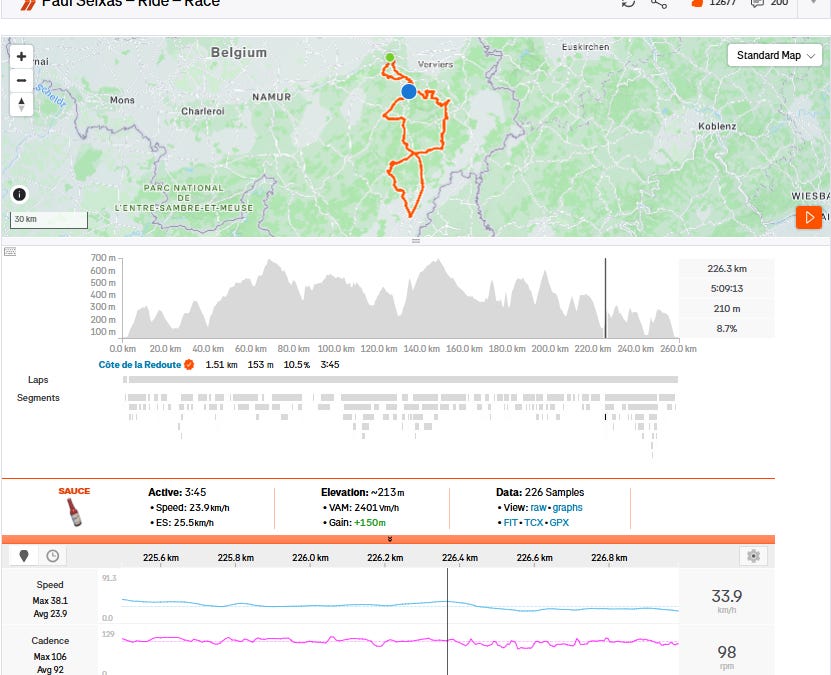
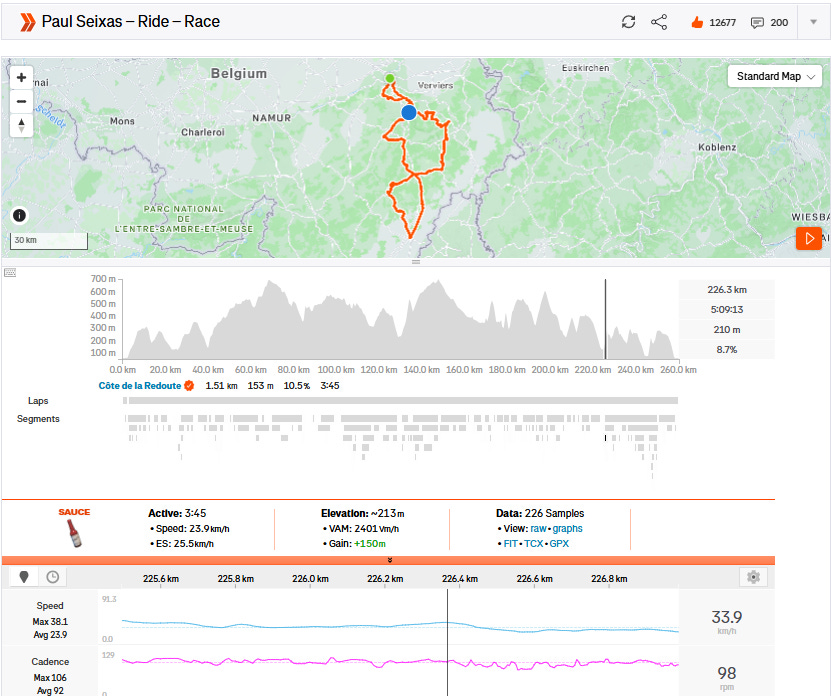
 Analysing the power from several key performances ahead of the World Championships road race.
Hi Subscribers,
Ever since my time at Velonews abruptly ended in 2022, I’ve wanted to work with Zach Nehr again. One of the most analytical and data-driven freelance writers out there, he’s carved out a niche by poring over and interpreting power data, both after races and ahead of major showdowns.
You’ve probably seen his name on plenty of titles over the last few years, so it’s a huge honour to have him contribute to the Substack. And it’s only possible because of all your amazing support.
Here, Zach looks at the key favourites for this weekend’s men’s road race, using power data, historical performances, the course profile, and potential race scenarios to assess the contenders for what could be the most hotly contested men’s Worlds in years.
With Tadej Pogačar out of the picture, the door is wide open for a new world champion. But who has the numbers to win? Paul Seixas, Isaac del Toro, Remco Evenepoel, Tom Pidcock, Wout van Aert and Mathieu van der Poel all bring very different strengths to the Montréal course.
Don’t forget: there’s a 20% sale on all annual subscriptions right now, so if you want to read my in-depth, behind-the-scenes coverage through the end of next season, now’s a great time to sign up.
Daniel 🫶
For the first time in three years, someone other than Tadej Pogačar will win the men’s elite title at the UCI Road Race World Championships. After the Slovenian crashed out of the Vuelta a España, questions arose about the rest of his season. But it wasn’t long before it was announced that Pogačar wouldn’t race in 2026, opening the door for another rider to win the rainbow jersey in Montréal.
Twitter 🟢 — Instagram 🔴 — Bluesky 🔵
The list of favourites is long and diverse, a testament to the wonderful course design in Canada’s second-largest city. The Worlds is held on a course nearly identical to the city circuits used in the Grand Prix Cycliste de Montréal. It is an Ardennes-style parcours with hardly a flat metre of road over the entire 13.2-kilometre loop. The circuit’s main feature is the 1.7km climb of the Voie Camillien-Houde, with an average gradient of 7.9%. It isn’t as steep as La Redoute in Liège-Bastogne-Liège, but it isn’t as shallow as the Oude Kwaremont, either. That makes it the perfect climb for an all-rounder, someone who can generate massive power for four minutes, not just pure w/kg.
The elite men will complete 12 repetitions of the Voie Camillien-Houde, preceded by a flat 100-kilometre run-in. This suggests the early break will likely form on flat roads rather than on the climb, and fatigue will be lower than on a parcours that consists mainly of hilly roads. The closest comparison is Liège-Bastogne-Liège, which featured 4,365 metres of elevation gain in this year’s 252-kilometre edition. That is a bit more climbing than the Montréal Worlds, which has 3,595 metres of elevation gain over 273 kilometres.
Crucially, both races feature decisive four-minute climbs in the final hour of racing: Liège-Bastogne-Liège has the Côte de La Redoute and Côte de Roche aux Faucons, while the Worlds features three reps of the Voie Camillien-Houde in the final 40km alone. When we start thinking about the Worlds road race favourites, we have to look at Liège-Bastogne-Liège and the GP de Montréal.
Browse the top 10 finishers in each of these races, and you’ll find riders capable of producing world-class four-minute power after 5+ hours of racing. Names like Isaac del Toro, Paul Seixas, Tom Pidcock, Remco Evenepoel, and Quinn Simmons come to mind. But the list of Worlds favourites runs much deeper.
The final climb up the Voie Camillien-Houde tops out 9km from the finish of the Worlds road race. From there, riders will fly down Montréal’s rolling, twisty roads before the uphill sprint to the line. The course is made for attackers, but not necessarily for lightweight climbers. You need lots of watts to win in Montréal, and that’s exactly what we’ll see from riders like Mathieu van der Poel, Wout Van Aert, and Mads Pedersen. These riders are 10-15 kg heavier than del Toro, Seixas, and Evenepoel, but that is not an automatic disadvantage in Montréal.
Take Quinn Simmons, for example. The American weighs about 73kg, but that didn’t stop him from finishing third and fourth in the 2025 and 2026 GP de Montréals. Simmons even attacked on the penultimate climb, the Voie Camillien-Houde, in this year’s GP de Montréal, pushing 535w (7.4w/kg) for just under four minutes.