
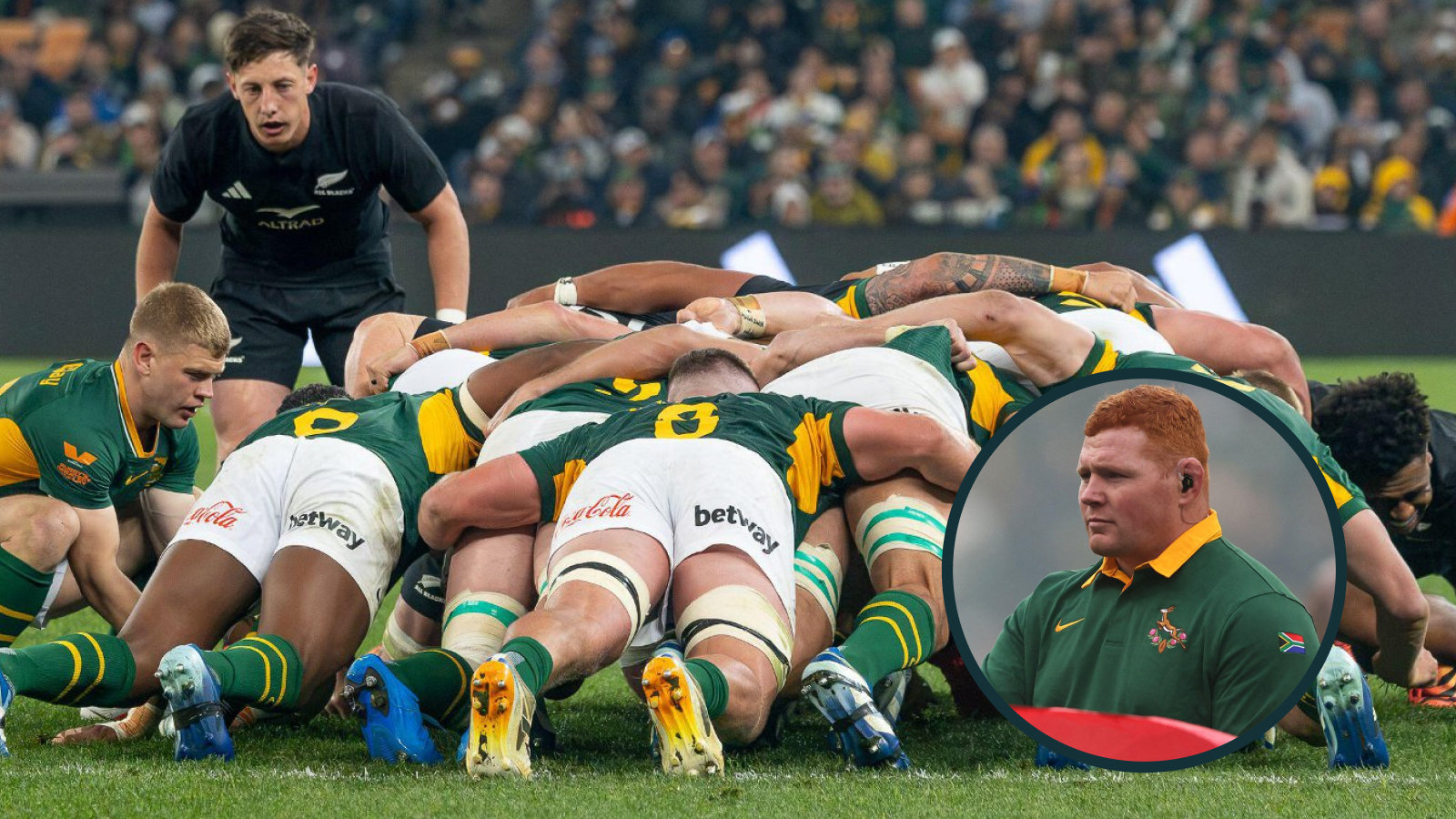
Springboks legend Steven Kitshoff is the latest ex-international to voice his dissatisfaction with World Rugby’s ‘brake foot’ law and has called for it to be removed from the game.
There was plenty of debate around the scrums during the recent Rugby’s Greatest Rivalry series between South Africa and New Zealand.
During the early stages of the fourth Test in Baltimore, the All Blacks were penalised twice for scrum infringements, firstly with a free-kick and then with a long-arm penalty.
On both occasions, referee Karl Dickson was unhappy with their brake foot, where the hooker has one foot positioned in the middle of the tunnel prior to engagement.
After that match, All Blacks senior assistant coach Neil Barnes said “no one gives a s*** about” that law.
World Rugby initially introduced the ‘brake foot’ law four years ago and stated at the time that it is designed to create more stability and reduce axial loading – the pressure on the head and neck.
Former Wallabies hooker Jeremy Paul recently said the ‘brake foot’ law is not safe and described it as “dangerous as hell” and ex-Springboks loosehead prop Kitshoff, who retired last year due to a serious neck injury, has similar views on the matter.
During a combined episode of the Rugby Unity and For The Love Of Rugby: South Africa podcasts recently, former All Blacks head coach Steve Hansen raised the topic of the ‘brake foot’ law while discussing the issue of teams finishing matches with disproportionate numbers of players on the field due to yellow cards for head contact incidents.
‘It’s just a nightmare’
“It’s the same problem with this brake foot and the scrums,” he said. “Oh man, it’s just a nightmare. I mean, someone’s going to get seriously injured shortly, and who’s going to take responsibility for that?”
Kitshoff echoed Hansen’s sentiments and urged for the ‘brake foot’ law to be eradicated from the game.
“Yeah, I think it was brought into the game to try and keep the game safer, but these guys I speaking often to Malcolm (Marx) and the hookers at the Springboks, they’re putting themselves in such an uncomfortable position by keeping the brake foot forward, and they just can’t get into that snap, they can’t get into a good scrumming position,” he revealed
“So the brake foot was brought in to make the game safer, to control the distance of the scrum, to not over lean, put too much pressure on the neck.
“But now, say the Springboks got a big engagement and they get across the line quite aggressively, other teams need to find a way to almost manage that first initial impact and that first initial drive.
“So, I think the brake foot needs to change again. I think it needs to go back to where it was. Normally, a hooker can have both feet back because actually the props and the hookers, they keep their space very well.0
“The locks do a great job on keeping the guys back. So there is a clear bind and a bind process to keep the weight across, but then having that brake foot in such a weird spot is difficult and almost the refs forget about it for a while and then all of a sudden, you just start seeing them get pinged again.
‘The brake foot needs to go’
“So, for me, the brake foot needs to go out of rugby, especially in the senior and the professional era or phase of rugby.”
Ex-Wallabies head coach Ewen McKenzie agrees and said due to the ‘brake foot’ law, there are several scrums where a “contest” between opposing forward packs does not take place.
“I’m not a fan of the brake foot because all it’s doing is giving the referee a default option to go for the free kick penalty and the scrum doesn’t even happen,” he explained.
“I mean, I get it if you have a scrum penalty and there’s actually a scrum going on, but we don’t even get into the scrum and they’re calling the break foot and so it goes to a free kick.
“We don’t get the contest, which is part of the game. So I think you can talk about the break foot or we can go back and make the hookers strike for the ball. If they have to strike for the ball, they’ll have an entirely different position and they’ll be hanging off their props, right, because they’ve got to get themselves in a position to strike for the ball.
“So that means we’ve got to put the ball back in the middle of the tunnel and go back to the way it was and all those things weren’t relevant back in the day.
“Now, I understand we’re trying to avoid injuries and things like that, but I don’t know that we’ve solved that. We’ve certainly made it more of a pushing contest and the good big guy is going to beat the good little guy anyway.
“I just don’t think it’s relevant. I don’t think it’s something the referees need to be able to manage because it’s just an easy out.”
Hansen then identified the part of the ‘brake foot’ law which is the root cause of the problems which players experience.
“Well, we’ve had a brake foot though for probably four or five years. Now, all of a sudden, it’s become you’ve got to keep your heel on the ground. That’s the bit that’s causing the problem,” he said.
“We’re talking about getting rid of it. It’s been there for yonks. Keeping your heel on the ground, you’ve got to come up and over yourself and people can’t do it.
“Marx has got a sore neck. I know Cody Taylor’s got a sore neck. They’re two of the best hookers in the world and we’re risking them injury. It’s ridiculous.
“But no one wants that. Every team, I know the South Africans have, I know the All Blacks have, I know other teams up in Northern Hemisphere have spoken to the powers to be about changing it, but no one wants to change it.”