
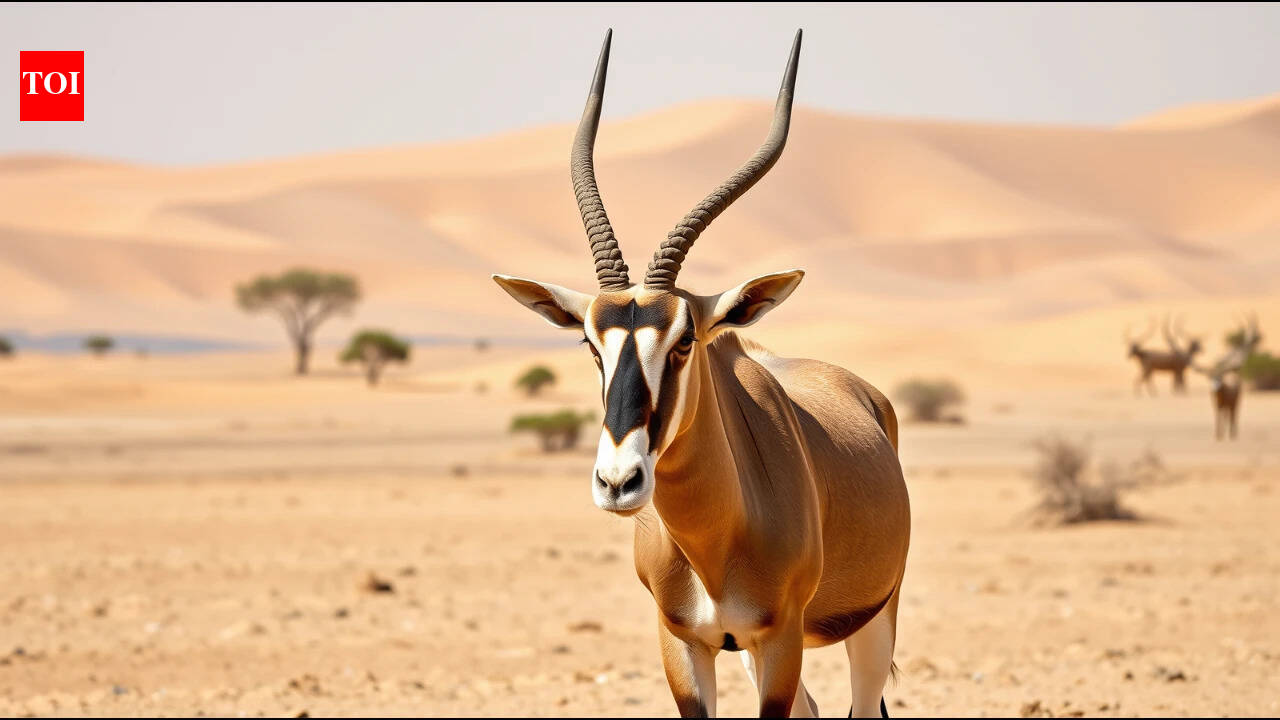
 Representative Image of a scimitar-horned oryx standing majestically in the Ouadi Rimé–Ouadi Achim Faunal Reserve landscape (AI Generated Image) The scimitar-horned oryx, a desert antelope that once ranged across parts of North Africa and the Sahel, was declared Extinct in the Wild by the International Union for Conservation of Nature (IUCN) in 2000. After decades of unsustainable hunting and habitat degradation eliminated its remaining wild populations, conservationists maintained the species in captivity while developing a plan to return it to its former range. In March 2016, 25 captive-bred scimitar-horned oryx were transported from Abu Dhabi to Chad as part of a major reintroduction programme. A decade later, the population living freely in Chad numbers more than 600 animals. The recovery led the IUCN to change the species’ classification from Extinct in the Wild to Endangered in December 2023. The reintroduced animals now live in the Ouadi Rimé-Ouadi Achim Faunal Reserve, a large protected area of Sahelian grasslands in Chad.
The antelope disappeared from the wild during the 20th century
The scimitar-horned oryx (Oryx dammah) was once widespread across the grasslands and semi-desert regions of North Africa and the Sahel. Its decline was driven primarily by hunting, while habitat degradation and other environmental pressures also contributed to the collapse of wild populations. By the late 20th century, the species had disappeared from much of its former range. The last known photograph of a wild scimitar-horned oryx was taken in Niger’s Aïr Mountains in 1980, according to the Smithsonian’s National Zoo and Conservation Biology Institute. The species was subsequently considered extinct in the wild and was formally classified as Extinct in the Wild by the IUCN in 2000. The oryx is adapted to hot, dry environments. Its pale coat helps reflect solar radiation, while physiological adaptations allow it to tolerate extreme heat and conserve water. It can obtain much of the water it needs from the plants it eats and can survive for extended periods without drinking. Both males and females have long, slender horns that curve backwards, giving the species its distinctive appearance.
Captive animals provided a chance to restore the species
Although the wild population disappeared, scimitar-horned oryx survived in zoos and private collections. Conservation organisations gradually developed captive populations that could serve as a source for future reintroduction. A key part of the effort was the creation of a genetically diverse “world herd” in Abu Dhabi. The herd brought together animals with ancestry from captive populations in the United States, Europe and the United Arab Emirates. This captive population provided the animals needed to begin rebuilding a wild population after the species disappeared from its natural range. The reintroduction effort involved the Environment Agency-Abu Dhabi, Sahara Conservation, the Government of Chad and international organisations including the Smithsonian’s National Zoo and Conservation Biology Institute, the Zoological Society of London, the Royal Zoological Society of Scotland, Saint Louis Zoo and Fossil Rim Wildlife Center.
The first oryx returned to Chad in 2016
In March 2016, 25 scimitar-horned oryx were transported by aircraft from Abu Dhabi to Chad. The animals were taken to the Ouadi Rimé-Ouadi Achim Faunal Reserve, marking the return of the species to the country after decades of absence. Following their arrival, the animals were kept in pre-release enclosures to acclimatise to their new surroundings before being released into the wider reserve. The programme also used GPS satellite collars to monitor the animals’ movements and survival.The first release consisted of 23 individuals. The aim was not simply to place captive animals in the reserve, but to establish a self-sustaining population capable of reproducing in the wild. The first scimitar-horned oryx calf born in Chad was recorded in December 2016. Further releases followed as conservationists sought to strengthen the founding population and expand the species’ presence across the reserve.
Wild-born calves drove the population’s recovery
Reproduction became central to the success of the programme. Instead of relying entirely on animals brought from captivity, the population began growing through births inside the reserve. Sahara Conservation’s records show that hundreds of captive-bred oryx were subsequently transported to Chad as part of the reintroduction programme. In 2023, the organisation reported that 285 captive-bred oryx had been brought to Chad since 2016, while more than 500 calves had been born in the wild and the population had reached at least 600 animals. The programme continued to add captive-bred animals. In November 2024, another 50 scimitar-horned oryx were transferred from Abu Dhabi to Chad, bringing the total number reintroduced since 2016 to 385, according to Sahara Conservation’s year-end account.Sahara Conservation’s 2024 Annual Report also recorded 580 oryx born in the wild by that point. However, because the organisation’s more recent public project page describes the figure as “over 500,” this article uses the more conservative formulation rather than presenting 580 as the current total. The recovery has not been without setbacks. Sahara Conservation reported that unusually hot conditions during the late dry season in 2024 caused significant wildlife mortality. More than 100 scimitar-horned oryx, mainly young and newly released individuals, were estimated to have died during a July survey. The organisation said the population showed signs of resilience after the rains returned.
The species is no longer classified as extinct in the wild
The recovery led to a major change in the species’ official conservation status. In December 2023, the IUCN moved the scimitar-horned oryx from Extinct in the Wild to Endangered on its Red List. Sahara Conservation reported that the wild population had exceeded 600 animals by the end of 2023, surpassing the programme’s original target of 500.The change in classification does not mean that the species is no longer threatened. It remains Endangered, and its continued survival depends on protecting the recovering population and the habitat in which it lives. The animals are monitored through a combination of satellite tracking and field surveys. Conservation teams track their movements, reproduction, distribution and survival across the reserve.
Protecting the reserve remains central to the recovery
The return of the scimitar-horned oryx to Chad has involved long-term cooperation between the Government of Chad, the Environment Agency-Abu Dhabi and international conservation organisations. The work combines captive breeding, animal transfers, field monitoring, satellite tracking and habitat protection. The Ouadi Rimé-Ouadi Achim Faunal Reserve provides the landscape in which the reintroduced population can live and reproduce. The wider conservation programme also includes efforts to manage the reserve for multiple species and work with local communities.In August 2026, Sahara Conservation marked 10 years since the return of the scimitar-horned oryx to Chad, describing the anniversary as a milestone in the long-running restoration programme. A decade after the first animals were transported back to Chad, the scimitar-horned oryx is no longer a species surviving only in captivity. More than 600 now live freely in the reserve, including animals born there. Its change in IUCN status from Extinct in the Wild to Endangered marks a major shift in its conservation history, while continued monitoring and protection of its habitat remain essential to maintaining its recovery.