

There is no agreed definition of rural crime. Data relating to rural crimes is not routinely published in different parts of the UK.
The PSNI does produce updates on both agricultural and rural crimes specifically focused on burglaries, robberies and thefts.
The latest PSNI data (focused on burglaries, robberies and thefts) cover the 12 months ending in June this year and indicate that both agricultural and rural crimes showed small increases year-on-year.
The longer-term trend is downward. Recorded rural burglary, robbery and theft in NI have fallen by 44.5% since 2010-11, while agricultural crimes are down 78.1% over the same period.
FactCheckNI was unable to find robust data about the number of recorded crimes in different regions of the UK.
However, major insurer NFU Mutual produces annual Rural Crime Reports based on insurance claims that provide estimates of the costs of rural crimes across the UK and in different regions.
According to their latest annual report, the total cost of rural crime in the UK fell from £44.1m in 2024 to £41.5m in 2025 – but costs rose in three of the UK’s 12 regions (including Northern Ireland).
In a press release published on 6 September to mark the start of Rural Crime Week, UUP MLA Diana Armstrong claimed:
“Rural crime cost Northern Ireland an estimated £2.2 million last year, a 24% rise, at a time when the cost across the United Kingdom as a whole fell by 6%. We are one of only a few regions going backwards. That should stop everyone in their tracks.”
On 11 September the MLA made a similar claim in a separate press release, stating:
“Rural crime is rising here while falling across the rest of the United Kingdom.”
The first claim is about the cost of crime and is supported by evidence.
The second claim appears similar but isn’t quite the same, addressing the level of crime rather than its cost.
While there is evidence indicating that rural crime levels rose last year in Northern Ireland and fell in Great Britain, over the past 15 years there is strong evidence that rural crime in NI has significantly declined.
The evidence about a rise in the cost of rural crime from last year comes from major rural insurer NFU Mutual, which produces an annual Rural Crime Report.
The latest such report was published in May and found that the total cost of rural crime in the UK in 2025 (based on data from insurance claims paid out by NFU Mutual) was £41.5m, down 6% from the equivalent figure of £44.1m in 2024.
Costs fell in nine of the UK’s 12 regions, but increased in North East England, Scotland and Northern Ireland. The proportionally largest increase occurred in Northern Ireland, where costs rose by 24%, from around £1.8m to around £2.2m.
Across the UK in general there is not a huge amount of reliable police or national statistical data about rural crime, and the data that does exist does not allow for suitable comparisons between regions.
However, the PSNI does produce updates about both agricultural and rural crimes focused on burglaries, robberies and thefts.
Incidences of both agri and rural crimes have dropped significantly in the past 15 years, although both saw small increases between 2024-25 and 2025-26.
For more information, read on.
FactCheckNI contacted Ms Armstrong about this claim. No response had been received by the time of writing.
In the UK, there is no official definition of rural crime, although a 2025 House of Commons Library briefing paper suggests that it “generally relates to crime that is particularly prevalent in rural areas”, such as theft of farm equipment or livestock, fly tipping, wildlife offences or breaches or County Lines drugs offences.
It is also important to note that “constituency and police force area statistics for rural crime are not routinely published” meaning that official data on recorded rural crimes are neither straightforward to come by nor easy to use for comparisons between different nations or police jurisdictions.
Northern Ireland – agricultural, rural and urban
The PSNI does provide updates on local agricultural and rural crime. The latest bulletin was published on 30 July and covers the 12-month period until the end of June this year.
It is important to note that the PSNI uses its own definitions of agricultural crime and rural crime. They are not the same thing. Moreover, not all crimes are considered in this dataset.
Agricultural crime is defined as “offences of burglary, robbery and theft where the victim is involved in an agricultural-based activity” and “where the property [including livestock] or vehicles stolen have an agricultural link”.
The PSNI use postcodes to categorise crimes as urban or rural.
Using these definitions means that not all agricultural crimes will be rural crimes (although in practice the vast majority are).
This fact check will provide details on both agricultural and rural crime in NI.
According to the latest PSNI data, in the year ending 30 June 2026:
There were 199 agricultural crimes recorded in Northern Ireland, an increase of 15 (7.54%) compared with the previous 12 months. Despite this increase, this remains one of the lowest twelve month figures for agricultural crimes since the data series began in 2010/11.
97% of agricultural crime was identified as occurring in rural settlement areas.
Agricultural crime represented less than 1% of all burglary, robbery and theft offences.
Five policing districts experienced an increase in levels of agriculture crime, while six experienced a decrease.
However, it is worth noting that over the past 15 years there has been a huge reduction in recorded agricultural crimes.
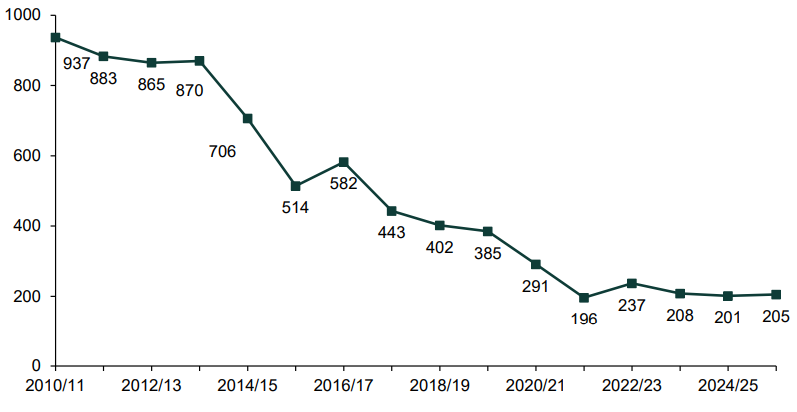
Figure 1 – source: PSNI
Please note that the police update presents two separate figures for the total number of recorded agricultural crimes in “2025-26” – 199 and 205. According to the data tables accompanying the bulletin there were 205 agriculture crimes recorded in the 12 months to 31 March 2026 and 199 in the 12 months to 30 June 2026 – hence the slight disparity in the figures noted in the bullet points above and those shown in Figure 1.
According to the PSNI:
“Burglary and robbery represented 20 per cent of agricultural crime, while theft represented 80 per cent. Since 2010/11 burglary and robbery have represented between 20 and 36 per cent of agricultural crime while theft has represented between 64 and 80 per cent.”
What about rural (and, for comparison, urban) crimes? In the 12 months to 30 June this year:
Across Northern Ireland, burglary, robbery and theft offences fell by 1.8% per cent (a drop of 402 offences). Around 15% of these crimes happen in rural areas.
The number of burglary, robbery and theft offences in rural settlements increased by 3.2% (a rise of 108 offences).
Levels of burglary, robbery and theft offences in urban settlements fell by 2.6% (510 offences).
Over the longer term, the number of recorded burglaries, robberies and thefts have been falling in both urban and rural areas.
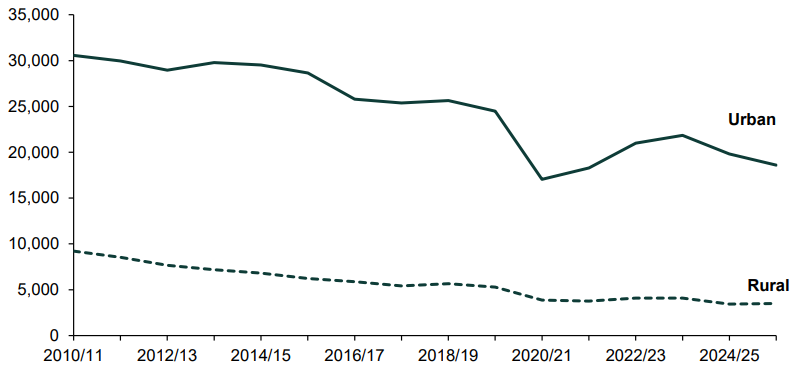
Figure 2 – source: PSNI
Over this 15-year period crimes of burglary, robbery and theft have been falling proportionately faster in rural areas than in urban ones.
In 2010-11, the number of recorded rural crimes was 8,913 while in 2025-26 the equivalent figure was 3,495 – a drop of 44.5%.
The proportion of all burglary, robbery and theft offences recorded occurring in urban settlement areas has gradually increased from 77% in 2010-11 to 85% in the last two years.
Equivalently, the proportion of these offences occurring in rural settlements has fallen from 23% in 2010-11 to around 15% in recent years.
As noted above, different parts of the UK do not necessarily produce detailed statistics about rural or agricultural crime that are readily comparable.
Crime figures for England and Wales are primarily published by the Office for National Statistics (ONS). However, major ONS crime updates do not include comprehensive data about rural (or agricultural) crimes.
ONS data tables include information on types of crimes – including burglary, robbery and theft – but this is not categorised as urban or rural (or designated as agricultural). The same is true for the data tables relating to individual police forces in the two nations.
However, focusing just on England we found ONS data on Communities and Households Statistics that includes some crime figures.
The latest Statistical Digest of Rural England was published in May this year and includes details on urban/rural splits in crime. However, the crimes considered in this dataset are much broader than the PSNI’s focus on burglaries, robberies and thefts and, as such, the data that is available is suitable for direct comparisons with NI. The report notes:
For the year ending March 2024, police recorded 59 crimes per 1,000 population (excluding fraud) in predominantly rural areas and 99 crimes per 1,000 population in predominantly Urban areas outside of London.
In predominantly rural areas, there were 3.4 more crimes per 1,000 population recorded in 2023-24 than in 2022-23.
Regarding Scotland, a Freedom of Information (FoI) response from Police Scotland published in April 2025 in relation to a request for data on the “number and types of rural crimes recorded over the last five years” provided no data, stating that “the information [requested] is not held by Police Scotland … Police Scotland does not designate crimes as ‘rural’ or otherwise.”
Overall, official crime data from police forces or via national statistics lacks a fully comprehensive data set (or even agreed definitions of rural or agri crime) and is much too patchy to allow for good comparisons between different parts of the UK.
However, these are not the only sources of data.
The National Farmers’ Union (NFU) is a major representative body for farmers in England and Wales. It also works in partnership with NFU Mutual, a member-run insurance mutual that specialises in providing cover for farmers across the UK.
NFU Mutual publishes annual reports on rural crimes across the UK. This report provides a solid evidence base to compare the extent of rural crime – in terms of financial cost, if not number of incidents – between different parts of the UK. It is presented as a source of note in House of Commons Library research and also via campaigning organisations such as the National Rural Crime Network.
The latest NFU Mutual report was published in May this year and looks at rural crime in the calendar year 2025.
However, some key differences should be noted between the crime figures in this report and those from police data or national statistics as outlined above. The most important one concerns what is being measured.
NFU Mutual does not count instances of crime, instead it calculates the estimated total cost of rural crime in each region “based on NFU Mutual claims statistics”. The report itself contains no clear definition of rural crime: FactCheckNI has contacted the organisation to ask if they use a definition but has yet to hear back. However given the details of how they calculate their figures it is clear by implication that this only relates to those crimes which can result in a claim for insurance.
Once again, this data is not suitable for direct comparisons with the PSNI figures outlined above or with the data available via the report on Communities and Households Statistics in England. These all measure different things. The PSNI and NFU Mutual figures rely on relatively narrow definitions of crime (specifically burglary, robbery and theft in the case of PSNI, while the NFU Mutual data concerns crimes that resulted in a claim for insurance, ruling out significant crimes such as many offences of violence or drugs) while the figures for England cover a much broader range.
Regardless, the NFU Mutual data does allow for comparisons between different regions of the UK based on the fact this report has a common methodology between those regions, and can show a general trend if there are changes.
The report found that the total cost of rural crimes in the UK fell by 6% between 2024 and 2025, down to a total of £41.5m. However, this overall decline was not replicated in all the regions of the UK:
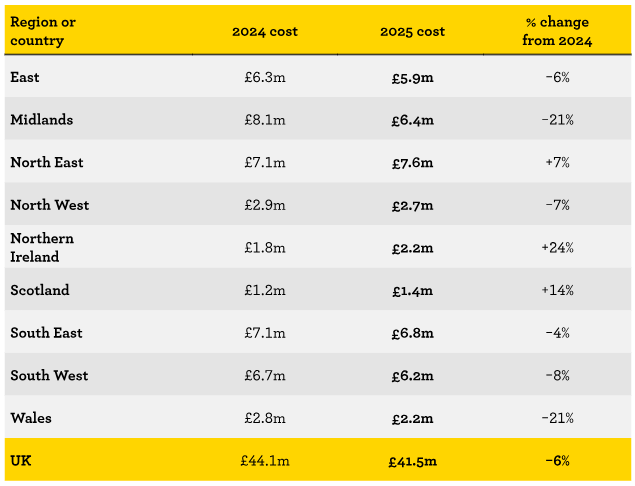
Figure 3 – source: NFU Mutual (note that these figures are rounded to the nearest £100k but the percentage changes are based on exact data)
As can be seen in this table, only three of the UK’s 12 regions saw an increase in costs of rural crime (as measured by NFU Mutual) between 2024 and 2025: North East England, Scotland and Northern Ireland.
Of those, Northern Ireland had the largest growth, with costs rising by almost a quarter – from £1.8m to £2.2m.
It seems certain that this is the report relied upon by Ms Armstrong for her claim, noting that she stated:
“Rural crime cost Northern Ireland an estimated £2.2 million last year, a 24% rise, at a time when the cost across the United Kingdom as a whole fell by 6%.”
Although this method concerns the total cost of crime rather than the number of incidents of crime (and note that it is perfectly possible for either one of these measurements to fall while the other rises), it still represents a solid metric to indicate the scale of crime.
Furthermore, the NFU Mutual reports allow for proper comparisons between different regions of the UK. Taken altogether, this provides evidence to support the claim.
Both the NFU and the Ulster Farmers’ Union (UFU) warn that incidences of rural crime could be significantly underreported.
The effect of this on any data – whether via police recorded crimes or via insurance costs as a result of crime – will depend on the scale of underreporting.
However, this is worth bearing in mind as a caveat to all the figures outlined above.