
The family of Syd Barrett and organisers Neil Jones, Mark Wilkinson and Rob Ayling have announced a programme of official events to celebrate what would have been the much-missed musician and artist’s 80th birthday and to raise money for mental health charities.
Chief among these events will be a live tribute concert at the Cambridge Corn Exchange on 10 October, which is also World Mental Health Day.
 Rosemary Breen. Picture: Keith Heppell
The show is to be headlined by Britpop favourites Kula Shaker, with additional performances from Soft Machine, Men on the Border, Diana Silveira & The Psychedelic Circus, Radhika, and Pünk Flöyd, with some surprise guests still to be announced.
One person who plans to attend the tribute concert at the Corn Exchange (the location of Syd’s last gig in February 1972), along with 29 other members of the Barrett family, is his younger sister Rosemary Breen, who is keen to help keep her beloved brother’s memory alive.
Syd, a pioneering singer-songwriter and visual artist, who in later life became something of an enigma (at least to the wider world), was born on 6 January, 1946 in Cambridge.
He sadly passed away on 7 July, 2006 at the age of 60 from pancreatic cancer.
I met up with Rosemary at Cambridge’s Quy Mill Hotel on a pleasant late summer’s day last week.
Warm, welcoming, politely spoken and very friendly, Rosemary is the youngest of the five Barrett children (three now remain – Rosemary, her brother Don and her sister Ruth), and the closest in age to Syd.
She recalled growing up in Cambridge and life with her brother, before and after fame took hold.
What would Syd, who was always known to the family as Roger, have made of all this fuss 20 years after his death and more than 50 years since he last performed in public?
“He would have laughed!,” says Rosemary. “The one thing he never ever understood was what you do if you’re a celebrity.
“He wasn’t interested and he didn’t care, and he just thought it was really hysterical that anybody thought anything like that about him.
“He never ever could get his head round the point of celebrity. He was just having fun – as simple as that. And when it stopped being fun, he stopped doing it.
“The money was never considered. It’s amazing but he just could never understand it.”
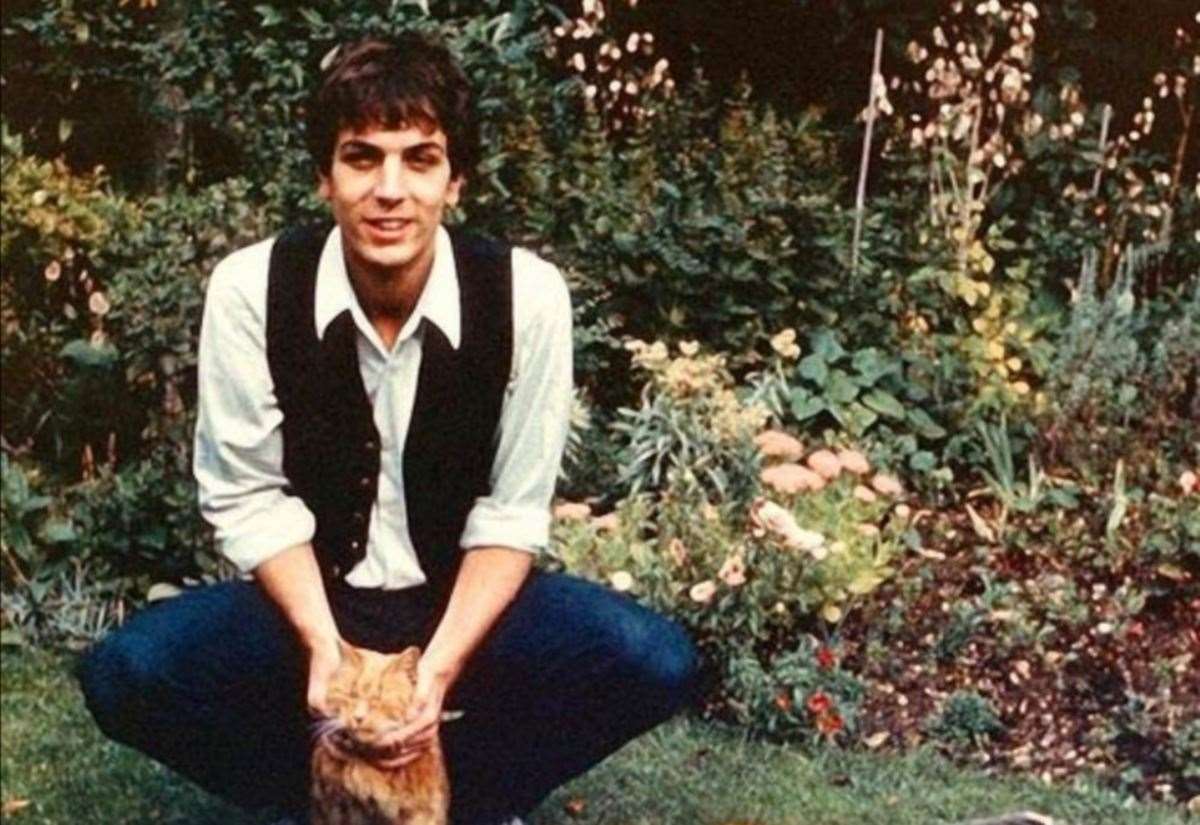
Syd with Frisky the cat
Rosemary notes that all the adulation, and the curiosity of fans to discover what had become of Syd, even after he’d long since stepped away from the limelight, “used to annoy him a bit, because people would come to the door…
“And he ended up saying ‘Syd doesn’t live here’ because that was easier – and actually it was true, and I think he knew it. So it was a bit annoying for him, but other than that he just tried to dismiss it.”
Interestingly, Rosemary reveals that it was “mainly Italian boys” who used to find out where Syd lived and then come and knock on the door, adding: “Italy have got a real thing about him…”
Looking ahead to the upcoming events, Rosemary says: “It’s very exciting; the concert was sold out virtually overnight, which is amazing, something I can hardly believe.
“The interest that there still is for Syd just never ceases to amaze me – it’s incredible, really incredible.
“The concert they’ve had to start early, because so many bands wanted to come and perform, I gather, so it’s going to be more like a festival.”
As well as the concert, there will be a major exhibition exploring Barrett’s life, art and cultural impact which will run from Saturday, 3 October to Sunday, 11 October at Openspace – 54a Cherry Hinton Road.
The gallery will be hosting some of Barrett’s original paintings and sketches, along with prints of larger works.
The exhibition will also include work by contemporary artists, including his nephew Ian Barrett, Mark Wilkinson, Mikey Georgeson, James Wilkinson, Rob Martin, Spadge Hopkins, and Justin Wiggan.
At 2pm on Friday, 9 October, there will be a talk there by Rob Chapman, author of Syd Barrett: A Very Irregular Head, widely considered to be the definitive biography of Syd Barrett.
Then, at 5pm at the same venue, Roddy Bogawa, co-director of the 2023 documentary Have You Got It Yet? The Story of Syd Barrett and Pink Floyd, will be speaking/showing a few outtakes of the film.
This will be followed by a screening of the film at the Arts Picturehouse on St Andrew’s Street at at 8.30pm. To book, go to picturehouses.com/cinema/arts-picturehouse-cambridge.
To further highlight the ongoing fascination with, when it comes to popular culture at least, Cambridge’s most famous son, a commemorative double vinyl and double CD album, titled Clowns and Jugglers: The Songs of Syd Barrett, is to be released also on 9 October.
The album features new recordings, previously unreleased material, and live performances celebrating Syd’s enduring influence.
Contributors include Kula Shaker, Martha Wainwright, Mystery Jets, Rosalie Cunningham, David Gilmour, and Nick Mason’s Saucerful of Secrets.
The album’s sleeve features one of Syd Barrett’s most iconic images and has been created by Mark Wilkinson, famous for his work with the likes of Iron Maiden, Marillion, and Judas Priest.
‘Clowns and Jugglers: The Songs of Syd Barrett’
And if all that wasn’t enough, Rosemary also informed me of a charity football match that is due to take place on the same day as the tribute concert.
“Cambridge United are playing Blackpool that day [10 October] and all the proceeds are for mental health charities,” she reveals.
“The T-shirts are sort of relating to Syd, without being too obvious, and then the T-shirts one can buy.”
On the artworks that will be on display at Openspace, which is actually near where Syd used to live, Rosemary says: “They’re mainly Syd’s work, from the family, because when he died, the family all had a piece of his work.
“So that’s all going to get together and will be on show – plus my nephew’s got some art there. And possibly other people as well.”
Reflecting on her and her brother’s upbringing in Cambridge, Rosemary says: “Cambridge was very different; it was a free place – we just walked around…
“When I think about the parking, for example, when we first had cars, Syd and I, we just used to drive into Cambridge and park outside the various pubs that were right in the middle – where Marks & Spencer is now.
“You just parked outside and went and had a drink and came out. It’s such a different place 1790410930. It was very looked after by the university; it was the university that was the boss of Cambridge.”
What would Syd have made of how Cambridge has changed just in the 20 years since his passing?
“I think he would have thought it was exciting,” replies Rosemary, “he was always up for a bit of excitement… and technology, he used to enjoy a bit of technology and building things.
“I think the Science Park and everything it involves would be really interesting [to him]. You can tell from his music that he liked to experiment.
“He would experiment with sound, he would experiment with the sounds that electronics make, so I think he’d have been really interested in what is happening now with that.”
Syd Barrett and his sister Rosemary as children
Rosemary notes that when it came to music, Syd was “really a jazz lover, all the time – it was jazz that was his thing.
“Getting involved in the Pink Floyd and all that it was just because it was fun; it wasn’t for any serious reason at all.
“If he listened to music, it would be jazz, it would be the Dave Brubeck Quartet, all that sort of thing he would listen to endlessly, and that side of music.”
Rosemary says she realised that her brother had a real talent for art “when he was about three”, noting: “He drew sensibly; he was a very young child, but what he drew made sense.
“It was drawings that you understood, which is unusual for a child, and from then on it just progressed.”
Rosemary worked as a nurse for many years and cared for Syd after he moved back to his home town from London for good in 1982, having famously walked the 50 miles back to Cambridge (“he had huge blisters on his feet!,” she laughs).
“We were always very close in our relationship,” she says, “and we had fun together. But it was mainly him doing daft things and me cheering him on!”
Syd Barrett tribute concert poster
Syd founded Pink Floyd, along with drummer Nick Mason, bass player/vocalist Roger Waters and keyboard player/vocalist Richard Wright, in 1965.
As the band’s primary songwriter and frontman, he was largely responsible for their whimsical, psychedelic and very English style – a deeply endearing style that can clearly be heard on their acclaimed debut album, 1967’s The Piper at the Gates of Dawn.
He also contributed to Pink Floyd’s second album, 1968’s A Saucerful of Secrets, and released two solo albums: The Madcap Laughs and Barrett (both 1970).
On how she first came to realise that her brother was part of a rather successful musical group, Rosemary remembers: “I was at St George’s Hospital in Tooting and I was working on the children’s ward.
“And I asked him – he was at art school, he was at Camberwell [College of Arts] – to come and paint all the glass walls.
“It was a very old-fashioned hospital and there were lots and lots of glass partitions between the wards, little six-bedded wards for the children.
“He came along and painted some wonderful pictures, and it was about then when he said to me that he’d been playing with the other people.
“Of course I knew them because they were Cambridge people – he told me then about it – and to him it was just something he’d do on a Saturday night.
“It wasn’t anything more than that because they were all at college, so they didn’t have that much time.
“Then some time later, he was on Top of the Pops. I was working and this patient had a television on and I saw him on Top of the Pops!
“I didn’t actually say anything – you didn’t in those days. As a nurse you didn’t speak out of turn – you were very strictly controlled.
“I suppose that was the beginning of seeing that he was doing something other than what he should be doing, which was being at Camberwell and working!”
Rosemary Breen. Picture: Keith Heppell
Rosemary says she went “once or twice” to see the band, including once at the Roundhouse in London.
“I was working; in those days it was half a day off a week,” she notes, “so it wasn’t as if I had much time.
“We did keep in touch, obviously, but for the first year or so they were all over the world – they worked very hard.”
Much has been written about Syd’s eventual departure from Pink Floyd in 1968, and about his drug use and subsequent struggles with his mental health.
“He was enjoying himself in the band, he really was – initially,” explains Rosemary, “but he was exhausted, it was just too much.
“They were doing too much and I think they were all worn out, quite honestly, and if you’re really tired and you’re asked to do something, you think ‘How am I going to get the energy to do it?’
“And if you’re young and drugs are available, you’re going to use them, which is very sad.”
Rosemary admits that she noticed a marked change in Syd’s behaviour.
“It was horrible,” she says, her voice tinged with sadness. “He just sort of left his character – he left ‘him’.”
She adds that elements of who he was did come back “but increasingly they got less and less. He was very damaged.
“It was still him – and I still loved him as much as ever – but it was difficult to see him not happy.”
Rosemary says there is “a lot more awareness” these days of issues surrounding mental health.
“In fact it’s really quite restricted, isn’t it?,” she says. “It’s known what the drugs will do and how much to take and when and how.
“It’s now all out there – what you should do and what you shouldn’t do, which is so much better, if that’s the way you’re going to go.”
Rosemary concludes: “Thinking about him [Syd], he was such a huge, bright person, and he just disappeared.
“And I’d love to think that young people might think about him, or what happened to him, and be very careful with what they’re doing.
“I just wish that youngsters would, if they learn about it, take it on board what happened to him and be very careful.”
I’d read somewhere previously that Syd always used to love watching television and I wondered what sort of programmes he used to enjoy watching.
“It would probably be architecture,” says Rosemary, “anything to do with old churches and things, he used to enjoy looking at and thinking about.
“When he was in Cambridge we used to go out for drives and he would be keen on looking. Sometimes I think it was only because he wanted to get home and draw them…
“But what he really loved was Saturday at 5 o’clock; there was a jazz programme on the radio and he used to make sure he would get home for that.”
Syd Barrett tribute concert poster
The Syd Barrett Tribute Concert will take place at the Cambridge Corn Exchange on Saturday, 10 October. The event is sold out, but keep checking back at cornex.co.uk as tickets may become available.
Starting earlier in the month (on Saturday, 3 October) will be the exhibition featuring Syd’s artworks at Openspace, 54a Cherry Hinton Road, which will run until Sunday, 11 October.
For more information, go to bio.site/CamOpen.space.
For more on Syd Barrett, visit sydbarrett.com.