
Last week saw two big headlines dominate the conversation. First, the explosion of Meta’s Muse and its wearable AI “Charm,” then Chinese president Xi Jinping’s state visit to Washington — both closely watched by investors for their implications on both the AI trade and the state of play between the world’s two largest economies.
Nevertheless, they didn’t do much to markets for the week, with stocks holding mostly steady despite all the headlines and market forces swirling around.
This week, however, will pivot back to the earnings calendar, with Wednesday having the biggest event.
Memory giant Micron (MU) reports fiscal fourth quarter earnings. After the waffling of the AI infrastructure trade over the past two weeks, investors will be looking for signs of continued demand in the memory trade, which has emerged as one of the most significant bottlenecks for the AI build-out.
Elsewhere in the calendar, Nike (NKE) reports on Thursday, where embattled CEO Elliott Hill will look to assuage concerns from investors that Nike has lost its spark. One thing that’ll be hot on everyone’s minds: French soccer star Kylian Mbappé’s decision to leave Nike and join the team at On (ON), a tough loss for the American sportswear giant.
On the economic data front, it’s jobs week! Last month’s report of 162,000 jobs added in August — roughly three times expectations — has set a high bar for the September numbers, where economists are looking for 100,000 jobs added in Friday’s report. Also on the calendar is PCE inflation data on Wednesday. As the Fed’s preferred metric, the PCE data is set to be closely watched for a read on whether the FOMC will indeed hike rates again in 2026.
Meta wants your data — and your trust
We have to hand it to them: Last week was Meta’s week.
Meta (META) CEO Mark Zuckerberg laid out his vision for the company’s future during its Meta Connect conference on Wednesday, and it’s all about Muse.
The social media giant’s new AI agent has quickly jumped to the top of both Apple’s App Store and Google’s Play Store, and, according to Zuckerberg, millions of people are using it.
During Connect, Meta chief AI officer Alexandr Wang demonstrated a number of use cases for Muse, ranging from the mundane, like scheduling meetings, to more impressive feats like negotiating better rates for cable service and making purchases across multiple services.
Meta is also bringing Muse to its next-generation Meta VR Glasses, allowing you to speak to a digital avatar of your agent, as well as to its Muse Charm. A handheld, purpose-built device, the Muse Charm lets you interact with your Muse agent without a smartphone or smart glasses.
The company said it will make money from Muse by taking a small cut on transactions made via the agent.
We’ll be watching this week to see if the company’s streak continues. If Meta is going to win over users beyond early adopters and AI boosters, it will need to convince people that it takes privacy and security seriously.
According to William Blair analyst Ralph Schackart, security and privacy will become a major selling point for companies marketing AI agents.
“As consumers increasingly trust AI systems with financial information, communications, calendars, purchasing decisions, and other sensitive tasks, we believe trust could become an important competitive differentiator,” he wrote in a note to investors.
 23 September 2026, United States, Menlo Park: Mark Zuckerberg, CEO of the Facebook parent company Meta, takes the stage at the Meta Connect developer conference. Behind him is a personalized mascot of the AI assistant Muse. Photo: Andrej Sokolow/dpa (Photo by Andrej Sokolow/picture alliance via Getty Images) · picture alliance via Getty Images The September jobs report has a high bar to clear
Economists and investors alike will be asking the same question in the run-up to Friday’s jobs report: Can they do it again?
After the August data far overperformed — 162,000 vs. 53,000 est. — investors will be looking to see whether the US economy can keep the good times rolling. On average, economists foresee 100,000 jobs added, and BNP Paribas, which is forecasting 90,000 jobs, says there’s reason to stay optimistic.
“We remain upbeat on the US labor market as the Fed’s tightening cycle gets underway, expecting economic momentum to push the jobless rate lower into early 2027,” Bloomberg US senior economist Andrew Husby wrote to clients. “In fact, we believe that further downside risks to the unemployment rate are under-appreciated by the consensus and FOMC projections.”
In other words, the economy may very well heat up.
But there are two sides to every story. If the report comes in below expectations, don’t be surprised, says Bank of America economist Aditya Bhave. Coming off the exceptionally strong August report, BofA is forecasting 60,000 jobs added — a disappointment for the market that would signal “payback from Aug’s unusually favorable seasonal factors,” Bhave wrote.
There’s also another wrinkle. Even if the economy is creating jobs, Americans may not be feeling as rosy as the labor market numbers may imply as consumer sentiment tanks under the weight of high prices — especially at the pump.
By the University of Michigan’s barometer, overall consumer sentiment fell to 48.1 in September, down from August’s 51.7, as consumers’ expectations for their personal finances weakened by about 10%. The reading was slightly above the Street’s expectation of 47.5.
“The short-run outlook for business conditions plunged amid renewed worries that elevated fuel prices and re-escalating trade disputes could pass through to the economy as a whole,” Joanne Hsu, the survey’s director, said in the release.
 Signage for a job fair is seen on 5th Avenue after the release of the jobs report in Manhattan, New York City, U.S., September 3, 2021. REUTERS/Andrew Kelly · Reuters / REUTERS Short-term certainty with China, but nothing long-term — yet
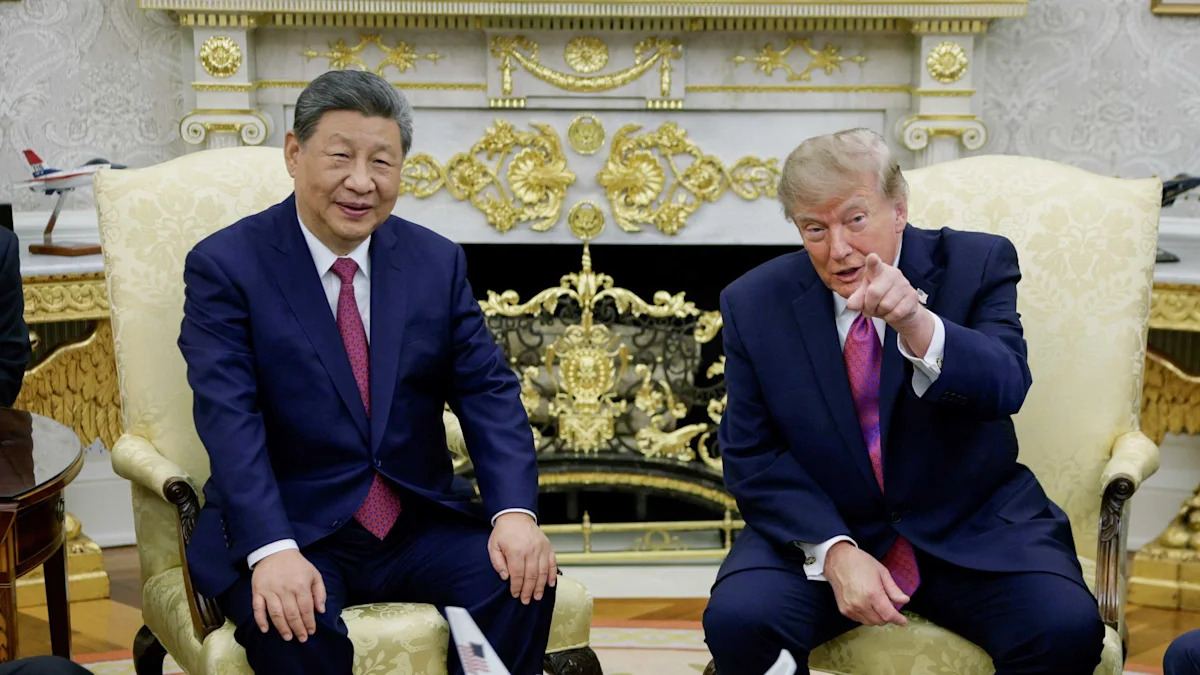
The biggest piece of news from Chinese leader Xi Jinping’s first state visit since November 2023 was the extension of the current trade truce between the US and China — set to expire in November — by two months, setting up a new early 2027 deadline for continuing trade talks.
The Chinese didn’t immediately confirm that extension, but Xi opened the summit with notably conciliatory remarks on trade. He offered his support, according to a translation, for “a constructive China-US relationship of strategic stability,” as well as increased flights “to facilitate two-way travel and trade.”
A two-month extension could be a letdown for some importers who had been hoping for a one-year extension of the trade pact announced last year in South Korea, but the continuation of current tariff rates and rules for the remainder of 2026 could add a measure of stability.
The extension of the truce will last, Bessent said on Fox News, until Jan. 10, 2027, in order to “to give us more time to see what we can do on the economic front.” He has also suggested that a bigger deal with China could be hammered out in the months ahead, a deal that he said the Chinese “came up with.” More to watch.
Meanwhile, long-term certainty is more elusive, with both sides keeping options for further provocations on the table.
Trump’s team is considering new 7.5% tariffs on China around the issue of overcapacity, but has delayed moving forward until after this week’s meeting — and perhaps until after the midterm elections, amid withering US public opinion of tariffs.
US President Donald Trump and Chinese President Xi Jinping shake hands alongside US first lady Melania Trump and Chinese President Xi Jinping’s wife Peng Liyuan after visiting the National Archives Museum in Washington, D.C., US, September 25, 2026. (REUTERS/Kylie Cooper) · REUTERS / REUTERS Economic and earnings calendar Monday
Economic data: Dallas Fed manufacturing activity, September (7.3 expected, 11.6 previously)
Earnings calendar: Jefferies Financial Group (JEF), Vail Resorts (MTN)
Tuesday
Economic data: FHFA house price index, month-on-month, July (+0% previously); Conference Board consumer confidence, September (90 expected, 89.4 previously); Conference Board present situation, September (121.2 previously), JOLTS job openings, August (7.225 million expected, 7.271 million previously); JOLTS quits rate, August (1.9% previously); JOLTS layoffs rate, August (1% previously); Dallas Fed services activity, September (4.2 previously)
Earnings calendar: Carnival Corporation (CCL), CarMax (KMX), AAR (AIR), Uranium Energy Corp. (UEC), Concentrix Corporation (CNXC)
Wednesday
Economic data: MBA mortgage applications, week ended Sept. 25 (-1.5% previously); ADP employment change, September (+70,000 expected, +38,000 previously); Retail inventories, month-on-month, August (+0.8% previously); Personal income, August (+0.5% expected, +0.4% previously); Personal spending, August (+0.9% expected, +0.2% previously); PCE price index, month-on-month, August (+0.4% expected, +0.2% previously); PCE price index, year-on-year, August (+3.7% expected, +3.7% previously); Core PCE price index, month-on-month, August (+0.3% expected, +0.2% previously); Core PCE price index, year-on-year, August (+3.3% expected, +3.3% previously); GDP annualized, quarter-on-quarter, second quarter (+1.5% expected, +1.5% previously); Personal consumption, second quarter (+3.4% expected, +3.4% previously); MNI Chicago PMI, September (51.2 expected, 47.1 previously)
Earnings calendar: Micron Technology (MU), Jabil (JBL), FactSet Research Systems (FDS), Conagra Brands (CAG)
Thursday
Economic data: Challenger job cuts, year-on-year, September (-38.5% previously); Initial jobless claims, week ended Sept. 26 (197,000 previously); Continuing claims, week ended Sept. 19 (1.719 million previously); S&P Global US manufacturing PMI, September final reading (57 previously); ISM manufacturing, September (55 expected, 54.6 previously); ISM prices paid, September (72 expected, 71.1 previously); ISM new orders, September (53.7 previously); ISM employment, September (51.2 previously); Construction spending, month-on-month, August (+0.1% expected, -0.5% previously); Omdia total vehicle sales, September (16.59 million expected, 16.76 million previously)
Earnings calendar: Accenture (ACN), NIKE (NKE), McCormick & Company (MKC), Acuity (AYI)
Friday
Economic data: Change in nonfarm payrolls, September (+100,000 expected, +162,000 previously); Change in private payrolls, September (+90,000 expected, +127,000 previously); Change in manufacturing payrolls, September (+10,000 expected, +16,000 previously); Average hourly earnings, month-on-month, September (+0.3% expected, +0.3% previously); Average hourly earnings, year-on-year, September (+3.2% expected, +3.1% previously); Unemployment rate, September (4.1% expected, 4.1% previously); Labor force participation rate, September (61.6% previously); Factory orders, August (-0.1% expected, +0.9% previously)
Earnings calendar: Trilogy Metals (TMQ)
Click here for in-depth analysis of the latest stock market news and events moving stock prices
Read the latest financial and business news from Yahoo Finance