
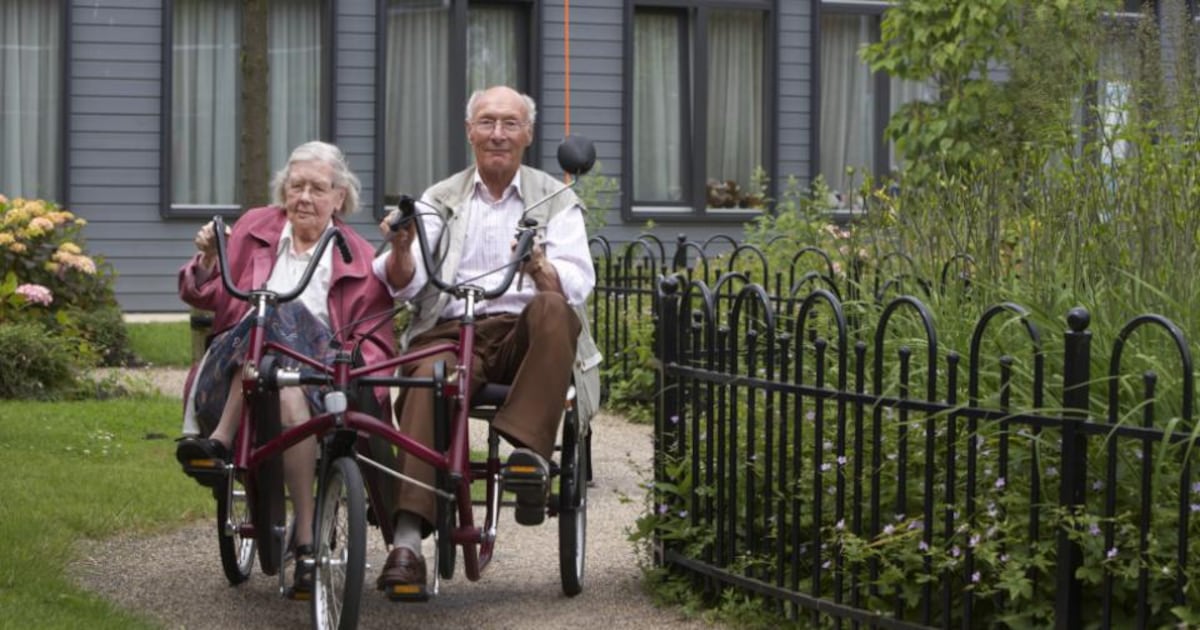
A curiosity of Irish society is that we’re great at death, but bad at ageing. Last week, the sound emanating from Nursing Homes Ireland’s (NHI) annual conference was the din of alarm bells. The Department of Health estimates that Ireland’s over-85 population will grow by 162 per cent by 2045. NHI calls this a “demographic tipping point”, and says 1,000 additional nursing home beds will be needed every year until 2040. The countries cited as being best for elderly care tend to be ones that invest heavily in home-based care. While the NHI is driving the current conversation, the scope needs to be widened beyond nursing homes.
According to OECD data, the majority of spending on long-term care in Ireland is on nursing homes.
Almost 64 per cent of Ireland’s spending on long-term care goes to nursing homes. Home care provision represents just eight per cent of the proportional spend in Ireland. In France, almost a quarter of long-term care spend is on home care providers; Korea spends a third, as does Germany and so on. Overall, Ireland has the eighth-highest percentage of spend on nursing homes when it comes to long-term care for the elderly in the OECD, but half of the countries that have a higher percentage spend on nursing homes also have a greater proportional spend on home care than Ireland.
This tells us a few things. First, there’s an imbalance with regards to the proportion of spending on nursing homes relative to other care. Second, it’s expensive. And third, we clearly need to up our home care for older people in terms of budget, resources and services. This requires resourcing, recruitment and housing. How is a low-paid carer, for example, tasked with overseeing older people in a rural community, meant to find an affordable home in a rural housing crisis?
There are lessons from elsewhere. The world’s first dementia village, Hogeweyk, opened in the Netherlands in 2009, and was designed to look like a typical Dutch village. The CareBright Community in Limerick followed aspects of this model.
Collaborative housing is another model. Last February, a new housing and support scheme development opened in Inchicore in Dublin, with social housing apartments and on-site services. The group Cohousing Communities for people over 50 proposes a model of a neighbourhood of 30 to 50 homes, where the community collectively owns and governs shared spaces and amenities, including gardens. While I think it’s fair to be reticent about co-living models when they are run by global for-profit companies, there is a middle ground where people develop a cooperative model, have shared ownership and have autonomy over how things are organised. That, of course, requires means.
In Finland, there are now around 300 family care homes. These are private homes with live-in carers, where a small number of older people live together under one roof. This means older people who may not be able to live independently can maintain a home environment that is highly personalised to individuals within a small group.
It is extraordinarily difficult in Ireland to get communal and co-operative housing projects over the line, and yet for many people they feel like a desirable future option. Everyone values community, support, neighbourliness and a vibrant social life. This needs to be facilitated in a housing context – from private financing to state funding to planning and construction – to allow people to live happily into older age.
Everyone’s needs are different, but the need for care, in all its variants, is universal. So, if everyone needs care in some capacity, we have to talk more about that as a value. That means dignity and autonomy, but it also means solidarity and connection, which can come in many forms. It can mean an enhanced culture of volunteerism in society, where there is greater intergenerational interaction, and systems that support that. But it is also about practical things that often exist outside traditional thinking when it comes to care for older people. It means much better rural transport. It means more community centres. It means more social events that aren’t so age-segregated.
It also means more representation of older people in media and public life. I am often struck by, in media coverage and political conversations about care for older people, how few voices of older people are actually featured. Yes, advocates are important, as are representative groups speaking on behalf of older people. But minority groups often repeat the mantra “nothing about us without us”. That also goes for conversations about older people. Without that, it can feel as though we are building systems in a paternalistic manner, without including the perspectives and desires – not just the needs – of those who will be navigating those systems.
Growing older is something we should talk about at all stages of life. Many middle-aged people are loath to talk about later-in-life ageing. And when it comes to the crunch and care is needed, the plans aren’t there, and there’s a scramble to the default of an institutional setting. But if we don’t talk about how we want to live when we are older, then ideas people have about how they would like to grow older won’t come to the fore. It’s an important conversation to have. It can include nursing homes, but it also needs to move beyond them.