
I pedalled up a narrow track near Caersws to reach Alan and Jill’s little farm, old friends I’d first met in India on a bike race two decades ago. Anders meanwhile was on a tight schedule of planes and trains from Athens to tiny Caersws station and I was relieved when, late at night, he arrived with huge bag, grin and hugs. Croeso Y Cymru (Welcome to Wales).
Meeting the locals out on the trail. Photo / Huw Kingston
After a big brekkie we sorted gear, eventually setting off mid-morning for Machynlleth. With sweat stinging my eyes at the top of a particularly challenging climb, I spied a bar, alas one with no beer, the owner just spring-cleaning a mobile party trailer outside his farm. We rode on, making do with a welcome mug of tea with Phil and Polly at the small hamlet of Staylittle, their base for MTB Wales, offering regular guided tours along the Traws Eryri, and sharing with us a wealth of route tips. Soon we were climbing and crossing moorlands, serenaded by skylarks, before a ridiculously fast, 15km downward spiral to Machynlleth.
With a feast of market stall goodies on board for fuel, we set off the next day on the Traws Eryri proper. Half a plan to take a hike up Cadair Idris came to nothing with the mountain shrouded in mist. One-lane roads, some tar-sealed, some dirt, took us past the impressive crag of Craig yr Aderyn.
A roadside sign sums up Welsh pride perfectly. Photo / Huw Kingston
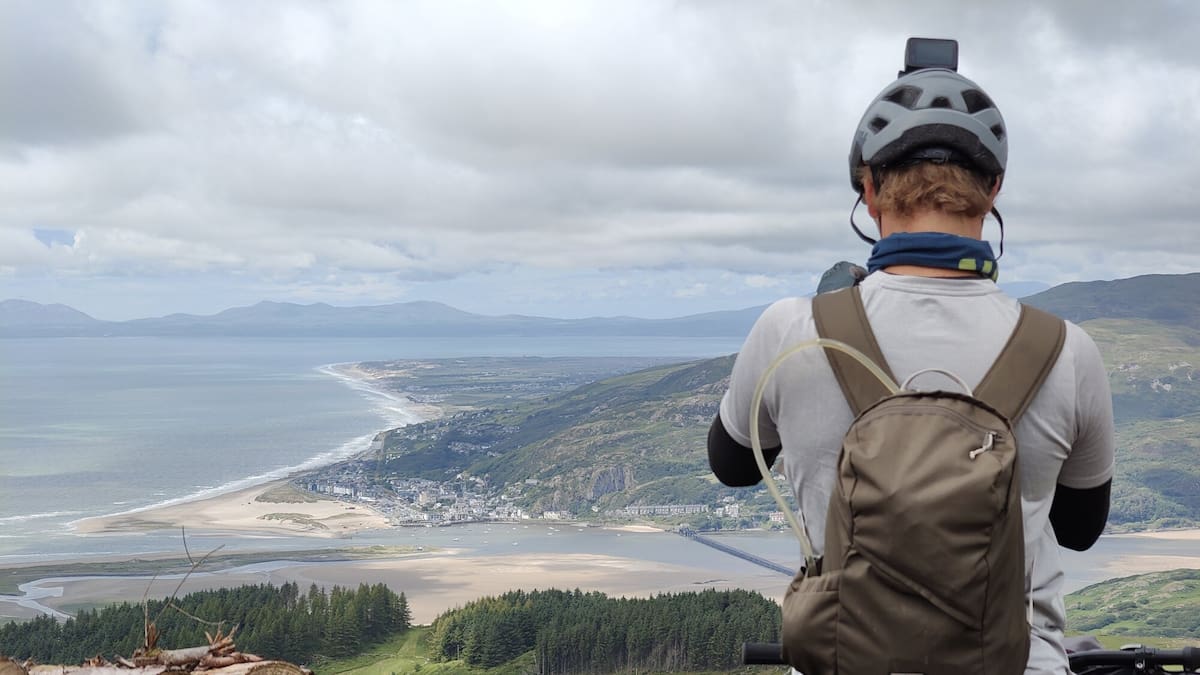
Sun now out, a long whaleback ridge gave magnificent views down to the sea, and the Mawddach estuary. Grandfather holding up grandson, grandson’s knee holding up. Magic to be together: riding, eating, laughing, chatting. A cracking descent to Dolgellau, rough at times, was our prize for earlier climbs, a shower and refreshments at the Old Ship Hotel further reward.
Anders was intrigued by the Welsh language, my own knowledge limited to early schooling. It has strong use in Wales now, but amazingly it wasn’t until 2011 that Welsh was declared an official language. At dinner that night Anders got to talking with a Welshman who rattled off with ease the name of a small village further north – Llanfairpwllgwyngyllgogerychwyrndrobwllllantysiliogogogoch.
Anders rides the whaleback ridge toward Dolgellau. Photo / Huw Kingston
If Welsh is known for long words, so it is with Welsh weather. In preparation for a promised deluge, Anders hoovered up a mammoth breakfast pancake stack. Despite the best efforts of our waterproofs, by the time we reached Coed Y Brenin bike park, our enthusiasm for riding loops of the trails was dampened.
Soon after, we wandered, in a heads-down, hoods-up state, off the Traws Eryri route. Working out where we’d gone wrong and standing by a very thin track disappearing into bushes, I smiled at Anders. “It’s only 500m through to a farm track.” Indeed, but it took an hour, squelching through flooded tussock, battling branches and boulders, hoisting bikes over walls.
Anders off track but still smiling, near Coed Y Brenin. Photo / Huw Kingston
Eventually onto solid ground, we pedalled into the village of Trawsfynydd. Dripping, we guiltily entered Siop Glyndwr, the village store. Iwan, the welcoming owner, told us to grab what food we needed and kindly offered Llety Glyndwr, his bunkhouse, to dry out. Owain Glyndwr was a Welsh nobleman whose dispute with his English neighbour 600 years ago led to a 15-year revolt aimed at ending English rule. Success came for some years; he is still held in high regard in Wales.
Thick fog now replaced the rain, views limited as we headed through the old slate mining areas of Llan Ffestiniog, then Blaenau Ffestiniog, and on to Plas Weunydd Hotel, set amid the spoil heaps of history. “Top day, Papa, I wouldn’t have missed it,” said Anders.
Mist hung low the following morning, but the forecast had promise. It was actually hugely atmospheric, weaving bikes through disused quarries, mist swirling around tall chimneys, moss-covered slate piles glistening under their grey blanket.
Then suddenly the fog cleared; hills and valleys in view. From Penmachno it was beautiful rural riding, narrow winding lanes, occasional stone cottages. One was the birthplace of William Morgan who, in the 16th century, translated the Bible into Welsh, ensuring the language survived.
Ty Mawr Wybrnant, birthplace of William Morgan. Photo / Huw Kingston
Delight interrupted briefly by a short section on the busy A470 road, but soon we were back in the forest, then open moorland. Ahead, the heart of Snowdonia, the biggest mountains in Wales. As we descended to Capel Curig, memories of so many missions – Snowdon, The Glyders, The Carneddau….
Anders rides a rocky trail down to Capel Curig. Photo / Huw Kingston
The Rocks hostel was busy with weekend visitors; dinner at the Tyn-Y-Coed Inn likewise. Very high winds were forecast for our final day, but I was hopeful we might climb a mountain, rocky Tryfan perhaps.
A strong headwind slowed progress as we rode an ancient bridleway up the Ogwen Valley. Tryfan came into view, our preferred route, the long North Ridge, silhouetted against a grey sky. Closer, by small tents in farm campgrounds, occupants were up, sorting gear, casting any doubts to the wind.
Anders leaps from Adam to Eve on Tryfan’s summit. Photo / Huw Kingston
Emboldened by others’ enthusiasm, we stashed bikes behind boulders and followed others. Up we went on rock smoothed by countless thousands of boots and hands, crampon scratches reminders of winter ascents. Surprisingly, the wind eased the higher we climbed. On the summit, a steady breeze blew, but not enough to deter Anders from jumping between Adam and Eve, two monolithic boulders, a Tryfan ritual. I was just happy to share this mynnydd, this mountain, together.
Huw and Andres, part way up Tryfan. Photo / Huw Kingston
We descended via a steep, loose track, Anders’ knee complaining, back at the bottom as we moved from hike to bike. Riding past Llyn Ogwen, we quickly descended to gritty Bethesda. From wild Wales to wasteland Wales in a few kilometres, somehow charming in contrast. Natural mountain rawness, tamed perhaps by recreation and popularity. Manufactured quarries and derelict infrastructure, an eerie wildness.
Tired legs ached as we pulled onto the hills above Bethesda, the north Wales coast stretching below. Up and down on grassy tracks, passing ancient stone circles, all in warm Welsh sunshine, before a long descent to Conwy Castle. Anders and I celebrated the end of our journey and also my birthday. If only my dear mother had made that effort.
Huw and Anders together on the summit of Tryfan. Photo / Huw Kingston
Need to know
The Traws Eryri is a 196km, four-day route best ridden on a mountain bike. It starts and finishes at Machynlleth and Conwy, both accessible by rail.
Cycling UK (www.cyclinguk.org/routes/long-distance/traws-eryri ) outlines the route and has downloadable GPS files. A printed guidebook can also be ordered. There is no specific Traws Eryri signs, and the guidebook can be confusing, so have your wits about you or book on a guided tour. There are also plenty of alternative routes.
Two Welsh businesses, MTB Wales and Adventure Tours UK, both run Traws Eryri tours and other Welsh wonders, and can advise on bike hire, luggage transport and more.
We hired a bike for Anders from Wheelism.
The writer was partly hosted by Visit Wales