
Meet two new sea spiders: one with hairy feet and red eyes, and one so poor at grooming that tiny parasites cover its body.
Sea spiders look a lot like the spiders on land, yet they spend their whole lives in the ocean. Along the coast of British Columbia, scientists know little about them.
Researchers have now formally described two species from the Salish Sea, which stretches from the Strait of Georgia to Puget Sound in Washington state.
They’re the first new sea spiders named from there in almost a century, and one of them can’t groom itself. It goes through life coated in dirt, debris, and tiny parasites of its own.
Scientists know little about sea spiders
Cormac Toler-Scott led the work as part of his master’s degree in zoology at the University of British Columbia (UBC). Three UBC colleagues joined him, including Brian Leander, who supervised the project.
Toler-Scott’s research initially focused on different question, about invertebrates, the huge group of animals without a backbone that includes sea spiders.
“I was interested in how sea spiders are impacted by climate change and human disturbance, because marine invertebrates in the Salish Sea are particularly at-risk, and I couldn’t find anything,” said Toler-Scott.
“That’s largely because people don’t know much about what species exist here and what their lifestyle is.” According to Toler-Scott, the same goes for many ocean animals with jointed legs and hard outer shells.
“In order to understand how marine invertebrates are being impacted by things like climate change, and how we can better protect these key elements of the ecosystem, we have to be able to identify them.”
Sea spiders kept odd traits
Sea spiders appeared around 500 million years ago. Their relatives include scorpions, spiders, and horseshoe crabs and, like them, sea spiders have jointed legs. Unlike spiders and scorpions, though, they never left the ocean.
They look like their land cousins with two big differences. Some kinds have as many as 12 legs, and they feed through a sucking tube called a proboscis.
Sizes vary a lot. The smallest measure less than 0.4 inch (1 centimeter), while the largest, in Antarctica, reach more than 27 inches (70 centimeters) and hunt smaller animals in deep water.
“They’ve retained some weird traits,” said Toler-Scott.
“A lot of the shallow water species are quite small, and so they’ll live as parasites on larger organisms, and they use this weird apparatus called a proboscis to suck the juices out of their host.”
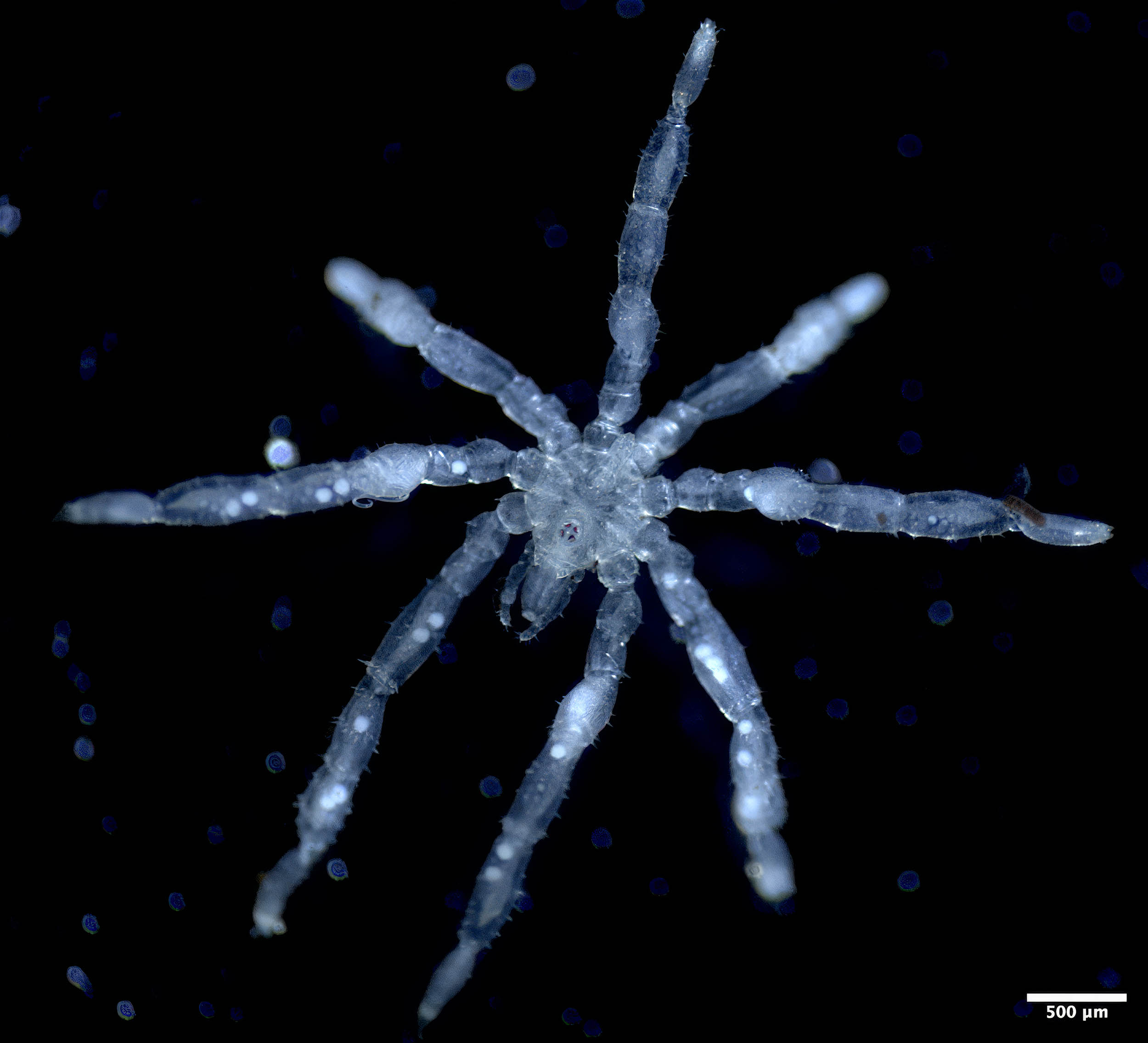 An image of the new sea spider species, Callipallene pilosuspedes. Credit: Cormac Toler-Scott. Click image to enlarge.Fathers carry the eggs
Sea spiders breathe through their skin, and it’s the males that rear the young. The ovaries of a female sea spider lie in her legs. The eggs they make pop out of a special pore.
During mating, the male uses a pair of limbs at the base of his head to scoop up the eggs. Those limbs are called ovigers. He dabs the eggs in a glue that comes from his legs, then sticks them to his own body in clusters, where they develop.
Ovigers turned out to matter for both of the new species. In one, they work well, and in the other, they don’t.
Sea spider newcomer grooms itself
Divers collected the animals between September 2023 and August 2024. They worked in water up to 59 feet (18 meters) deep, across a range of habitats near Quadra Island, Vancouver, Bamfield, and Victoria.
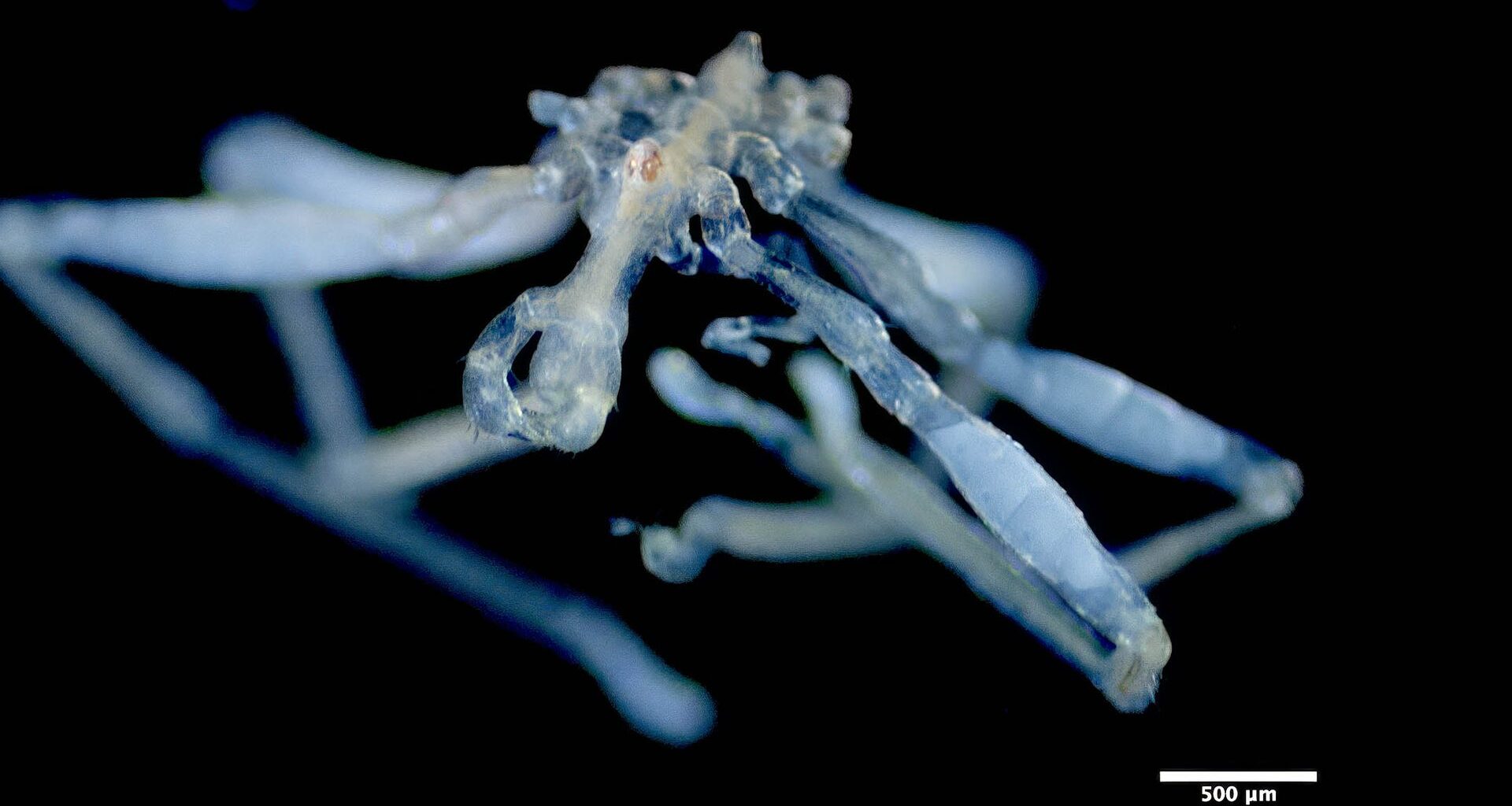
One species was named Callipallene pilosuspedes, a play on the Latin for hairy feet. Long, curved spines cover its lower legs.
It has red eyes and a short proboscis with claws that grab food before it bites. A triangle with three lips forms its mouth, and each lip bears tendrils for sensing.
This spider’s ovigers are very nimble, and they work as grooming tools. The researchers watched it under a microscope as it wrapped these limbs around its legs and cleaned itself with the comb-like spines.
So far, though, the team has found only one of these spiders.
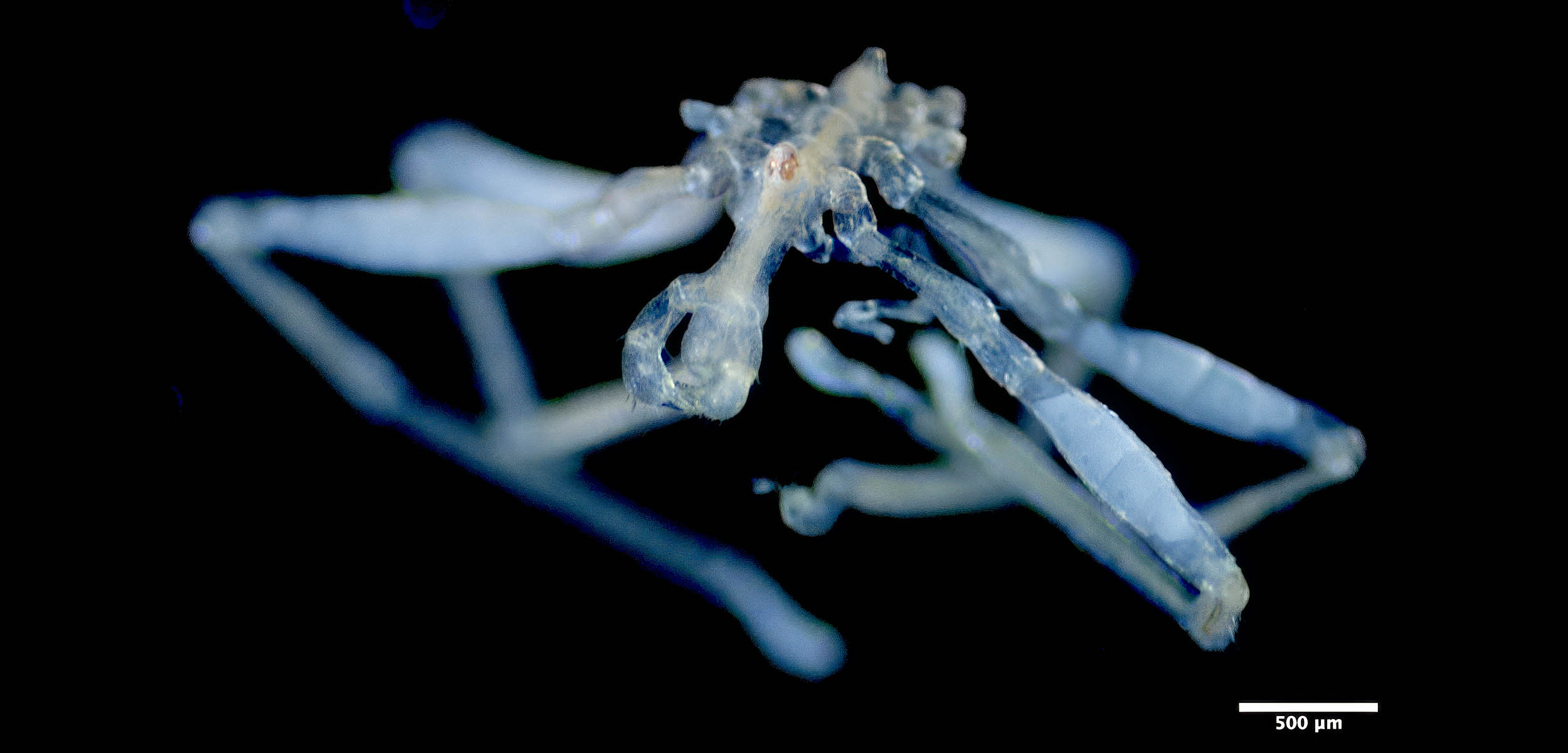 A photo of a new species of sea spider Tanystylum kiixin. Credit: Cormac Toler-Scott. Click image to enlarge.A messy sea spider hosts parasites
The researchers named the other new species, Tanystylum kiixin, after the ancient Indigenous village site near where it was first collected. The word is pronounced kee-hin, and it comes from the sound of waves crashing at the base of the site.
This spider lives closely with a hydroid called Plumularia setacea. Hydroids are small, plant-like animals that are related to jellyfish.
Its ovigers are much smaller and less nimble, so it can’t groom itself well. Mixed in with the dirt and debris on these spiders, the researchers often found tiny parasites.
Toler-Scott described the setup as “an ecosystem within an ecosystem within an ecosystem.”
Other species may be out there
The authors described the project as the first thorough scientific study of sea spiders in the Salish Sea. Besides naming two species, they described five known species again in more detail, using extremely close-up microscope images alongside DNA.
They also produced genetic data for several species that had never been sequenced before. And they made an identification guide covering the Salish Sea and the west coast of Vancouver Island.
The researchers published their results on August 26, 2026. Both new species have been registered in a global database. With only one hairy-footed spider in hand, the team can’t yet say how common that species is.
Researchers don’t know yet how climate change and human disturbance affect the sea spiders living here, which is the question Toler-Scott set out to answer.
“I only had one field season but there’s definitely more diversity out there that we haven’t documented,” he said.
With the new identification guide, future divers can sort the known species from the ones still waiting for a name.
The full study was published in the journal Organisms Diversity & Evolution.
—–
Like what you read? Subscribe to our newsletter for engaging articles, exclusive content, and the latest updates.
Check us out on EarthSnap, a free app brought to you by Eric Ralls and Earth.com.
—–