
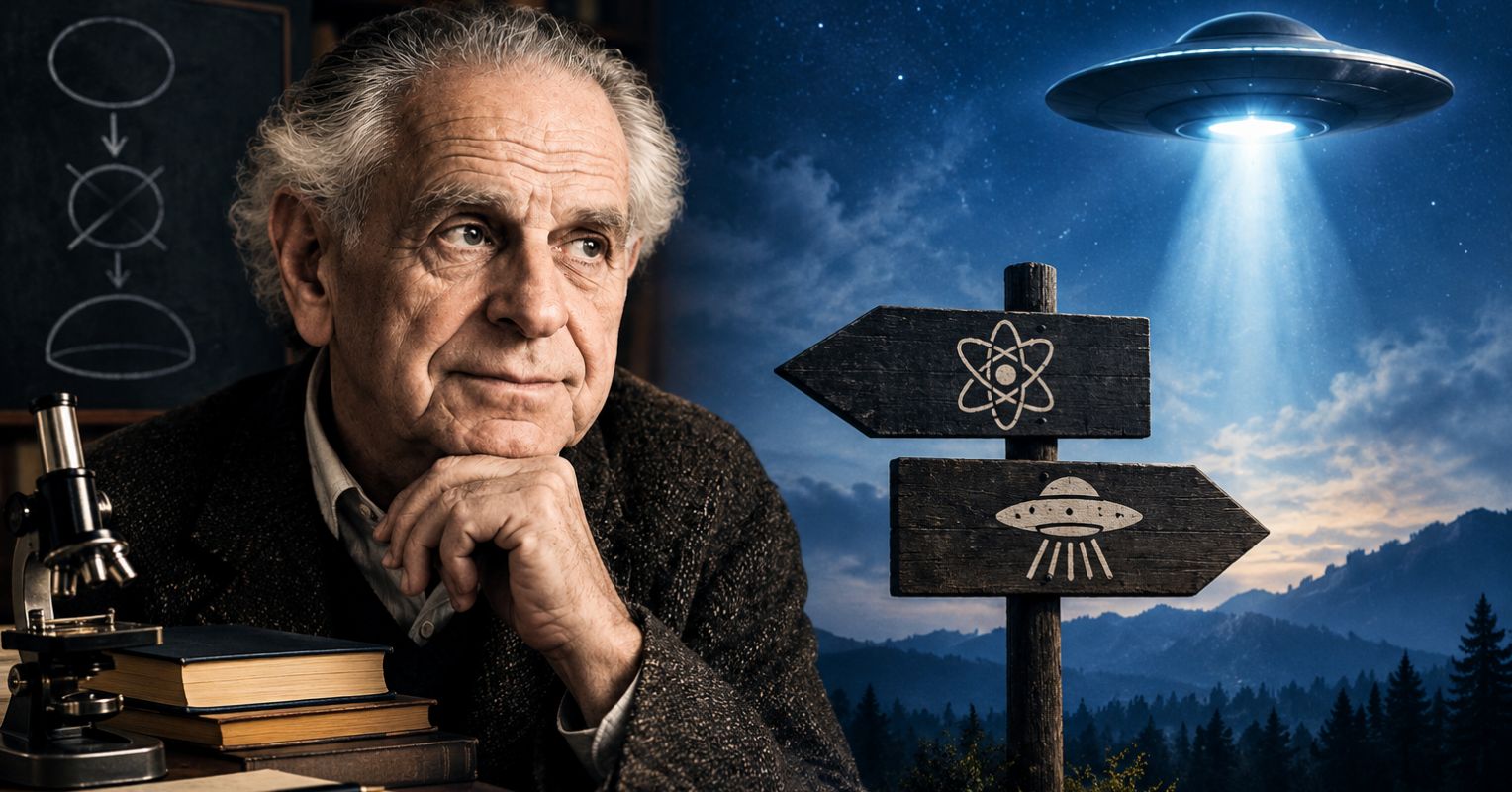
Sir Karl Popper (1902-1994), one of the most influential 20th-century philosophers of science, was determined to distinguish real science from pseudo-science. It irked him that some so-called “scientific theories” seemed as easy to confirm as vague horoscope predictions. So what would Popper have to say about ufology—the study of UFOs (or UAPs)?
The Demarcation Problem
Popper was particularly troubled by Freudian psychoanalysis, Alfred Adler’s individual psychology, and Karl Marx’s theory of history because these theories seemed too easy to confirm with simple observations and confirmation bias (i.e., the tendency to observe only what you already believe). For example, if our horoscope reports we will soon face “a significant challenge” in our lives, sure enough, something happens that fits the bill since life is full of challenges. But there should be something special about scientific theories, Popper believed—something that sets them apart as a reliable path to knowledge and scientific progress.
For Popper, that something was the criterion of falsifiability: a theory is scientific only if it is falsifiable (i.e., if it can potentially be proven false). If, by contrast, a theory can only be confirmed with cumulative supporting evidence, then it is pseudo-scientific.
A famous example of falsifiability is how Einstein’s theory of general relativity earned scientific status according to Popper’s criterion. The theory predicts that light rays from distant stars will be deflected (i.e., bent) by the sun’s gravitational field. And during a solar eclipse in 1919, astrophysicists observed that starlight was in fact deflected by the sun and by almost precisely the degree predicted by Einstein. The theory is scientific, in Popper’s sense, because it made a falsifiable prediction (it could have been that starlight was not deflected or not to the degree predicted by Einstein), though it was not in fact falsified.
Ufology and Falsifiable Predictions
From what I’ve observed, ufologists are mainly concerned with making observations and sharing information—both important aspects of any investigative enterprise, but not yet “scientific” according to Popper’s criterion.
To be scientific in a Popperian sense, ufology would need to make falsifiable predictions; for example, that the night-sky objects people are calling UFOs are really just holograms or a play of light, and not physical objects at all. Why propose this?
If UFOs are just light, this could account for many of the UFO reports, including the glowing orbs, light triangles, and strings of lights famously witnessed over New Jersey a few years ago. We haven’t made contact with these objects while they are aflight, so we cannot assume they are actual physical objects with characteristics like weight and material composition.
Crafts Unlike Any We’ve Ever Seen Before
The many UFO sightings reported by pilots while in flight typically include references to instantaneous acceleration, right-angle pivots, and absence of sound and propulsion (like exhaust plumes)—all of which sound more like apparitions than physical crafts moving through spacetime. These elusive UFOs we can see but never catch invoke the metaphorical cat chasing the laser pointer around the living room.
This UFOs-are-light hypothesis does not speak to reports of crashed crafts people claim to have touched or physical traces like purported burn marks left at UFO crash sites. But it does begin to advance one subset of so-called UFOs—the night-sky light phenomena—as a potential subject of scientific investigation.
Popper observed that “science is one of the very few human activities […] in which errors are systematically criticized and fairly often, in time, corrected” and that “in science, we often learn from our mistakes, and […] can speak clearly and sensibly about making progress there” (Popper, 1963).
Following Popper here, could our error be in assuming these UFOs are solid, physical crafts, which incites fear when they appear to fly dangerously close to our aircraft and hover above our cities and nuclear power plants? If they’re not such objects, and are instead light-based phenomena, then we could begin to make progress in other, more promising directions toward a true understanding of what these things are and why they’re here.