
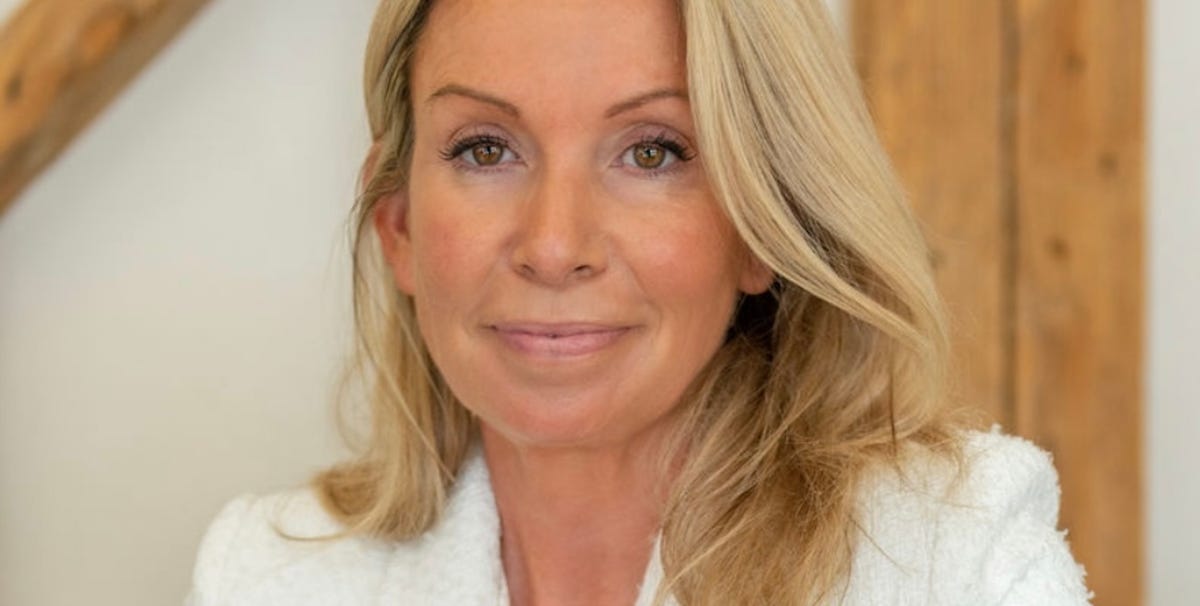
Eighteen months after being diagnosed with endometrial cancer – a type of womb cancer – Jo Brown, now 57, is feeling positive and strong.
‘I feel in a great place and honoured to be able to share my story because I don’t want anyone to feel scared, alone or uncertain about what to do,’ the Guildford-based interior design studio owner tells Women’s Health.
How Jo knew something was wrong
While Jo says she didn’t necessarily feel unwell, after experiencing some bleeding alongside ‘just a little bit of [continual] pain in my stomach’, she booked an appointment with her private gynaecologist – but only after some encouragement from her sister.
‘I hadn’t really gone through the menopause [yet], so I was at the age when bleeding was still normal,’ says Jo. ‘When you bleed, you just don’t really think anything of it.’
Still, her sister urged her to get checked, particularly because of the abdominal pain.
Following tests, however, her private doctor didn’t find anything.
‘I’ll never forget my consultant saying, “There’s absolutely nothing to worry about – this will just go away. Just forget about it, there is nothing there,”‘ recalls Jo.
‘I was elated. I was so, so happy. But the problem was that the symptoms didn’t go away.’
As the lower abdominal pain persisted and the bleeding became progressively heavier, Jo decided to book an appointment with her NHS GP.
‘The problem was that the symptoms didn’t go away’
‘I said, “Look, I’m really worried because I feel like inside my body, there’s something wrong,”‘ she remembers.
‘I just said, “I don’t know. I really trust my consultant. She’s been my gynaecologist for years and years. I really trust her and her instinct.”‘
After her GP referred her to the two-week urgent NHS cancer pathway and she underwent the same tests she’d previously had privately, ‘they found it [stage 2 high-grade endometrial cancer] straight away’.
‘That was a shock to me because I went in thinking there was nothing wrong with me – my private team had told me there was nothing wrong with me,’ she says.
Jo was then treated at The Royal Marsden NHS Foundation Trust, where she underwent a radical hysterectomy followed by ‘super-targeted’ radiotherapy every weekday for six weeks, as well as brachytherapy – an internal radiotherapy treatment sometimes used for gynaecological cancers.
‘Thank God I got a second opinion – I would have been stage 1 if they’d found it [initially], and that’s what guts me,’ she says.
Still, she tries not to dwell on it, instead choosing to focus on raising awareness of gynaecological cancers.
‘I did my best and I was let down by the first team. But I want to look at the positive and think, actually, I got cared for by an amazing team and couldn’t be in a better place now,’ she adds.
What she wants women to know
Jo’s biggest message is simple: never dismiss bleeding that could be abnormal.
If, like Jo, you’re at an age where you’re unsure what’s normal, it’s always better to get checked. You’re not wasting anybody’s time.
‘Just don’t hesitate – don’t hesitate to get advice and get help. It’s put my faith back into the NHS,’ says Jo. ‘Listen to your body and get it checked; don’t give up and always get a second opinion.’
‘Don’t give up and always get a second opinion’
According to gynaecological cancers charity The Lady Garden Foundation, endometrial cancer is most commonly diagnosed in women aged 60-79, with incidence peaking between the ages of 75 and 79.
‘Cases are rising, but if caught early, womb cancer is very treatable,’ the charity says.
Overall, Cancer Research UK estimates around 10,200 women are diagnosed with womb cancer in the UK every year, making it the fourth most common cancer in women.
‘Keep going until someone listens to you and finds out what’s wrong,’ Jo reiterates. ‘Because if you feel there’s something that isn’t right, normally there is.’
‘We need to have a better understanding of what happens to our bodies at certain times and that bleeding isn’t [always] normal,’ she adds. ‘I thought it was normal, and it’s not. That’s something I wish I’d known – that I’d been educated about the warning signs.’
Symptoms of endometrial (womb) cancer
‘Womb cancer starts in the cells of the womb, or uterus, and most womb cancers begin in the lining of the womb, called the endometrium. This is also known as endometrial cancer,’ explains Mr John Butler, consultant gynaecological oncology surgeon at The Royal Marsden NHS Foundation Trust and medical director at the Lady Garden Foundation.
‘The most common symptom of womb cancer is abnormal vaginal bleeding, particularly in women who have been through the menopause and have stopped having periods.’
Other symptoms include:
Pain or discomfort in the lower abdomenPain during sexChanges in vaginal dischargeLoss of appetite and weightTiredness or weaknessFeeling or being sickConstipationFeeling breathlessPassing urine more often than usualGynaecological cancers: know what’s normal for you
‘More than 21,000 women in the UK are diagnosed with a gynaecological cancer – ovarian, cervical, womb, vaginal or vulval – every year. However, awareness of their signs and symptoms remains low,’ says Mr Butler.
‘It’s vital that women of all ages get to know their bodies and understand what to look out for because the earlier a cancer is found, the easier it is to treat and the greater the chance of successful treatment. We know there can be fear and embarrassment around gynaecological health, but we must talk more openly.’
While September marks Gynaecological Cancer Awareness Month, these conversations need to continue all year round.
‘Abnormal vaginal bleeding or discharge is common across many gynaecological cancers, but there are other symptoms to be aware of too, including abdominal bloating, pelvic pain and needing to urinate more frequently,’ Mr Butler says.
‘These symptoms are more often than not caused by something other than cancer, which means gynaecological cancers can sometimes be overlooked. That’s why it’s so important to get anything unusual for you that persists checked by your GP.’
Since 2014, the Lady Garden Foundation has generously supported gynaecological cancer research, treatment and care at The Royal Marsden through The Royal Marsden Cancer Charity.
Hannah Bradfield is a Senior Health and Fitness Writer for Women’s Health UK. An NCTJ-accredited journalist, Hannah graduated from Loughborough University with a BA in English and Sport Science and an MA in Media and Cultural Analysis. She has been covering sports, health and fitness for the last five years and has created content for outlets including BBC Sport, BBC Sounds, Runner’s World and Stylist. She especially enjoys interviewing those working within the community to improve access to sport, exercise and wellness. Hannah is a 2024 John Schofield Trust Fellow and was also named a 2022 Rising Star in Journalism by The Printing Charity. A keen runner, Hannah was firmly a sprinter growing up (also dabbling in long jump) but has since transitioned to longer-distance running. While 10K is her favoured race distance, she loves running or volunteering at parkrun every Saturday, followed, of course, by pastries. She’s always looking for fun new runs and races to do and brunch spots to try.