
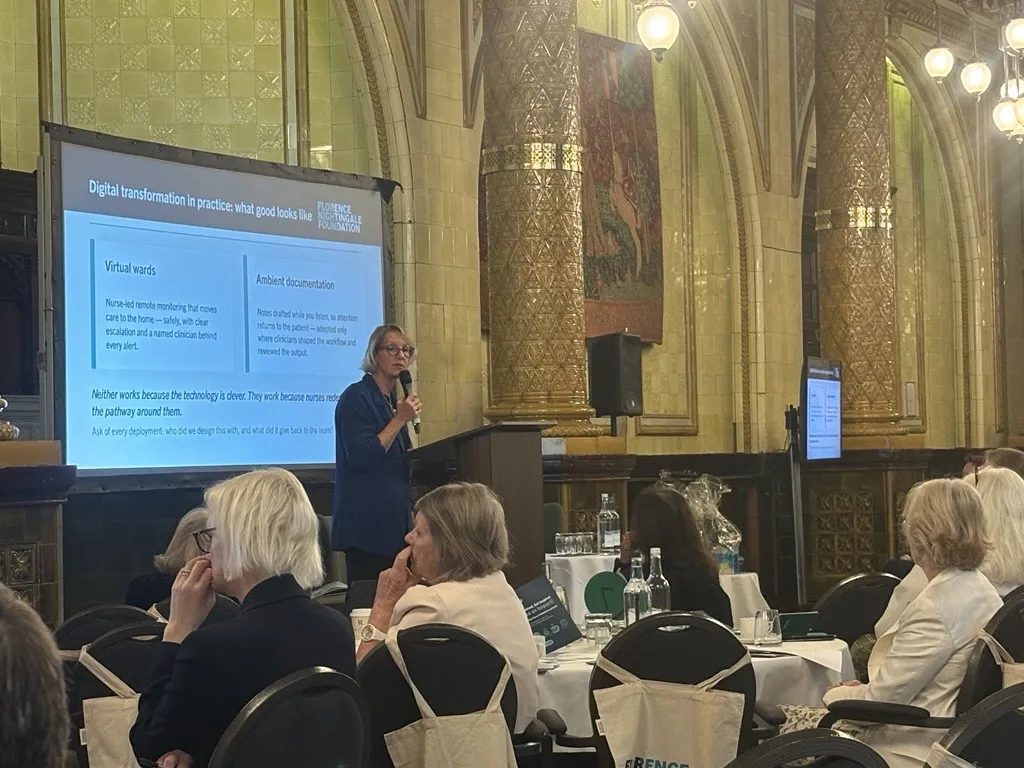
An influential technology and nursing leader has told Nursing Times that staff should be “sceptical” about artificial intelligence (AI), but warned that the workforce will lose control over how it’s used if they do not embrace it.
Dr Kathleen McGrow, chief nursing information officer for Microsoft, said that nurses must accept that AI is here to stay in order to decide how it is used in practice, otherwise forces outside of the profession “will make us use it”.
“We can’t just discount AI and say we’re not going to use it, because other people will make us use it”
Kathleen McGrow
Dr McGrow added that nurses themselves should “find answers” to the complex questions raised by AI and “leverage” the nurse-specific skills that are irreplaceable.
The nursing leader, who is from Baltimore, US, was the keynote speaker at a Florence Nightingale Foundation (FNF) technology conference, held in London today.
Ms McGrow is an ex-trauma care nurse who became a nursing leader at Microsoft in 2018 after a 20-year career in nursing innovation and informatics.
The conference’s overall discussion theme was Leadership, Innovation, and Digital Transformation, and Ms McGrow explained what her role had taught her about the future impact of AI.
The nursing leader told attendees in her speech that AI was here to stay, and as it would likely become part of everyday practice, the workforce must let it assist them.
She also said that the nursing workforce would only be assisted and amplified by the technology, not replaced.
Nursing Times caught up with her in the moments after she spoke to ask about her claims, and to find out whether nurses should still feel weary about the future of their profession.
Dr McGrow said: “AI is a whole new concept that we’re all grappling with. There’s still much to learn on how it’s going to impact us, so I think being sceptical is a positive thing.
“Being sceptical means we ask questions, and these questions are taken up to nursing leaders. But I think we need to try to find answers.
“We can’t just discount AI and say we’re not going to use it, because other people will make us use it, and we don’t want others influencing our work,” she said, referring to health care providers and health organisation leaders without a nursing background.
Dr McGrow then said the priority should be ensuring nurses themselves had a say, and that the technology assisted rather than replaced them.
“When it comes to the nurse at the bedside, [nurses] should feel comfortable with the tools that they’re using,” she told Nurisng Times.
“I think it’s important that AI should be there to assist them, to help them, not to take over what they do.”
“The nurse will always hold more wisdom because they have that ability of judgment”
Kathleen McGrow
She then said: “This is a whole new concept that we’re all grappling with: our patients are using AI, the providers are using AI, and there’s still much to learn on how it’s going to impact us.
“There’s also a lot of fear, uncertainty and doubt, and I think that’s why education is so key,” she said, adding that nursing leaders were an important part of the profession because they could educate.
“I think we need more nurses in leadership roles who are helping to define a future roadmap for the profession.”
On whether nurses will ever stop being assisted and start being overtaken by technology, Dr McGrow said nurses had an irreplaceable “wisdom” about patients and in clinical decision-making.
“The nurse will always hold more wisdom because they have that ability of judgment,” she said.
“AI will never have that gut feeling, so [nurses] have to leverage their assessment skills, and their judgment.
“You’re the one obtaining wisdom on the patient,” she said, addressing nurses directly.
The nursing leader finally shared why technological development made it important that more nurses took on leadership roles like hers.
“I think we need more nurse informaticists,” she said. “I bridge the gap. I have a lot of deep clinical knowledge, hands-on patient care, and I know enough about technology.
“I think we need more people in these roles so that we’re building this workforce with nurses, not for nurses.”
Today’s conference doubled as a graduation ceremony for members of FNF’s nursing leadership scholarship programme.
In her keynote speech, Dr McGrow urged scholars to make the opportunity AI presented count by addressing its potential risks and rewards in their upcoming leadership careers.
As well as Dr McGrow’s speech, attendees were privy to a discussion about UK midwifery with England’s chief midwifery officer (CMO) for England Kate Brintworth, and CMO for Wales Karen Jewell.