
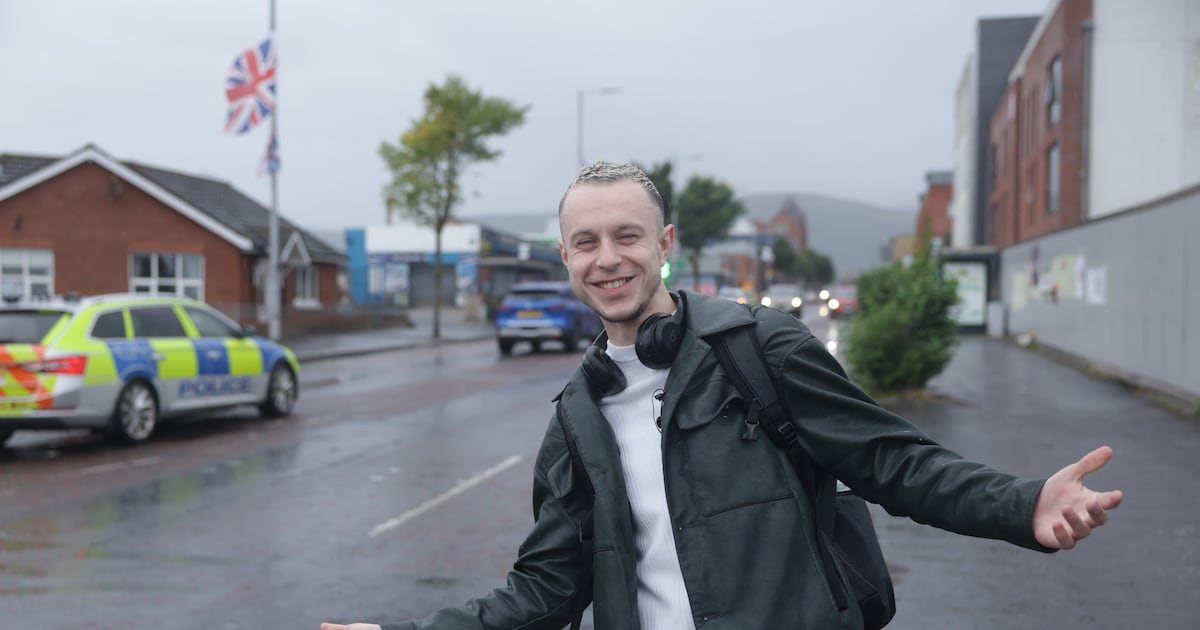
Passing cars slow to beep their horns at Gareth Spence when he walks through the rain-soaked streets of Belfast’s Shankill estate. This is the loyalist stronghold where the rapper, known as Young Spencer, grew up.
Neighbours wave from doorsteps under a sea of red, white and blue bunting as two enormous dogs attempt to jump their owner’s gate.
It was “UDA country”, says the 32-year-old, nodding his head in the direction of paramilitary murals on gable ends.
“Welcome to Loyalist Lower Shankill, 2nd Batt C Com” is daubed on a blue wall, a reference to the notorious C Company unit of the Ulster Defence Association. The unit – linked to dozens of sectarian murders – was embroiled in a bloody loyalist feud more than 25 years ago.
“There’s a big distinction between coming from here and further up the Shankill Road … some people see you as coming from down in the gutter when you’re from this part,” says Spence.
“Growing up as a teenager, you’re thinking, ‘maybe change that?’ There’s been people making change here for years. Youth workers, football coaches, community workers – these people were integral to my upbringing and how I’ve been raised.”
In August, Young Spencer performed at a sell-out concert headlined by rap group Kneecap, during the Féile an Phobail community arts festival in west Belfast.
Fans draped in Tricolours chanted his lyrics at the Uppa Falls charity gig in Falls Park. Climate activist Greta Thunberg was among many in the crowd wearing Kneecap’s signature balaclavas.
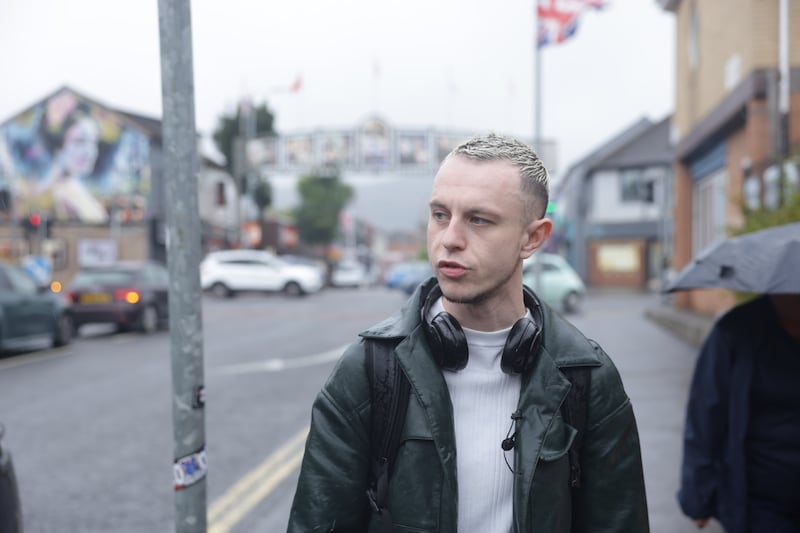 Gareth Spence says the country is changing. Photograph: Enda O’Dowd
“As a proud British born and raised Protestant from the Shankill estate, I thought I’d died and gone to Fenian heaven for about two hours,” Spence says, with a smile, about the performance.
“But do you know what, you live here with a curiosity because often when you’re young, you’re told, ‘don’t mix with themuns’. They’re not you and you’ll never mix’. So then you grow this curiosity and you confront it. I was the type that always liked asking ‘why’.”
Our interview took place before the resurrection of the Drumcree parades dispute in Portadown.
Asked about its fallout on Tuesday, Spence admits he is worried.
“It’s really starting to separate people again in my community. Tensions are rising,” he says.
He is speaking on his phone while walking up the nationalist Cliftonville Road in north Belfast.
A motorist beeps the horn and gets out of his car.
It is day three of the standoff between Garvaghy Road residents and the Orange Order.
“That’s it right there in a nutshell. I’m coming up the Cliftonville and there’s someone called Kevin – who I don’t know – pulling in to shake my hand.
“So I still feel confident in the future generation and its abilities – regardless of what happens politically.”
Back in early September, when we meet on the Shankill Road, he has rushed from his day job at a school in north Belfast. Dressed in a green leather jacket, white top and jeans, headphones hang round his neck. Four teenagers shout his name from their car outside a KFC.
Despite the visible support, Spence is aware that his association with Kneecap “divides opinion on this road”.
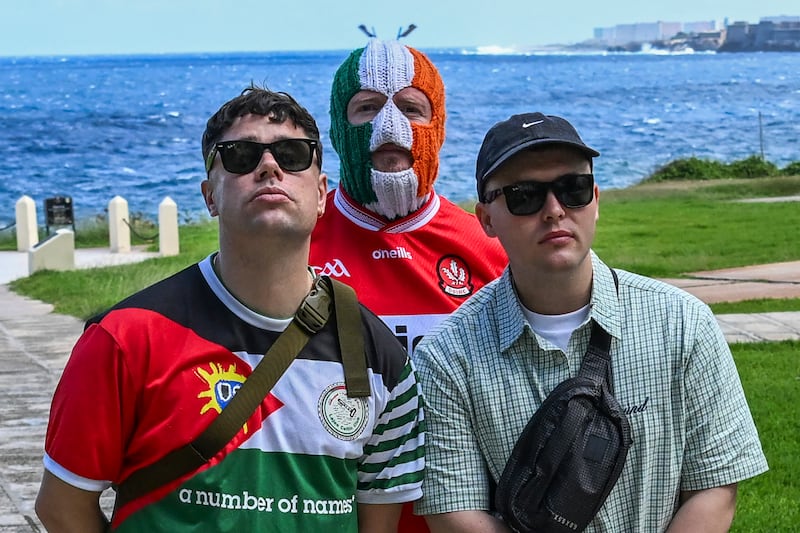 Kneecap trio Móglaí Bap, DJ Próvaí and Mo Chara. Photograph: Yamil Lage/AFP via Getty Images
It is the second time in two years he has shared a stage with the Irish language rappers. Online critics have accused him of selling out.
“Of course, there’s the hatred. There’s people who just don’t understand what you’re doing,” he says. “But mainly I’ve have been blown away by the love and appreciation. It always outweighs any negativity.”
Others have claimed he is “chasing headlines”.
“I’ve had people complain that we’re not really conscious of kids watching us. We are. That’s the whole point,” Spence says.
“We’ve had to deal with the ramifications of not growing up directly in the Troubles but being raised by families who were. That’s created a sense of worry within us. We’re just young people who have our ways and methods of how we feel we can bring people together, through music and art.
“Kneecap and Young Spencer could not have supported each other 30 years ago because somebody was dying; someone was getting killed.”
In an interview with The Irish Times earlier this year, Kneecap’s Mo Chara expressed his respect for the Shankill rapper. Their relationship highlights how young people are “moving on”, he said.
“I’m a republican and I suppose he’s a unionist. But he is being authentically himself, and I respect that. I respect him. He has this tune, P.R.O.D., and I love that. I think that’s unreal,” Mo Chara said.
Spence nods on hearing this.
[ Stevie Wonder releases four unheard tracks from Songs in the Key of Life sessionsOpens in new window ]
‘I don’t agree with everything the lads say and they don’t agree with everything I say, but I respect the artistry,” he says.
“I see more than the headlines that people want to create. I see genuine lads that’s telling their story of how they grew up in west Belfast – that’s what I’ve always related to.”
Passing a playpark close to his home in the estate – it was waste ground known as the “Muckhills” when he was a child – Spence points to a street where children from a nearby Catholic school cut through on their way home.
“These are still very much impoverished areas, it’s the same on both sides. But it’s different to when I was growing up,” he says.
“I saw two guys the other week at a car wash on the Shankill wearing Celtic tops. It was all right to me. I’m a Rangers fan but I thought, ‘go do your thing, go get your car washed’.”
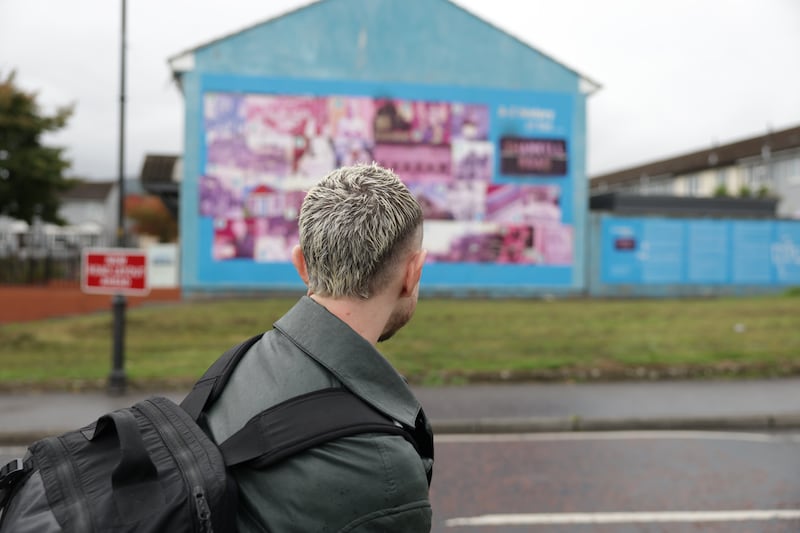 Young Spencer in the Shankill area of Belfast. Photograph: Enda O’Dowd
Not every fan of Kneecap is from the “Catholic/nationalist side,” he says.
“Kids come up in the school where I work and tell me quietly, ‘I listen to Kneecap too’. What’s amazing for me is to see that barrier start to become broken down.”
Walking up to Beatties fish bar (a “staple” of Shankill life, he says smiling, “my granny used to come here”), Spence speaks a few words of Irish. He has started taking classes.
“A lot of people say that’s not my language. But should that deter me from learning Irish? How many proud Irish Protestants have spoken it?
“I think it’s a very poetic language because there’s a multitude of things you can say for one thing.”
Windows are misted up in Beatties, where a pensioner is tucking into a chip butty and mug of strong tea before the evening rush. Union flag bunting criss-crosses the entire ceiling of the small premises.
Spence orders a pastie before returning to the Irish language.
“If you go on holiday, you always think about learning the language. To me, any genuine person would respect you for trying.
“What makes that any different from me being over in west Belfast saying to someone, Sláinte a chara, míle buíochas [cheers my friend, thanks a million]. It’s just a term of endearment.”
A so-called Peace Wall divides the Shankill Road from the Falls Road.
Built at the beginning of the Troubles, it reaches 14 metres (45ft) in height at certain points and stretches for 650 metres, making it the highest and longest of the remaining interface structures in the city.
Outside the shop, Spence acknowledges that if he “grew up 10 minutes the other side of that wall” he’d be “campaigning for the same things”.
“I’d be wanting the Irish language to be as pivotal as the English language is.”
The P.R.O.D acronym he uses on his social media platforms is a “set of principles to live by” as opposed to a label, he says, adding: “Passion, persistence, respect, resilience, opportunity to overcome, dedication, determination.”
Music has been “therapy” since his early teens. Educated in an integrated primary school – “my mum was big on us mixing with other kids” – he spent childhood summers playing cross-community football tournaments.
His parents separated when he was 12.
“I was bullied in school and things got bad. Thankfully I got help and the writing took over.”
He beams in torrential rain recalling the moment “some random person” posted a tweet suggesting a Young Spencer-Kneecap collaboration during Covid. “Kneecap reposted it. I thought it was crazy but it showed there was mutual respect.”
When the band’s film was released in 2024, Spence says he remembers watching it and “wanting to reach out to them even if nothing ever comes back”.
Fears of a backlash stopped him.
“The conflict in my own mind was that right away I knew someone from where I’m from is going to have a problem. I then wrote a song called Shankill Son. I said in the song, ‘Salute the Kneecap from P.R.O.D.’ and I knew it would start the spark and start the conversation.
“I thought then we could build some sort of connection. We don’t have to be best mates but I thought we could do something for the city that we both come from, that we’re both proud of and not be deterred from the fact that you’re from the Falls and I’m from the Shankill.”
A month before Kneecap’s pre-Christmas SSE Arena performance in 2024, he received a message from them.
“It was Móglaí Bap. He asked if I wanted to do a few songs in the SSE.
“Right away, I’m pacing up and down the livingroom, thinking ‘oh my God’. I’ve been dreaming of this … but I was worried about telling my family.
“It wasn’t normal for where I was from. And fair play to the lads, I’ll always have respect for them. Not too many people on my side have been offered an opportunity like that.”
Last month he was invited to perform at the Fleadh in Belfast. The event has been hailed a watershed moment for the city; loyalist marching bands were among those who took part.
“There was something like two billion eyes and ears on Belfast because of the Fleadh,” says Spence.
“A lot of people are going to say, ‘well that’s not us’. But I think now, the conversations we’re having, the news we’re making, the unity we’re bringing among this city and this country regardless of what it’s called – Northern Ireland or the North – is breathtaking.”
At traffic lights on our walk back down the Shankill, Spence laughs when he spots a blue sticker on a lamp-post.
“Belfast Groove Collective” is written on it.
“That’s my cousin, he’s part of it. He’s in a band,” he says. “Right now, everyone wants to be a rapper. Everyone wants to be an artist.
“The thought that you could be a rapper and perform to a sell-out crowd in Belfast was unthinkable 20 years ago. You were a laughing stock to even talk about it.
“There’s so much change.”