
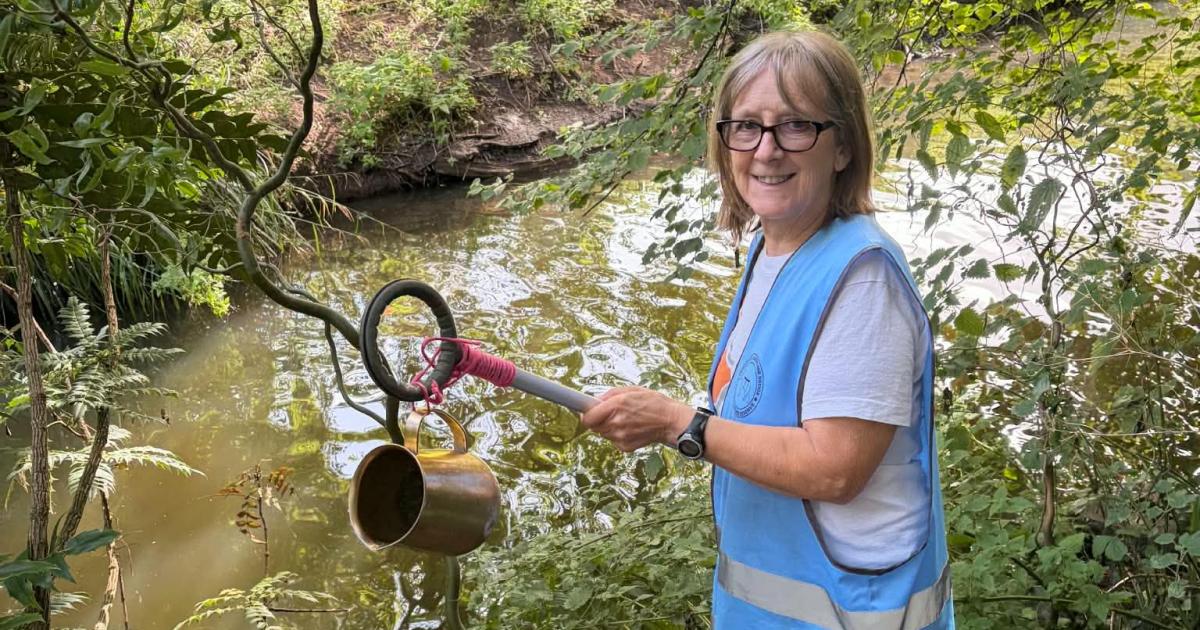
Campaigners who have been tracking pollution levels in the Laugherne Brook are pleased that work by Severn Trent to reduce phosphates appears to be making a difference.
In 2024 members of the Friends of Laugherne Brook took part in the Great WaterBlitz, a biannual campaign encouraging people to test the quality of their local body of water.
TREATMENT: Severn Trent’s water treatment works at Hallow (Image: Bertie Ballinger)
Volunteers Bertie Ballinger and Margaret Layland found nitrate levels ranged from 2mg to 5mg per litre of water, while phosphate levels were between 0.5mg and 1mg per litre.
“This was not good and a sign of poor ecological status,” said Mr Ballinger.
“Since then, we have worked with Severn Trent to get them to clean up the Laugherne Brook, and in March they gave me a tour of their facility in Hallow.
“They had, in December 2025, improved the system that filters phosphate.
“Margaret has now done the Great WaterBlitz again, with different results.”
Nitrate levels had remained between 2mg and 5mg per litre, but phosphate levels had dropped significantly to 0.05–0.1mg per litre.
Mr Ballinger called it “a dramatic change, and proof that the changes made by Severn Trent are working”.
“This is good news for environmental campaigners like myself and the Friends of Laugherne Brook.
“It shows that we can work with organisations to make meaningful change.”
He added that “more needs to be done to identify where the nitrate is entering the brook, as it is usually agricultural runoff”.
Campaigners would ideally like to see nitrate levels between 1mg and 2mg per litre, but Mr Ballinger said “certainly there is progress being made, even if overall the brook’s health is poor”.
A Severn Trent spokesperson said: “We welcome the work of community groups like Friends of Laugherne Brook and share their passion about improving the health of our rivers and waterways.
“We’re spending £2bn across the Severn Trent region to improve rivers and reduce overflow spills and are investing at many of our sewage treatment works, including in Hallow in Worcester, to cut phosphates from the waste process.
“We don’t own rivers, but care deeply about them and will continue working with communities and other sectors, including agriculture and industry, to help protect and improve them for future generations.”