
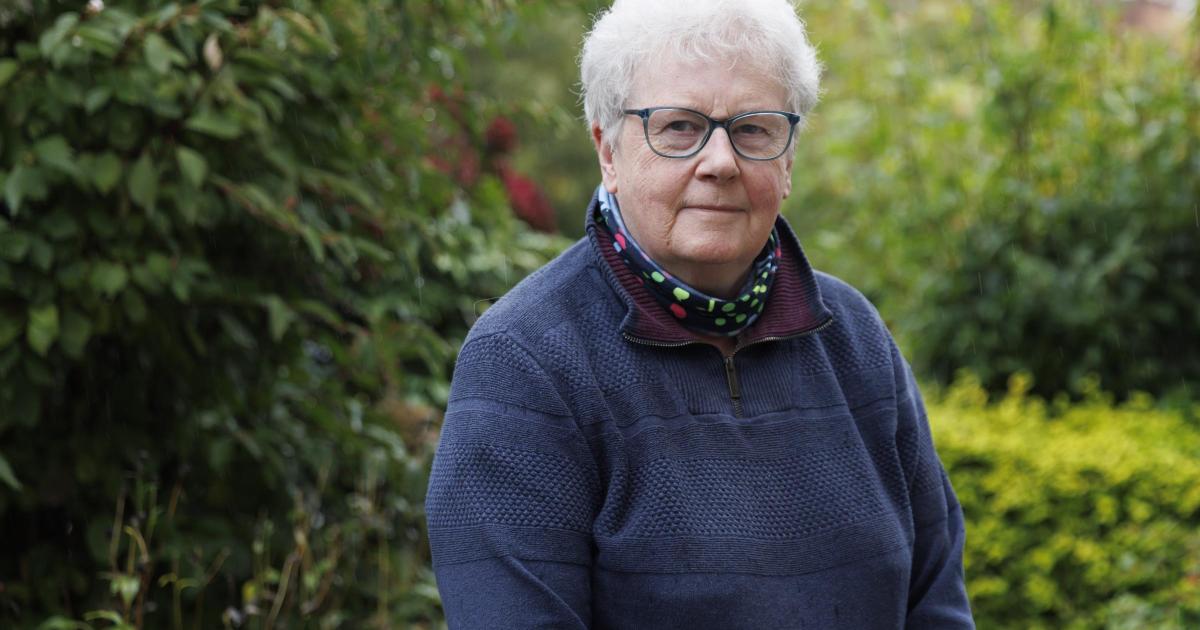
Rose Jackson, spokesperson for the Scottish Pensioners’ Forum, told the Sunday National: “Why hit us? Why not look at companies and people that have got plenty of money and maybe don’t pay enough tax because they put stuff offshore so they don’t have to pay tax on it?”
She expressed concern about the policy replicating the settlement for pensioners in Scotland, whose pensions would be affected but already benefit from free personal care.
The 76-year-old, who lives in Pumpherston, West Lothian, previously worked in the jute mills in Dundee and in the care sector where she remembers looking after “malnourished” pensioners before her retirement 17 years ago.
She said: “I think it’s absolutely ridiculous, the fact that my age group have paid in all our days.
“The majority of us, baby-boomers they call us, started working the day we left school and then 35-40 years paid into the system.”
The grandmother-of-three added that she and her husband, a retired civil servant, are comfortable and have paid off the mortgage on their home but “still have to watch the pennies”, and she worries about what changes today mean for her younger family.
Jackson also highlighted how women were disproportionately vulnerable to pensioner poverty.
Until 1970, women could be barred from joining private pension schemes if they were married or only worked part time and even after the law change, women have also struggled with pay inequality, working in lower-paid roles and taking breaks from their careers to raise children, reducing their entitlements later in life.
“If my husband wasn’t there, I would really be struggling,” she said.
Elsewhere, Marlene Halliday, a member of Pensioners for Independence, told the Sunday National that she had some sympathy with Burnham’s position, thinking it was “on the one hand fair enough”, if the change was to pay for social care: “They have to get the money from somewhere.”
But the retired chemist, who lives in Broomhill, Glasgow, said that her experience volunteering in a Citizens Advice Bureau in the city, helping impoverished older people make ends meet, had shown her how bad things can get for the elderly.
“I used to sit down with older clients; they’d come in, and probably the old age pension was their income; they don’t have another source of income,” said Halliday (below).
Marlene Halliday, a member of Pensioners for Independence, pictured in Glasgow (Image: Colin Mearns)
“People like that, who probably have worked most of their lives, are not sitting with very much, probably nothing very much, in the bank and going from week to week using their old age pension.”
And Halliday echoed Jackson’s concerns that Scottish pensioners would be hit by a policy that would not necessarily improve their situation, as they already benefit from free personal care.
She said: “The Scottish Government has managed to do that; they didn’t do it by tweaking the old age pension, because they’re not allowed to.
“They’ve managed to get that in place without doing that. Could England not manage to do that?”
Burnham’s announcement on the triple lock, a policy brought in by the Tories in 2011 and means that the state pension rises annually by the highest of wage growth, prices or 2.5%, comes after a number of high-profile politicians on the right called for it to be axed.
Tory grandees Jeremy Hunt, the former chancellor, and Michael Gove have both called for the policy to be scrapped, and Conservative frontbencher Tom Tugendhat has called the policy “unaffordable”.
In general terms, pensioners have some of the lowest levels of poverty in the UK. But the figures show that pensioners are worse-off than is commonly assumed.
Some 21% of single pensioners live in poverty, compared to 12% of pensioners in couples and 16% of pensioners overall, according to the Joseph Rowntree Foundation (JRF).
That’s compared with 22% of working-age parents in couples and a 21% range across all categories, including children.
Pensioners in poverty amount to around 1.9 million people, according to the JRF.
In a response to a report on pensioner poverty by a Commons select committee last year, the UK Government pointed out that the cost of the triple lock was expected to reach £31 billion by 2029 and that pensioner benefits cost the state £174.9bn, or 5.8% of GDP, in that financial year.
The Institute for Fiscal Studies, a think tank, has predicted that Burnham’s planned investment in social care could result in a boost of more than £1bn to Scotland’s budget – but the SNP have highlighted analysis that suggested pensioners would be £2000 worse off if the changes go ahead.
To give Westminster a better understanding of pensioners’ situation, Jackson, of the Scottish Pensioners’ Forum, had an idea. “I suggested that they should send one of the MPs up to Benbecula in the winter to live on the basic state pension and see how they get on,” she said.
A UK Government spokesperson said: “This settlement will ensure that the state pension system is built to last for the pensioners of today and tomorrow, in Scotland and across the UK.
“We are committed to the triple lock for this rest of this parliament, and the adjusted triple lock will ensure a significant rise in the state pension every year.
“It will always increase by at least the highest of 2.5%, CPI inflation or a new earnings link – and Pension Credit is available for pensioners on the lowest incomes.”