
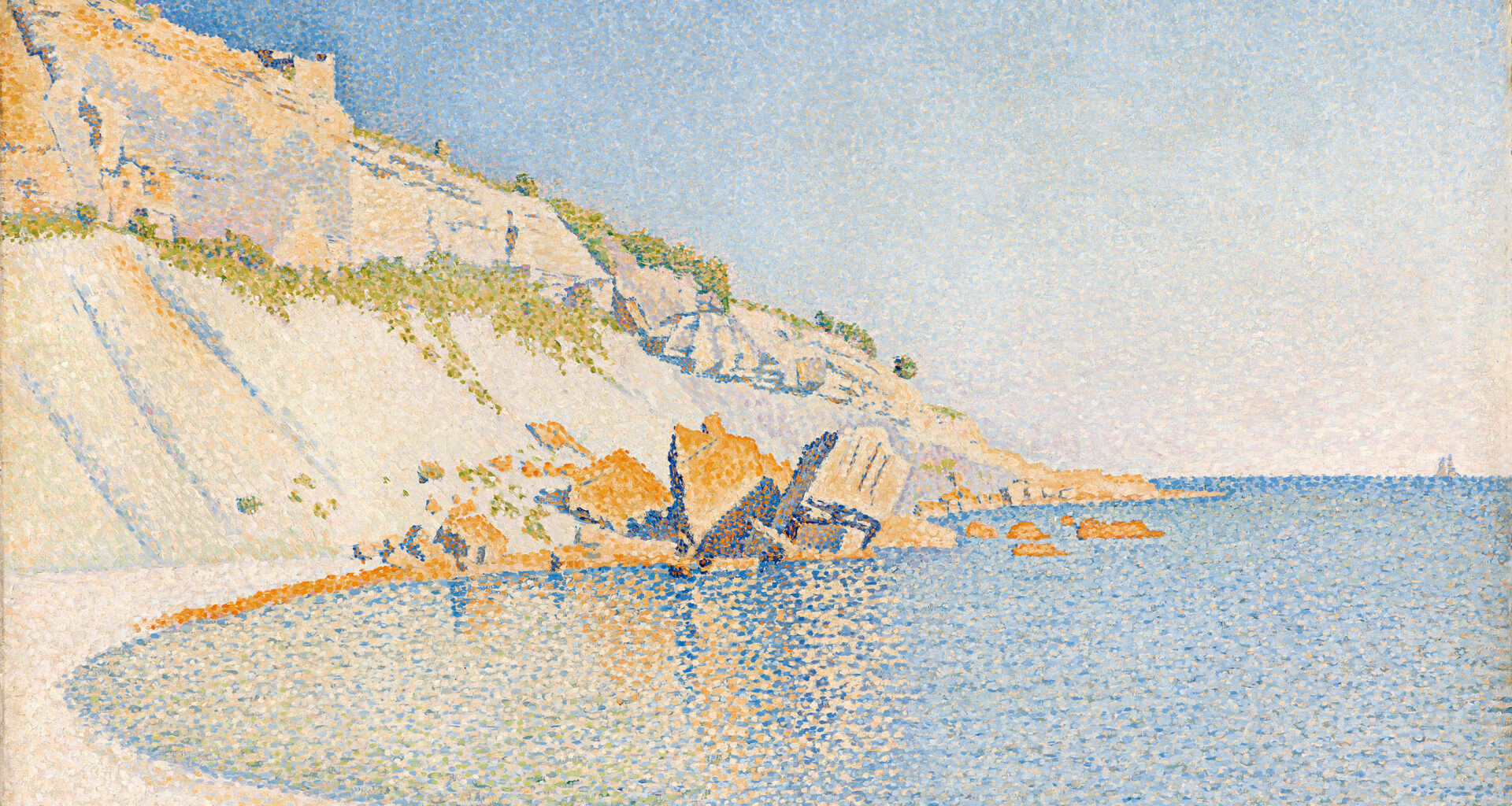
Today, the French Riviera is synonymous with sun-drenched allure, but things were very different two centuries ago. It started out as a winter destination frequented by European aristocrats drawn by the mild weather and the health benefits it was believed to bring against conditions such as tuberculosis. By the final quarter of the 19th century, Queen Victoria (of the United Kingdom), Empress Eugénie (of France) and King Leopold II (of Belgium) were all winter-time regulars.
Change, when it came, was thanks in large part to the completion of the Paris-Lyon-Méditerranée railway. From the 1870s, by changing at Marseilles, one could travel from Paris to pretty much any town on the Riviera in less than a day. Among the first artists to visit were Claude Monet and Pierre-Auguste Renoir.
Monet made two separate trips, each lasting a few months — to the village of Bordighera (just across the border in Italy) in 1884, and to the town of Antibes in 1888. The landscape paintings he produced there are among his best-loved. However, as revealed in a letter from Bordighera to his dealer Paul Durand-Ruel back in Paris, Monet struggled with the strength of the southern sunshine. ‘When surrounded with such dazzling light, one finds one’s palette rather poor,’ he wrote. ‘Here, art needs tones of gold and diamonds. In the end, I did all I could.’
It’s thought that Monet travelled to the Mediterranean in the first place upon the personal recommendation of his friend Guy de Maupassant. In the late 1880s, the author would also publish a book called Sur l’eau (‘Afloat’), in which he recounted a sailing trip he had taken along the Riviera, introducing readers to the charms of its many fishing villages, such as Sainte-Maxime and Saint-Tropez.
Other books began to appear, fuelling interest in the area. Most noteworthy is Stéphen Liégeard’s La Côte d’Azur (1887), a guidebook in which the writer coined the French term for the Riviera, even adopting it as his title. (The literal translation, ‘the Azure Coast’, reflects the clear blue colour of the sea and sky that one tends to find there.)