
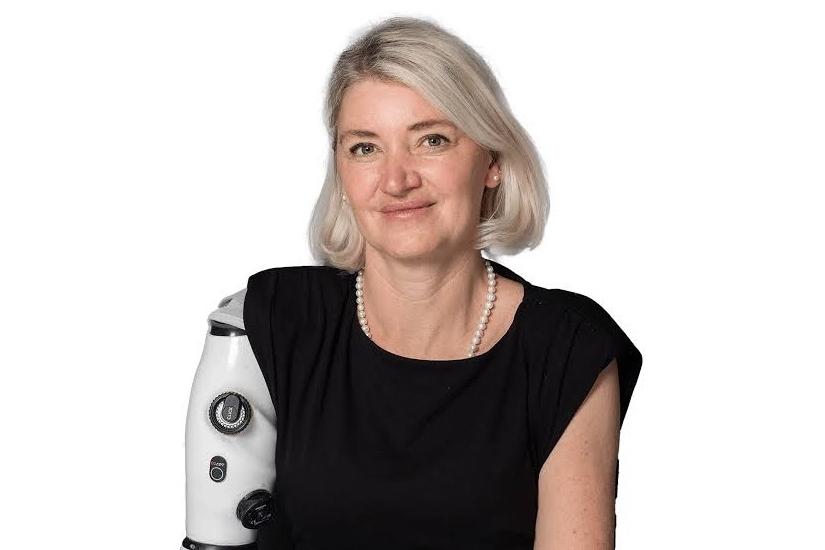
Sarah de Lagarde’s understanding of healthcare innovation is shaped by what it has enabled her to recover: independence, a working life and the freedom to pursue new ambitions. Having lost her right arm and lower right leg in a London Underground accident, she depends on advances in treatment and prosthetics every day. That experience now informs her work at Janus Henderson Investors, where she brings a personal perspective to the firm’s conversations with clients about developments in healthcare and technology.
As Brighter Future Strategist, de Lagarde works with Janus Henderson Investors’ healthcare and technology investment teams and engages with audiences about the practical significance of innovation. Her experience as a user of assistive technology complements the sector knowledge of the firm’s portfolio managers, helping connect a discussion of medical progress with the needs of the people it serves.
Speaking to Hubbis on the fourth anniversary of the accident, de Lagarde explores the questions that have become central to her professional purpose: how to assess effective innovation, why healthspan matters alongside lifespan, and how wealth can preserve access to care. Her planned South Pole expedition gives that work a further ambition, testing what medical and technological progress can make possible.
Key Takeaways
A professional purpose informed by experience: De Lagarde connects her recovery with Janus Henderson Investors’ healthcare and technology expertise to make the relevance of innovation tangible for clients.
Collaboration sits at the centre of her role: Working with portfolio managers has helped her understand the developments behind her own prosthetics and the wider possibilities for assistive technology.
Practical outcomes give innovation meaning: More intuitive prosthetic control illustrates how a technical advance can improve independence and ease the demands of daily life.
Healthspan gives longevity a clearer objective: She advocates careful assessment of products and treatments, with attention to the quality of additional years as well as their number.
Wealth can support future healthcare choices: Her experience informs a message about protecting health and preserving the resources to seek suitable care when needed.
Advocacy includes questions of responsibility: Alongside explaining the benefits of technology, she wants greater attention to data ownership, control and accountability.
Giving Innovation a Human Perspective
De Lagarde’s move into her current role began with a question about how to apply what she had learned. Before the accident, she was Global Head of Communications at Janus Henderson Investors, working across media relations and change management. She enjoyed the demands of responding to unexpected events: “Finding solutions to extraordinary events. That is what my brain was made for.” Recovery changed what she could sustain, but it also gave her a new area in which to apply that curiosity.
An open conversation with senior management allowed her to acknowledge that the constant availability required by the communications role would be difficult. At her request, her deputy took over. The firm’s willingness to discuss what she could and could not do created the space to consider a different contribution, informed by her experience and relevant to the business.
The connection emerged through the healthcare and technology teams. “Can I somehow find a role that fits in between both of these?” she recalls asking. Conversations with portfolio managers introduced her to the developments in bionics, prosthetics and medical assistive devices that would become central to her recovery. That exchange helped form the basis of her work as Brighter Future Strategist, guided by what she describes as “healthcare at the service of humans”.
Her contribution is to make the significance of those developments accessible through experience. Portfolio managers bring knowledge of the sectors and their investment opportunities; she brings an understanding of what it means to depend on the technology. Her remit includes engaging with clients, building awareness of Janus Henderson Investors’ offering and representing the firm at speaking events and industry forums. Explaining the practical applications of healthcare and technology gives her a way to introduce its expertise through subjects that audiences can relate to.
The professional satisfaction comes from being able to apply a difficult experience to something she believes has wider value.
“The job I have now, the opportunities that I’m given now, aligns very much with my core values,” she says.
She regards this as the most rewarding period of her career, reflecting both the colleagues she works with and the prospect of healthcare innovation improving people’s lives.
Understanding What the Technology Enables
Her prosthetic arm provides a concrete way into a subject that can otherwise remain technical. Electrodes on the surface of her residual limb detect patterns of muscle activity associated with different movements. Machine-learning pattern recognition can translate those signals into commands for a prosthesis. The practical benefit is a reduction in the attention needed to operate it: “I can talk and move the arm at the same time,” she says.
That improvement matters because using a prosthesis involves much more than having access to an advanced device. It must fit, respond reliably and work within the activities of the person wearing it. De Lagarde’s rehabilitation involved relearning how to walk, rebuilding weight and muscle and managing infections around her scars. Continued use requires attention to circulation, bone density and the condition of her residual limbs, as well as how her body responds to medication and different environments.
Even small changes in body size can affect socket fit. “One of the most frustrating elements is I can’t gain weight, but I can’t lose weight,” she says. Such constraints explain her interest in technology that can integrate more closely with the body. They also give her discussions with Janus Henderson Investors’ specialists a grounding in the practical problems that innovation is intended to address.
Osseointegration is one development she follows: an implant anchored in bone provides an attachment for a prosthetic limb, acting as what she calls a “docking station”. She is also interested in implanted electrodes that could capture muscle signals more clearly, and in devices intended to restore aspects of sight and hearing, including retinal implants and the continuing evolution of cochlear implants.
These interests extend the conversation beyond her own devices. Her recovery has made her attentive to how improvements in medical engineering can support a person’s capabilities. In her work with the firm’s healthcare and technology teams, that is the connection she seeks to explain: what a development means for the people who may use it, alongside the sector expertise needed to understand it.
Making the Longevity Conversation More Useful
The same focus on practical benefit shapes her view of longevity. High-profile figures such as Bryan Johnson and documentaries about efforts to live longer have helped bring the subject into mainstream discussion. De Lagarde sees the interest as an opportunity to talk about health, while remaining conscious that commercial enthusiasm can run ahead of evidence.
“There is a lot of hype around some of the products,” she says. Professional expertise is needed to assess whether particular treatments and products have a meaningful effect. Her collaboration with healthcare and technology specialists gives this part of her work a clear purpose: encouraging interest in innovation while explaining why informed scrutiny matters.
The objective itself is important.
“We don’t just want to increase our lifespan. We want to increase our healthspan as well.”
For de Lagarde, remaining active and well gives additional years their value. It is a distinction that connects medical innovation with the lives clients hope to lead, and gives the discussion a focus beyond the promise of greater longevity alone.
Connecting Wealth with Healthcare Choice
Her experience also informs the message she brings to a wealth management audience about the purpose of financial resources. “I think we forget that health is our greatest asset, and we sadly only recognise that once it’s gone,” she says. Losing capabilities she had taken for granted made protecting her remaining health an immediate priority.
The cost of prosthetics brought a further consideration into view. Exploring the treatment and devices available through public and private healthcare made her conscious of the relationship between resources and access. Her own approach to saving now includes the ability to seek suitable medical professionals and treatments, potentially outside her home country where appropriate.
That perspective gives her advocacy a connection to clients’ financial lives. She wants people to consider their health before a crisis and preserve the capacity to make decisions about care later. The message draws on her own circumstances, while opening a broader conversation about what long-term financial security is intended to support.
Work remains part of that picture for her. “I don’t believe in retirement per se,” she says. “I think I’ll probably be working until the day I keel over because it’s a psychological motivator.” Her priorities reflect a desire to remain engaged and productive, with financial flexibility helping protect that freedom as her healthcare needs evolve.
Considering Responsibility Alongside Opportunity
Reliance on assistive technology has also made questions of governance personal. As devices become more closely integrated with the body, de Lagarde wants attention paid to the data they generate, who controls it and where responsibility sits. “What belongs to you as an individual, and what belongs to a company?” she asks.
She uses an extreme hypothetical about an arm being hacked and manipulated to cause harm to ask who would be accountable. The example is intended to prompt a discussion about control when a person depends on an intelligent system. Her advocacy for healthcare and technology therefore includes both their potential to improve lives and the responsibilities accompanying their use.
Key Priorities
De Lagarde’s professional focus is to make Janus Henderson Investors’ healthcare and technology expertise more accessible to clients and wider audiences. Continued collaboration with portfolio managers helps her connect their sector knowledge with the practical questions raised by her experience. Through speaking engagements and client discussions, she wants to encourage a better understanding of how innovation can affect people’s lives and why informed assessment matters.
The themes she wants to develop are consistent: looking after health, understanding which innovations can make a useful difference, and preserving the freedom to obtain appropriate treatment. Maintaining her own health, particularly for her daughters, remains fundamental to being able to do that work.
Her planned Last Degree expedition to the South Pole would bring these interests together in a highly practical challenge. The intended team includes her husband, two medical professionals who supported her recovery and accompanied her on Kilimanjaro, and two Janus Henderson Investors colleagues working in healthcare and technology. The mission is to explore whether innovation in healthcare, supported by technology, can enable her to complete the journey with the physical challenges she now lives with.
Getting Personal with Sarah de Lagarde
Born in Muret, near Toulouse in southern France, de Lagarde studied in France, Germany and England. Her education encompassed economics, languages and business administration, including university study in Metz in north-eastern France. She and her husband have two daughters, now aged 12 and 15.
De Lagarde introduces herself as “80% human and 20% bionic”, a description delivered with a humour that also surfaced in the earliest hours of her ordeal. On 30 September 2022, rain made a taxi difficult to find, so she took the London Underground home from work. At High Barnet, she slipped on the wet platform and fell into the gap beside a stationary train. When it departed, it crushed her right arm above the elbow. A second train subsequently arrived, crushing her right leg below the knee.
She remained conscious throughout, repeatedly calling out her name and asking for help until someone heard her and raised the alarm. Beneath the train, the pain and loss of blood made holding on increasingly difficult. What sustained her was an image of her daughters’ faces and the thought of their voices asking her to come home. “So I credit my survival in that instance to my children,” she says. The determination to return to them carried through into the decisions that followed in hospital.
At the Royal London Hospital, surgeons explained that her limbs could not be saved and asked for her consent to remove them. Even then, she remembers thinking practically: she was right-handed and could no longer sign the form. A cross made with her left hand would suffice. Her response to losing the arm was equally direct. “Make sure you don’t replace it with a Barbie arm, like a plastic arm. I want a kick-ass robot arm,” she recalls telling the surgeon. Above all, she wanted him to do whatever was necessary for her to survive and go home to her family.
She recalls spending about 15 hours in emergency surgery, while her husband waited without knowing whether she would survive. Waking afterwards meant trying to understand what had happened and how completely her life had changed. Alongside that shock came gratitude for the medical professionals who had saved her. Their efforts, and the support of her family, left her with a strong sense of responsibility to make the most of the life she still had.
The psychological recovery extended beyond her own experience. Her husband and children had also lived through the shock and uncertainty, and the family made space to discuss what each of them had endured. “We, as a family, were in rehabilitation psychologically,” she says. Those conversations brought them closer, although she does not describe their relationship today as fundamentally different from before the accident. Her husband remains “an absolute rock, my greatest supporter”. Friends and colleagues have also helped her resume work and travel, providing the support behind the independence others now see.
Her positive outlook is a conscious practice rather than an uninterrupted state of mind. Some mornings, she wakes with the fleeting impression that her limbs have returned and the accident was only a nightmare. Recognising that they have not brings a fresh disappointment, and with it the temptation to dwell on why this happened to her. The ordinary details of the morning help her redirect that attention: waking in her own bed, having a coffee and talking to her family. Each is a reminder of what remains possible.
“I guess the silver lining here is that you realise that you have a lot more agency over your mindset than you think you have,” she says. Reaching that view has required work. She describes the psychological effects of trauma as something that needs to be managed, and discusses therapy and medication alongside the routines that help her personally. Exercise is particularly valuable. When she feels anxious, a walking pad at home gives her a way to move at a manageable intensity.
Walking also became a measure of progress she could build on. Initially told that 20 steps a day might be her limit, she was struck by how little that allowed: a trip to the bathroom and back. She began deliberately increasing the number. “And today I’m very at ease with ten thousand steps in one day,” she says. The achievement has particular meaning because hiking had been an important part of her life long before the accident.
A month before it happened, she and her husband had climbed Kilimanjaro, fulfilling a dream ten years in the making. Reaching the summit had been both demanding and deeply satisfying. In hospital, that recent experience made the prospect of such restricted mobility difficult to absorb. She kept asking how she could have climbed a mountain so recently and now be unable to walk more than a few steps. When a doctor told her she would probably never return to hiking, the answer stirred her determination. “Okay, now I’m going to do it,” she remembers thinking.
About two years of training followed, during which she built towards the much higher step count the climb would require. She reached the summit again exactly two years after her first ascent. Hiking continues to offer more than a physical goal: the scale of the landscape allows her to see her difficulties in a different proportion. “Look at me; I’m so small in this amazing landscape, this nature,” she says. The calm, the exertion and the mental challenge are all part of its appeal.
That appetite for a challenge also involves judging what is feasible. She considered Everest but ruled it out because she is not a mountaineer and the rope work would present difficulties. Her attention is on finding the next possibility rather than revisiting the decision that changed her life. Asked whether she wonders what would have happened had she taken a taxi that night, she is clear: “I never think about that because it doesn’t serve me to think like that.” Her instinct is to look ahead. “I just look forward.”