
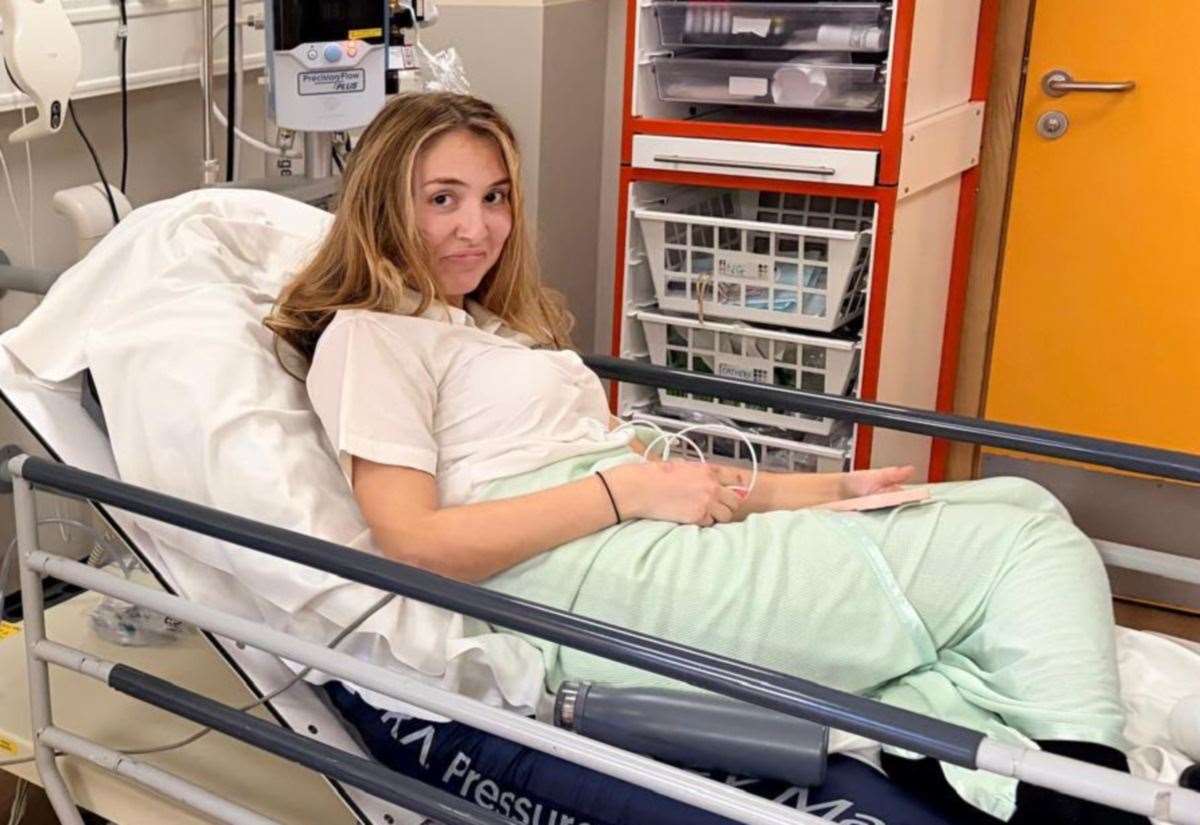
A teenager who went from an active lifestyle to having daily seizures and episodes of paralysis says she feared she “wouldn’t make it to 16” before her breakthrough diagnosis.
Hollie Dutton, from Sittingbourne, started experiencing tremors in her hands in April 2024 after playing a squash match.
 Hollie Dutton, from Sittingbourne, was diagnosed with Functional Neurological Disorder (FND) in July 2025
Her grandad Harold had Parkinson’s before he died, so she says it was “quite worrying” at first, but that it was put down to anxiety or a trapped nerve. However, they then started to get worse and spread up her arms.
She was referred to a neurologist and underwent an MRI after doctors feared she could have suffered a stroke.
Scans revealed she had syringomyelia, a rare neurological disorder where a cyst forms inside the spinal cord and expands over time, damaging surrounding nerve tissue, and spondylolisthesis, a spinal condition where one bone slips forward onto the bone below it. It was believed these were causing the tremors.
By April last year, Hollie started having tremors in her legs and began experiencing episodes of paralysis.
The 16-year-old told KentOnline: “Every now and then I’d go to school and my legs would give way to the point that I couldn’t walk properly and I would just fall.
“I used to play hockey pretty much full time for six years, and I was very active. But one day I was playing hockey, and my legs stopped working, and I had to get carried off the pitch.”
To rule out a tumour in her spinal cord, she was given another MRI and in July 2025 she was diagnosed with Functional Neurological Disorder (FND) – a problem with how the brain receives and sends information to the rest of the body.
According to the NHS, FND is estimated to be the second most common reason for neurological consultations after headaches, with up to 100,000 people in the UK being diagnosed with the condition.
It is often triggered by a combination of physical injury and psychological stress from underlying neurological conditions.
While those who have FND often experience persistent and varying symptoms, it can be potentially treatable.
Hollie woke up with paralysis following a seizureHollie now wants to use her experience to help other people living with FND, as well as their families
Hollie says receiving the diagnosis was a relief after months of uncertainty, as she had previously thought she “wouldn’t make it to 16”.
She said: “It was definitely a relief for me knowing that I wasn’t going crazy. Having to go to all these appointments to find out if it was something sinister was very worrying.
“The diagnosis itself was a relief, but my life completely changed overnight.”
She eventually went private to see a neuropsychologist and has been receiving cognitive behavioural therapy (CBT).
“The big challenge is that you can’t really treat it,” she said. “There’s not really medication that can change it, it’s very much a ‘you’ battle.”
On one occasion while playing hockey, Hollie had to be carried off the pitch after her legs stopped working
Her symptoms became particularly severe between September and December last year, when she was suffering seizures almost daily.
“I had been in five ambulances, had seizures for up to five hours and have woken up paralysed,” she said.
“A lot of the time when I was at school I was having seizures pretty much daily, and sometimes they would last for like hours on end on and off.
“I would miss lessons, and that really worried me so I’d end up catching up all six hours of work over the weekend and after school.
“I felt like a burden on people so I would hide away and would put myself in difficult situations where I would have seizures in bathrooms, and I had a seizure on barbed wire once.”
Hollie still experiences temporary paralysis, as well as verbal and motor tics
Hollie, who is now in sixth form studying history, art and maths, says her symptoms have become a lot more manageable in the past few months.
She still experiences temporary paralysis, as well as verbal and motor tics, but has now been seizure-free for 10 weeks.
She said: “A major part of the condition is accepting who you have become. When everything started happening, it was very much grieving who I used to be.
“I don’t think a lot of people see that you’re grieving an old life. You’ve had to start from scratch again, knowing that every day is different and uncertain.
“Going from being really active to not being able to walk some days, to being on the floor, I just felt really vulnerable and weak.”
Hollie had been playing hockey for six years before her diagnosis
Hollie, who is hoping to go to university to study architecture, now wants to use her experience to help other people living with FND, as well as their families.
She began sharing her experiences of the disorder on her Instagram, hols_.awareness, and TikTok, hols_.awarenessacc, after reaching what she described as “rock bottom” at the end of last year.
She has received messages from more than 100 people who have recently been diagnosed, as well as relatives looking for advice on how to support loved ones.
She said: “There is so little education and awareness, and many patients are diagnosed and discharged without a management plan, usually given a leaflet.
“I think when no one really knows about it, you kind of feel like you’re the only one and there’s no one you can relate to.
Hollie says she is relieved to have a diagnosis
“It does feel like you’re isolating yourself because you feel a bit chaotic and like you don’t belong.
“But the reality is that you’re not really a burden on people. You’re just trying to navigate your life.”
FND symptoms can range widely, and include fainting, vision issues, speech difficulties, brain fog, chronic pain and sleep problems.
To find out more about the condition, visit FND Action here.
Treatment focuses on retraining the brain to unlearn abnormal movement patterns and relearn normal function.
As well as CBT, other treatment options include physiotherapy and medication to treat co-existing conditions like depression and sleep disorders.