

Three Court of Appeal judges will decide whether the Mayor of London was right to approve a tennis tournament expansion onto Wimbledon Park while knowing the law might forbid it because of legal protections on the land itself. They reserved judgment on Thursday after two days of argument, and set no date for a ruling.
The expansion belongs to the All England Lawn Tennis Club (AELTC), the private members’ club that runs the famous Wimbledon tournament. City Hall’s officers assessed its proposal as if the land were held on a public trust, a duty to keep it open to the public, then recommended approval anyway. Save Wimbledon Park, the campaign group appealing, says that made the decision irrational.
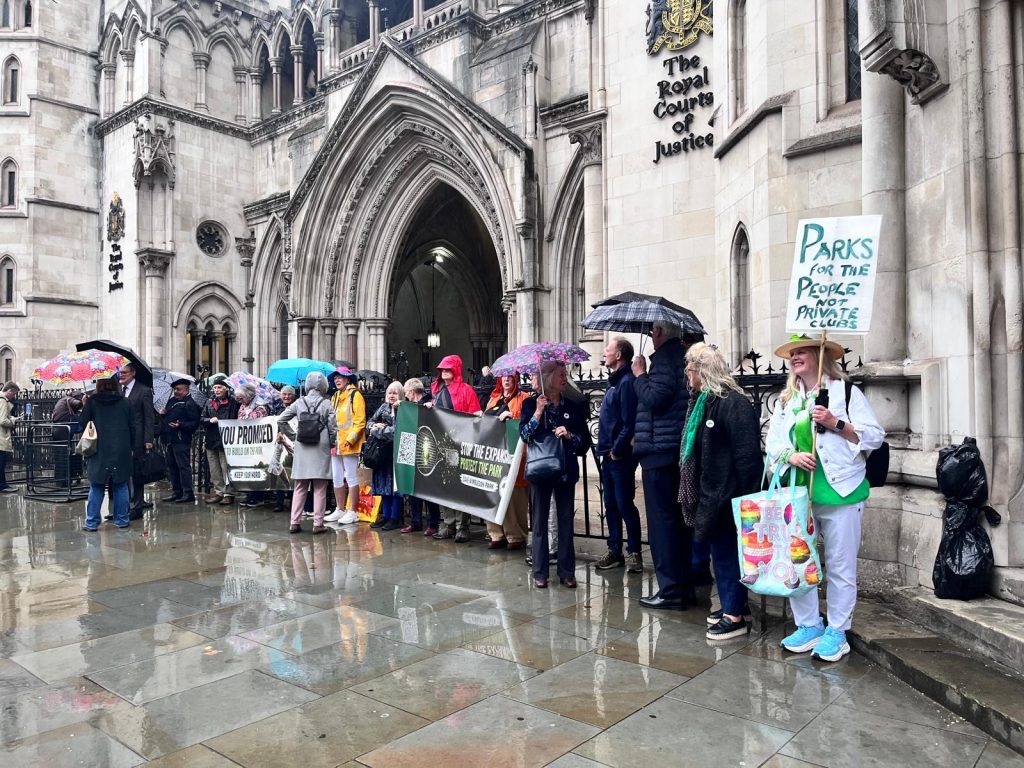
The permission covers an 8,000-seat show court and 38 grass tennis courts on the former golf course across Church Road from the Championships. The land is Metropolitan Open Land, protected like Green Belt, and part of a registered park landscaped by the famed landscape designer Capability Brown. Its Grade II* rating is the second-highest of the three grades on the national register.
Wandsworth councillors voted 7-0 to refuse the scheme and Merton Council approved it, so the decision passed to City Hall. The Mayor of London, Sadiq Khan, stepped aside because he had publicly backed the plans in 2021, and his deputy, Jules Pipe, approved them at a hearing in September 2024. Permission was formally granted on 18 November.
Lady Justice King, presiding alongside Lord Justice Holgate and Lord Justice Dingemans, said she hoped the judges “won’t be too long” in producing their ruling. It is the first of the three legal questions over the scheme to be decided.
So why would anyone approve something they assume the law may forbid?
AELTC and City Hall say this is how planning works. In their argument, a permission decides only whether a use of land is acceptable. Who owns the land, what promises bind it and what other laws apply are, they say, questions for other courts, other processes and sometimes Parliament.
Russell Harris KC, AELTC’s barrister, made the point at the expense of Sasha White KC, the campaigners’ barrister, whom he described as a big Arsenal fan. Mr Harris said that if he applied to knock down Mr White’s house and put up a memorial to Spurs, the council would still have to judge the plan on its planning merits. It would not have to decide whether Mr White would allow it.
AELTC accepts its scheme could not go ahead on land held on a public trust. It does not accept that a trust, if one exists, would stop it for good.
AELTC’s barrister listed three ways round one. Parliament can pass an Act, as it did in January for the national Holocaust Memorial, whose planning permission a court had quashed because of a 1900 law. A council can use its powers to acquire land and clear it of such trusts. Or the land can be handed back to Merton, which could advertise the trust’s discharge. If a development is in the public interest, he said, “in a parliamentary democracy there will be a way around it.”
Peers have debated changing the law with the Wimbledon Park scheme as their example. The debates included Lord O’Donnell, the former Cabinet Secretary, who sits on AELTC’s committee and was a director of three of its companies when the first amendment was tabled.
AELTC’s barrister mentioned the power ministers gained this year to discharge trusts of this kind, added to the English Devolution and Community Empowerment Act through an amendment by Conservative peer Lord Banner. The power cannot yet be used because the rules for applying have not been made. “I don’t rely on it because I don’t need to,” AELTC’s barrister said. The Mayor’s barrister mentioned the power too, noting it was not law when the decision was made.
The Mayor’s barrister told the judges that irrationality is a difficult argument to win, and an even harder one when a High Court judge has already found the decision rational. Officers accepted AELTC needed to expand, he said, but deliberately dropped AELTC’s own word for that need: “pressing”. The tennis club had not said it needed the courts by any particular date, he argued.
‘An illusion’
The campaigners’ barrister told the court the approach was “an illusion”. Officers said they had assumed the trust existed, he said, but in every balance they struck they also assumed the scheme would be built. Their summary table gives every benefit the same weight whether the land is held on trust or not.
“How can you say you’re taking into account something which everyone agrees cannot happen?” he asked.
City Hall had asked a barrister, Timothy Morshead KC, whether the public has rights over the golf course. Two days before the officers’ report, he advised that on the law as it stands the answer was yes: the owner “must make the land available to the public on a free and unrestricted basis”. Asking at all, the campaigners’ barrister said, showed officers thought the answer mattered.
Mr Morshead hedged. His advice rested on a 2023 Supreme Court ruling he had doubts about. “Barristers advise: only the Court decides,” he wrote.
There was no sign anyone asked Mr Morshead what that would mean for the scheme, the campaigners’ barrister said. And none of the three ways round a trust that AELTC now describes was put to the Deputy Mayor when he decided.
Lord Justice Holgate, who gave the campaigners permission to appeal in November 2025, put their case in one line: officers had “severed the existence of the trust from its enforcement”. He asked whether officers had referred to the permanence of a trust. “Not expressly, no,” the Mayor’s barrister replied.
But Lord Justice Holgate observed that in most planning cases, the merits do not turn on whether a scheme can be delivered. And Lord Justice Dingemans put to Save Wimbledon Park’s barrister a High Court judge’s point from an earlier case: if the trust stops the scheme, nothing is built, so there is no harm either.
What is on the land
The registered park once covered about 480 hectares around its lake. In the 1870s much of it was sold for housing, until the Borough of Wimbledon bought the northern part, including the lake, in 1914 and opened it to the public. About 60 hectares survive, roughly an eighth, according to the government’s heritage body, Historic England. The golf course is about half of what is left.
The site holds 1,112 trees. AELTC’s plans keep all 41 ancient and veteran trees, mostly oaks, which national planning policy treats as irreplaceable. Around 300 trees would be felled, four in five of them to make way for the tennis courts, buildings and paths. AELTC’s own tree assessment says the other 61 would go to restore the park’s historic landscape. Every tree on the golf course is protected by a tree preservation order or conservation area status. Officers counted the removal of “inappropriate” golf-related planting as a heritage gain.
The 1,500 replacement trees are not like for like. A thousand would be at least two years old; the other 500 would have trunks 12 to 16cm round. City Hall’s officers called the tree loss “regrettable”, and a planning condition requires the value of the lost trees to be at least replaced. Forest Research, the government’s forestry research agency, says the carbon a stand of trees takes up starts slowly and builds as the canopy grows. A new woodland of young trees holds very little carbon beside a stand of large ones, it says.
Critics dispute AELTC’s claim that the park would gain nature. Dr David Dawson, a former joint head of the Mayor of London’s environment group, calculates the scheme would cut the site’s wildlife value by 36%, against AELTC’s claimed 23% gain.
AELTC says the scheme would open 27 acres of new public parkland. The legal agreement attached to the permission, signed on 15 November 2024, requires that land to be kept open “in perpetuity”. But access is on a “permissive basis”, meaning by the owner’s permission rather than as a legal right. The northern parkland can be closed for up to 10 weeks around AELTC’s tournaments, longer if the councils agree.
If the campaigners win, they say the permission will be quashed and City Hall will have to decide again. If they lose, AELTC still faces two obstacles. The Court of Appeal will hear the campaigners’ challenge to the March ruling that no trust exists by 15 July 2027, and Lady Justice King said she hoped that would be “long before that”. And AELTC has admitted its plans would breach the 1993 covenants, which it would need to have lifted.
Analysis
Strip out the legal language and this is what happened. City Hall’s own barrister advised that the public has rights over the land. It approved the scheme anyway, on the basis that if there is a problem, someone else can sort it out later. AELTC and City Hall say that is simply how planning works. The campaigners say you cannot weigh benefits that may never arrive and call it a judgment.
Then look at who is making the arguments. AELTC’s barrister told the court Parliament could step in if the scheme is in “the national interest”. But AELTC is a private members’ club. The Grand Slams’ own joint statement says non-profit national bodies run the Australian Open, the French Open and the US Open, while Wimbledon is run by a private club. The national interest and a club’s interest are not the same thing, and the Wimbledon name does a lot of work in blurring them.
Would a developer of flats on the same land have been given the same hearing? The test in law would be identical. Put any other name on this scheme and ask how far it would have got.
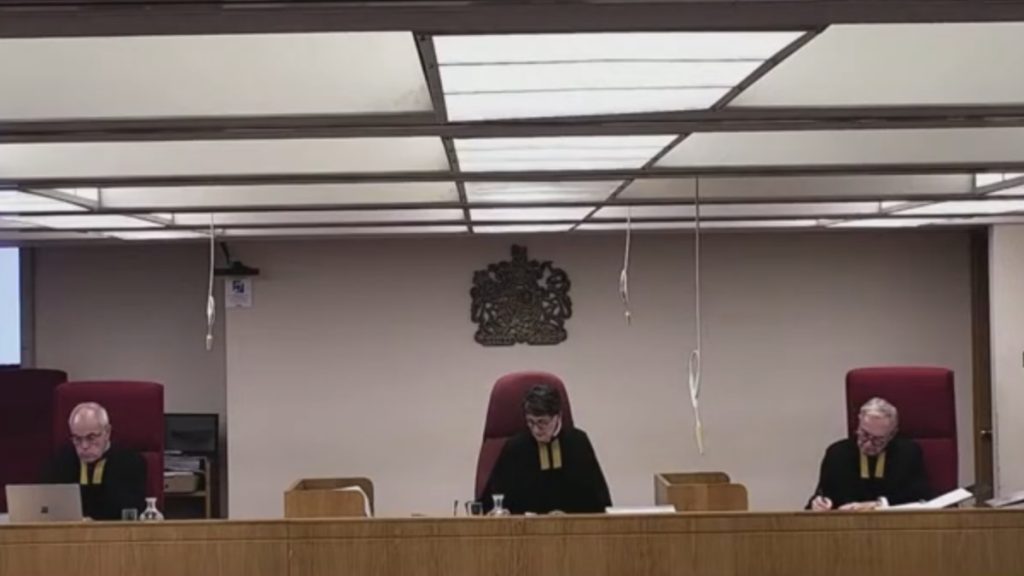 The three justices deciding the case
Most planning applications are not defended by pointing to what Parliament could do for them. This one reaches for the Act passed for a national Holocaust memorial, after peers, including a member of AELTC’s committee, debated changing the law with Wimbledon Park used as an example.
In fairness to City Hall, the trust was disputed when it decided, and would have to be settled elsewhere. And if the courts do find one, a fix is waiting: ministers have gained a power to lift such trusts. Lord Banner told peers that, for Wimbledon Park, “as things currently stand, the amendment is in fact academic”.
What gets lost in the legal argument is the land itself. This is an extraordinary stretch of open ground in the heart of London, laid out by Capability Brown more than 250 years ago, with his lake and its dam still there. It is Metropolitan Open Land, part of a Grade II* registered park, inside a conservation area, a designated nature conservation site and an archaeological priority zone. There are good reasons for all that protection. Every tree on it is protected too.
Felling a mature tree and planting a two-year-old in its place is not an even swap. The felled tree has decades of growth behind it; the new one starts almost from nothing. And, as the campaigners have been at pains to point out: once the land is gone, it won’t come back.
As for the judges, a court can overturn only a decision that was irrational, and a bench is hard to read. In January, the judge hearing the trust case openly discussed how his ruling might be appealed, which we read at the time as a sign he might rule against AELTC. He ruled for it.
Correction, 10 October: This article originally quoted Lord Banner as saying the amendment was “in fact academic” for Wimbledon Park. The quotation has been corrected to include his words “as things currently stand”.