
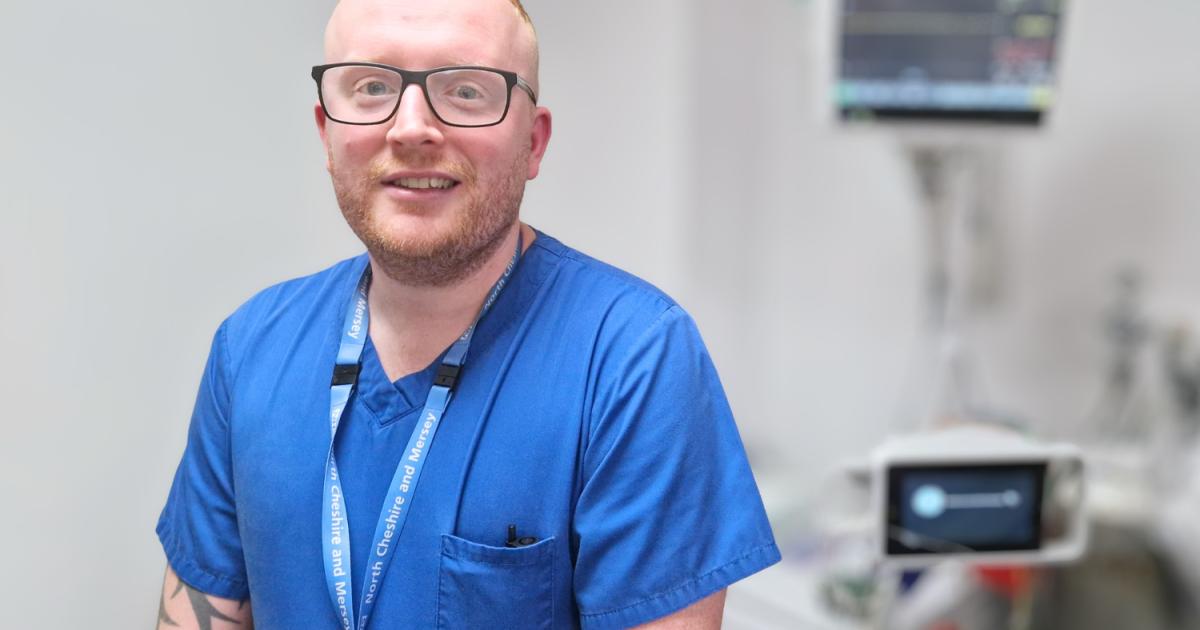
Born at the hospital and raised in Latchford, he has spent the past 16 years caring for patients there, most recently as a charge nurse in the Emergency Department (A&E).
His route into nursing was far from conventional, however.
The 36-year-old originally trained as a bricklayer after leaving school, but when building work proved hard to come by he took a part-time job in a care home kitchen which changed the direction of his career – and he has never looked back.
After being encouraged to try care work he joined the hospital as a healthcare assistant and later worked as an assistant practitioner, before obtaining a first-class degree at the University of Chester and qualifying as a registered nurse.
Now he helps support patients through some of the most difficult moments of their lives while also mentoring junior colleagues in one of the busiest and most pressured areas of the hospital, in the community he grew up in.
Life as an ED nurse
Combining patient care with leadership responsibilities, being an ED charge nurse is a vital role requiring compassion, dedication and resilience.
From patients arriving with life-threatening conditions to those who have suffered serious injuries or experienced a sudden deterioration in their health, staff look after some of the hospital’s sickest patients around the clock.
It can be physically and emotionally demanding, particularly during exceptionally busy periods when patients requiring urgent care are being cared for in corridor spaces.
And with winter on the horizon, teams have already started preparing for the expected increase in patient numbers.
“You never know what to expect when you begin your shift,” said Jonathan.
“No two days are ever the same. You meet such a wide range of patients, from those who are critically unwell and need immediate intervention, to people needing reassurance, assessment and support.
“You often see patients and families when they are having one of the most frightening or stressful days of their lives.
“It can be incredibly challenging, however being able to make a difficult situation a little easier for them can also be incredibly rewarding.
“I’m proud of the compassion my colleagues show, particularly when patients are frightened, confused, frustrated or distressed.
“There is a real sense that we look after each other here. Our team are like family – to me they are my second family.”
He is equally quick to acknowledge the contribution of colleagues behind the scenes, describing porters and cleaners as “an integral part of the team”.
“We support one another, share knowledge and step in when someone needs help. It’s that collective effort that makes such a difference,” he added.
(Image: Supplied)
Challenges facing ED at Warrington Hospital
The challenges facing ED at North Cheshire and Mersey NHS Foundation Trust, which runs Warrington Hospital, aren’t only related to the number of people who walk through its doors each day.
Outdated buildings that are no longer suitable for modern healthcare needs, a growing and ageing population, and mounting pressures on adult social care all take their toll.
On any given day approximately one in four hospital beds are occupied by patients who no longer require acute treatment and are medically fit to leave.
Known in clinical terms as having “no criteria to reside”, they remain there because the support they need, for example a package of care or community placement, isn’t available.
Those beds aren’t then available to patients waiting to be admitted, which can affect how many patients are cared for in corridor spaces.
It also affects how quickly you may be seen by a nurse or doctor.
Jonathan says staff understand the frustration that can sometimes be experienced by patients and their families.
“We don’t want anybody to be cared for in a corridor, it’s disheartening,” he said.
“You really feel for the patients and we want to provide the care and experience they deserve.
“We’re doing everything we can but when there are delays in the system and patients can’t leave hospital until the support they need is available, there are fewer beds for those coming through ED.”
Despite the ongoing pressures it is often the smallest moments that remind staff why they chose to work in healthcare.
Jonathan recently cared for a patient who arrived with severe abdominal pain.
A few days later, after being discharged following treatment, the man returned to the department with a simple message.
“He came back just to shake my hand and say thank you,” Jonathan said.
“That was really nice. It’s those moments that stay with you and inspire you to carry on.”
What the future looks like
Looking to the future, Jonathan remains optimistic.
From staff training and development to closer working with community teams and a determination to keep finding new ways to improve, he believes positive changes are taking shape.
More patients are now being assessed, treated and either admitted or discharged within four hours of arriving at ED or one of the urgent treatment centres in Widnes and Runcorn than was the case a year ago, making the trust one of the most improved regionally for its four-hour waiting time performance.
While this doesn’t mean every patient completes their treatment within four hours, it does mean people are moving through the department and receiving the care they need more quickly than they were.
Initiatives driving this change have included improved triage processes, ensuring people are seen in the right place at the right time, by the most appropriate service for their needs.
Services such as Surgical Same Day Emergency Care (SDEC), Same Day Emergency Care, Gynae Assessment Unit and Ambulatory Care are helping patients receive treatment without needing to be admitted, allowing ED teams to focus on those requiring urgent or emergency care.
Challenges do still remain in relation to the number of patients experiencing very long waits in the department however, and this will continue to be a priority for the trust over the coming months.
Jonathan and his team are particularly proud of their recognition from the University of Chester at the Celebrating Achievements and Practice Excellence awards (CAPE) as a leading placement location for student nurses, helping to develop the next generation of urgent and emergency care professionals.
Jonathan’s advice
And what advice would he give to someone considering a career in emergency nursing?
“I would say go for it, but understand it’s both incredibly rewarding and challenging,” he said.
“It is a career of lifelong learning and you develop your confidence and skills over time.
“You will have difficult days, but there are also so many moments that remind you why you chose the profession.
“You get the opportunity to make a genuine difference to people when they need you most.”