
Competition for Steam Frame: Pimax announces wireless PC VR headset Crystal Pro
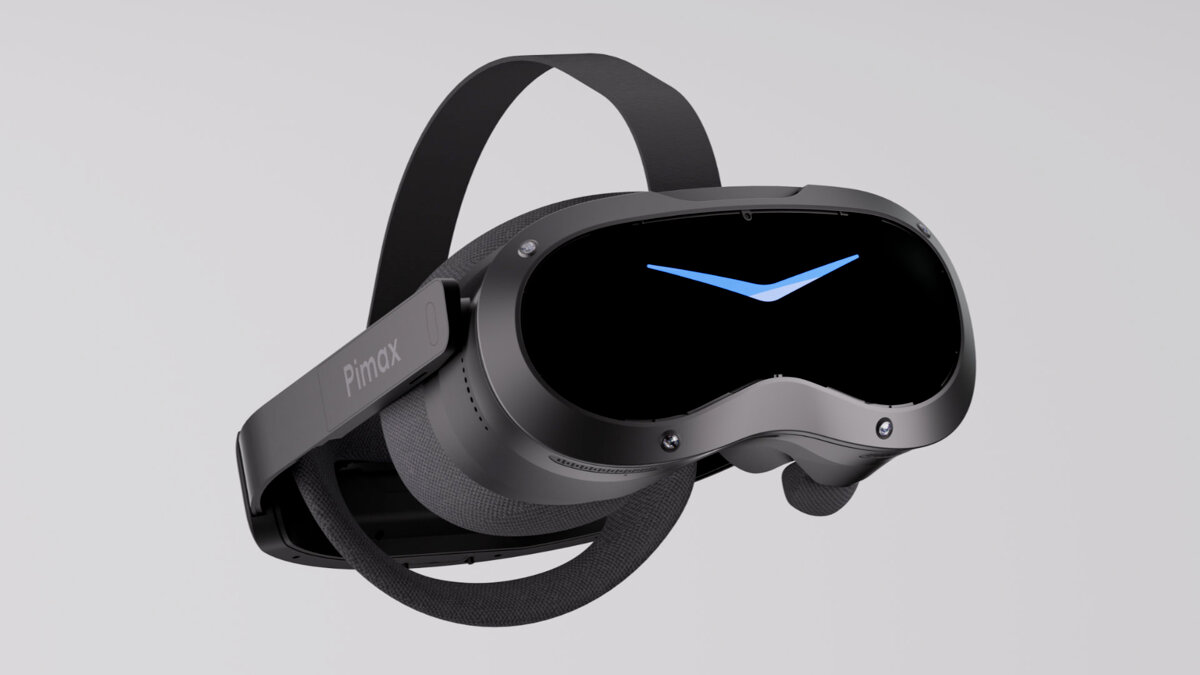
At its in-house launch event “Pimax Frontier,” the Chinese VR headset manufacturer Pimax presented a new headset. The Crystal Pro primarily differs from Pimax’’s previous VR headsets through its wireless approach, placing it surprisingly close to Valve’s Steam Frame. In addition to the VR headset, Pimax also showcased VR controllers without tracking rings for the first time and its own mini-PC designed for virtual reality.
Modular headset with external battery
The Crystal Pro features QLED displays with a resolution of 2880 × 2880 pixels per eye. This surpasses Valve’s Index successor, which achieves 2160 × 2160 pixels per eye. Instead of the pancake lenses predominantly used in compact VR headsets, Pimax continues to rely on aspherical glass lenses. These are intended to provide a horizontal field of view of 110 degrees. Additionally, it includes mini-LED backlighting with 576 dimming zones per eye and adjustable refresh rates of 72, 90, or 120 Hz.
The Crystal Pro is not entirely cable-free, as Pimax has omitted an integrated battery for a lighter and more comfortable design. Instead, a supplied external 16,000 mAh battery provides power, which, similar to Apple’s Vision Pro or Meta’s new VR glasses, fits in a pocket. Pimax has not yet provided information on battery life. The weight of the headset is also unknown.
Alternatively, the Crystal Pro can be operated with a cable, like all current Pimax VR headsets, via a DisplayPort 1.4a cable. For headset and controller tracking, Pimax offers two versions. By default, the VR headset uses camera-based SLAM tracking. However, interchangeable front plates also enable Lighthouse tracking via base stations or mixed reality passthrough with a LiDAR depth sensor.
PC VR goes wireless
The actual selling point for the Crystal Pro, however, is wireless PC streaming. An important note here: While the VR headset can be operated wirelessly, there is no native standalone mode, as offered by Steam Frame or Meta Quest 3, for example. The VR headset always requires a connection to a powerful computer.
Pimax optimizes the Wi-Fi connection to the PC through “Native Foveated Streaming,” as the company calls it. This is a further development of Foveated Rendering. While the latter concentrates computing power on the user’s gaze when rendering, the former optimizes transmission bandwidth. Both technologies support each other and benefit from integrated eye tracking, which tracks where the user’s gaze is currently directed.
This concept is not new: Valve’s wireless VR headset Steam Frame, which recently went on sale, also relies on a feature called “Foveated Streaming,” which also uses eye-tracking to specifically optimize image details where the eyes are looking. However, Valve uses compressed wireless streaming, while Pimax, with the optional 60G AirLink kit, also offers uncompressed transmission.
60 GHz radio with dual antenna
According to Pimax, the third-generation 60G AirLink kit uses a 60 GHz radio connection with a 2×2 MIMO configuration and is supposed to transmit an image corresponding to 2880 × 2880 pixels per eye. Pimax promises an additional latency of less than two milliseconds for the transmission path with its approach. Whether the Crystal Pro actually achieves this value remains to be seen in independent tests.
However, 60 GHz radio has a small drawback: it does not penetrate walls and typically only has a range of a few meters. Furthermore, it relies on a clear line of sight between transmitter and receiver. Furniture or one’s own body can briefly interrupt the connection. Pimax aims to mitigate this with a dual antenna: two spatial antennas back each other up in case one is temporarily obscured and split the data stream for a combined throughput of up to 6 Gbit/s. Two antennas are plugged into the back of the headset as receivers.
Controllers without tracking ring and own mini-PC
In addition to the headset, Pimax showcased new wireless VR controllers without the usual tracking ring, and with the button layout, it also approaches the Steam Frame. The left controller now features a classic D-pad, while the right one houses all four ABXY buttons. The shoulder buttons are split. New compared to the Steam Frame is a coupling option. Via an adapter, both controllers can be connected together and thus function as a classic gamepad under Windows and Steam.
Pimax also introduced the “Spation,” a compact mini-PC with desktop components such as an AMD Ryzen 7 9800X3D and optionally an AMD RX 9070 XT or Nvidia RTX 5070 Ti, which supports both Windows and SteamOS and is said to be perfectly tailored for VR applications. Pimax did not disclose prices or further details about the Spation.
Empfohlener redaktioneller Inhalt
Mit Ihrer Zustimmung wird hier ein externes YouTube-Video (Google Ireland Limited) geladen.
YouTube-Video jetzt laden
Prices and availability
The Crystal Pro is shipped by Pimax with integrated Wi-Fi streaming and a Wi-Fi 6E adapter as standard and is priced at 1,300 Euros (before taxes, import costs, and shipping). This puts it above Valve’s Steam Frame, which went on sale on September 14, 2026, for 1,060 Euros (256 GB model) and 1,280 Euros (1 TB model). In a bundle with the 60G AirLink kit, the Crystal Pro costs 1,780 euros. The kit is also available separately for 560 euros.
The VR headset is scheduled for delivery in early 2027. Interested parties can already reserve it for one US dollar. However, specific delivery dates for the Crystal Pro are still pending, as are the prices for the controllers and mini-PC. This is not an exception for Pimax. There are usually significant time periods between announcement and actual delivery. Valve also does not sell the Steam Frame freely in retail but through a reservation queue.
(joe)
Don’t miss any news – follow us on
Facebook,
LinkedIn or
Mastodon.
This article was originally published in
It was translated with technical assistance and editorially reviewed before publication.
Dieser Link ist leider nicht mehr gültig.
Links zu verschenkten Artikeln werden ungültig,
wenn diese älter als 7 Tage sind oder zu oft aufgerufen wurden.
Sie benötigen ein heise+ Paket, um diesen Artikel zu lesen. Jetzt eine Woche unverbindlich testen – ohne Verpflichtung!