
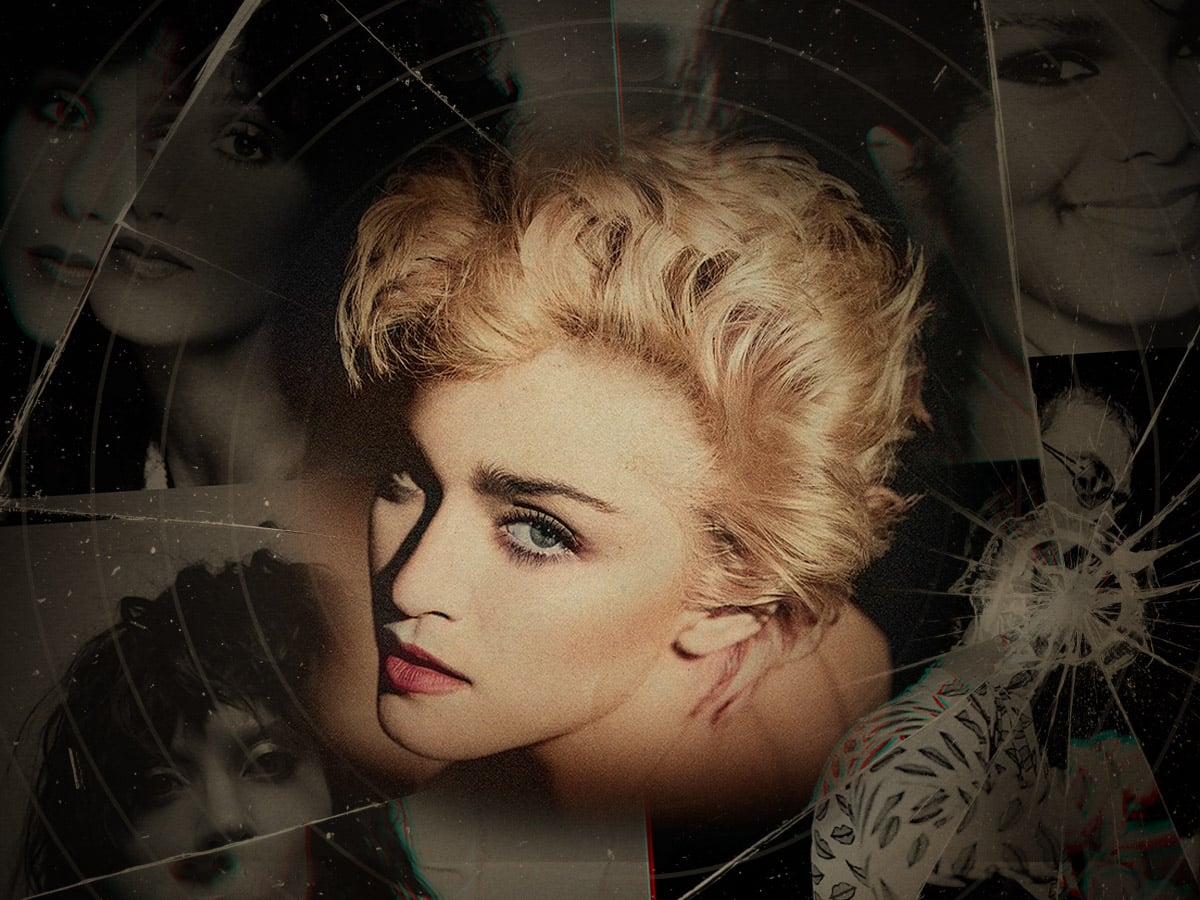
Credit: Far Out / Album Cover / Frank Lebon / Casablanca / Public Domain
Thu 15 October 2026 22:00, UK
Madonna has built a career on reinvention, but one of her most enduring transformations arrived practically by accident.
In 1985, she took an orphaned instrumental project and turned it into ‘Live to Tell’, a haunting ballad about mistrust and childhood trauma that she reportedly wrote “on the spot”. The song became the lead single from True Blue, an album certified seven times platinum in the US and estimated to have sold around 25 million copies worldwide.
The song began with producer Patrick Leonard, who had composed an instrumental for the film Fire with Fire. Paramount passed on it, leaving the piece without a home, but when Madonna heard it, while her then-husband Sean Penn was preparing to star in James Foley’s crime drama At Close Range, she saw a better home for it.
According to author Rikky Rooksby, she wrote the lyrics right there, crafting a melody and bridge inspired by the film’s themes of family secrets and emotional trauma. “Sometimes when I’m writing songs, I’m just channelling,” she later said, explaining that the lyrics reflected personal pain and yearning, whether autobiographical or fictional. After recording a demo, she played it for director James Foley and Penn, both of whom responded positively.
There was one complication, however, which was that Madonna had initially written the lyrics from a male perspective. When Leonard was asked who should sing it, he insisted it had to be her… More unexpectedly, he retained her demo vocals for the finished record, believing their unpolished quality captured something essential.
“It was so innocent and so shy,” he explained.
“It’s as naive, as raw as can be, and that’s part of what gave [‘Live to Tell’] all its charm.”
Madonna has offered several interpretations for the song over the years, linking it to resilience and yearning, while also saying that it was “true, but not necessarily autobiographical”. In a 2009 Rolling Stone interview, she suggested that the track may refer to her childhood or family relationships, and it might equally have been inspired by an F Scott Fitzgerald novel, a memory, or even both, but it is this deliberate vagueness that is central to its appeal, allowing listeners to project their own wounds onto the song to process them.
Further reading: From The Vault
In terms of the film, At Close Range, where Penn plays a young man drawn into a rural criminal empire led by his own estranged father (played by Christopher Walken), the plot mirrors the song’s depictions of a web of betrayal and a past too painful to name, and while it flopped at the box office, the song thrived.
Released in the US on March 26th, 1986, ‘Live to Tell’ entered the Billboard Top 100 at number 49 before climbing to number one, becoming Madonna’s third US chart-topper and her first on the adult contemporary list that also reached number one in Canada and Italy.
During her 2006 Confessions Tour, Madonna performed it suspended on a mirrored cross, wearing a crown of thorns while screens displayed statistics about children affected by Aids in Africa… Religious leaders condemned the imagery, German prosecutors considered blasphemy charges, and the tour release was banned in parts of Asia – the artist maintained that the performance was a plea for compassion, not an attack on faith.
That a song apparently written in one sitting could later carry such cultural and political weight says much about its durability – ‘Live to Tell’ remains one of Madonna’s most vulnerable recordings and proof that even the quickest work can still cut deep.
