

BAFTA-winning naturalist Steve Backshall was left delighted after discovering an ‘exotic’ animal in Falmouth, Cornwall, that he claims hasn’t been seen in the UK for years
14:34, 17 Oct 2026Updated 19:54, 17 Oct 2026

Steve Backshall was out looking for sea slugs in Falmouth, Cornwall(Image: Facebook/Steve Backshall)
Award-winning British naturalist, television presenter and adventurer Steve Backshall was thrilled after spotting an ‘exotic’ sea slug that he says hasn’t been recorded in the UK for years. Steve, 53, was searching for sea slugs in Falmouth when he came across the species, which he said “doesn’t look real”.
In footage posted to his Facebook page, Steve told viewers: “Come with me to find the most flamboyant, colourful creature in the whole of the British Isles. “An animal so exotic, it almost doesn’t look real.” Steve continued: “We have a pair of rainbow nudibranchs, or Babakina entwined together, and that morass of white sticky stuff is an egg mass.
“So this is a little baby rainbow nudis being born. Sort of.
“The rainbow nudibranch hadn’t been seen beyond northern Spain until 2022, and today we’ve found about 30 in one rockpool.”
Nudibranchs are a family of strikingly coloured, soft-bodied marine molluscs frequently regarded as amongst the ocean’s most spectacular creatures.
The term derives from the Latin nudus (naked) and Greek brankhia (gills). Unlike snails, fully grown nudibranchs discard their shells entirely, exposing their respiratory organs – feathery plumes or finger-like projections known as cerata – on their backs.
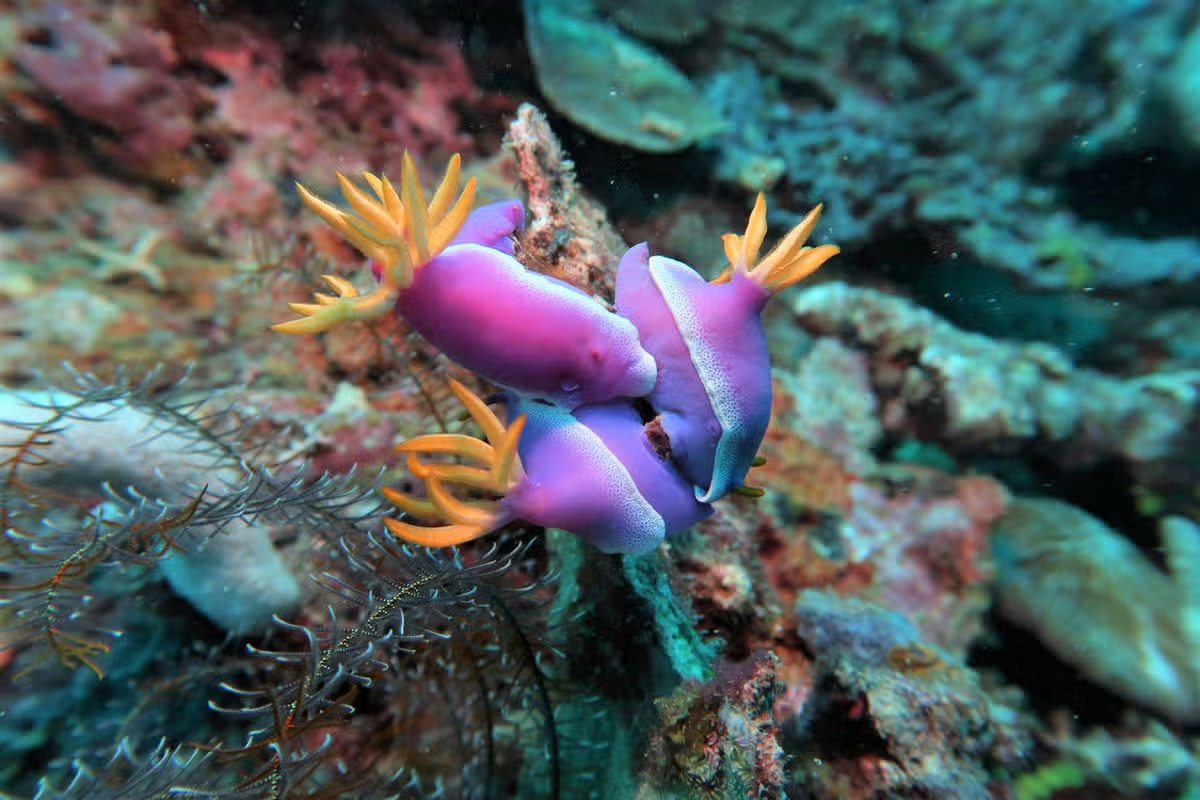
Nudibranchs are a family of strikingly coloured, soft-bodied marine molluscs frequently regarded as amongst the ocean’s most spectacular creatures (file)(Image: Kylie Brown via Getty Images)
They possess two horn-shaped tentacles on their heads, called rhinophores, which sense chemical signals in the water, enabling them to find food and potential mates. The marine creatures feast on sponges, coral, anemones, hydroids, and occasionally other nudibranchs.
Particular varieties, called aeolid nudibranchs, consume stinging creatures such as jellyfish or Portuguese man-o’-wars, break down the tissue, and retain the undamaged stinging cells (nematocysts) in their own extremities to deploy against predators.
Each nudibranch has both male and female reproductive systems, enabling any two fully-grown individuals of the same species to reproduce.

Steve is an award-winning British naturalist, television presenter and adventurer(Image: Mike Marsland, WireImagevia Getty Images)
Social media users were delighted by Steve’s find, with the post garnering over 1,000 likes.
One individual remarked: “Oh wow…they are beautiful! If the slugs which devour my plants in the garden were even a tiny bit as pretty as these sea slugs, I might appreciate them more!”.
Another commented: “Such great creatures, been hooked since finding my first Rostenga rubra back in 1995, so much detail on such a small animal. Enjoy you rockpooling Steve Backshall.”
A third person responded: “Yet another reason to visit Falmouth. As if you needed more..”
Besides the nudibranch, Steve also encountered the hair curler sea slug (Spurilla neapolitana), which is a type of aeolid nudibranch recognised for the distinctive, thick, tightly coiled appendages covering its dorsal surface.
He added in the clip: “The hair curler, well that was first seen in the UK just last year in May, and they’re everywhere.
“I mean, how good is this?”