
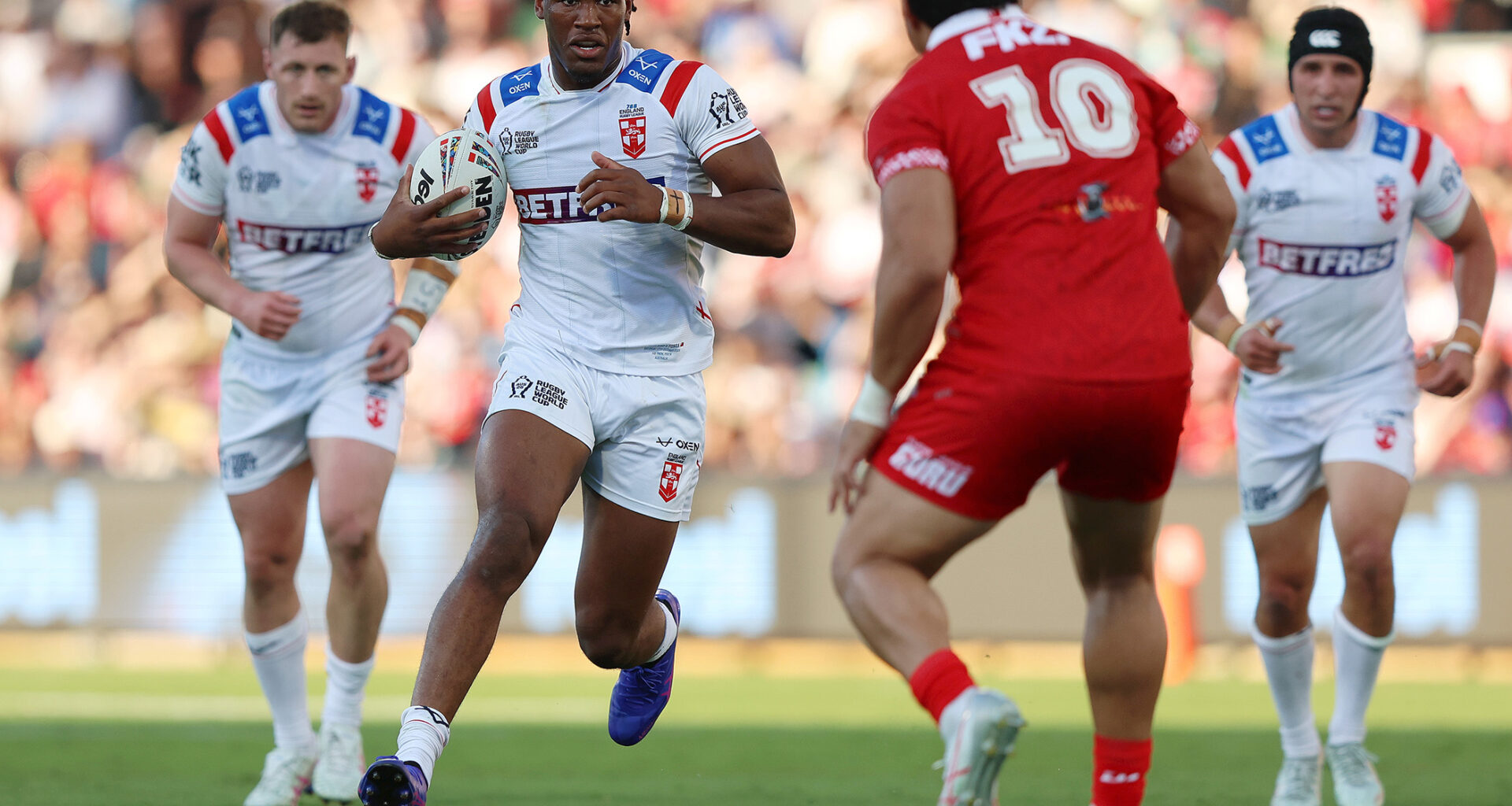
The circumstances are such that it is really very difficult to avoid the clichés. Pretty much all of them apply. By the time you have finished eating breakfast on Saturday morning, England may well stand on the brink (1) of World Cup humiliation (2). Their meeting with France – the old enemy (3) – is a must-win game (4). This is do-or-die time (5).
This latest installment in a rivalry that already includes Crécy, Agincourt and Waterloo (6-8) is being held in Perth, Western Australia, in the second round of fixtures in the Rugby League World Cup. The tournament’s strangely convoluted format means England have to win, and win well, to have any hope of making the semi-finals.
If all this has completely passed you by, there is a reason for that. As James Graham, a mainstay of the England team for more than a decade before his retirement, said this month, a “lot of people” in Britain “wouldn’t know a World Cup is being played now by a rugby code. A lot of people would have no real idea of how to watch or consume that product.”
It is hard to argue with that assessment. According to data from the analysis firm Two Circles, rugby league is one of the five most popular sports by attendance in Britain: far behind football, of course, but not a world away from horse-racing and rugby union. In its professional and semi-professional forms, it attracts a similar number of fans to cricket, more than motorsport.
Both the prime minister and the culture secretary form part of that cohort. Andy Burnham supports Leigh Leopards, his hometown team; Lisa Nandy’s ardent loyalties lie with Wigan Warriors, one of the sport’s true heavyweights. There is enough political interest in the World Cup for representatives of England’s men’s, women’s and wheelchair teams to have been invited to Downing Street before they left for their concurrent tournaments in the southern hemisphere.
But that has not been enough to see the World Cup broadcast on free-to-air television. The BBC held the rights to the previous edition, four years ago, but opted against airing it this year; the corporation only agreed to carry highlights packages a few weeks ago, after Nandy had expressed her “disappointment” that the competition would be paywalled on Premier Sports.
There are, admittedly, mitigating circumstances for that decision. The timings of the games are not conducive to attracting substantial audiences; the BBC, in particular, is in the midst of painful cutbacks. There have been reports that staff members are considering launching industrial action.
But it is also indicative of what has come to resemble the contraction of our sporting palate, driven in no small part by the demands and the desires of the media – particularly television – that is theoretically designed to reflect and expand it.
Rugby League, at this stage, should probably be considered Australia’s national sport: in July, the NRL (National Rugby League) signed a seven-year television deal, worth A$5.3 billion (£2.78 billion), outstripping the broadcast revenues of its great rival on the other side of the Barassi Line, the AFL, the governing body for Aussie Rules. The deal starts in 2028, by which time the NRL will have 19 teams, including one in Papua New Guinea; the league’s chair, Peter V’Landys, has described his competition as the “most viewed programme in Australia and in the Pacific”.
The contrast with the sport’s fortunes here is stark. Betfred’s arrangement as the primary sponsor of Super League will end this year, after almost a decade. So too will Sky Sports’ current deal as the competition’s broadcaster; any new arrangement will, most likely, result in the network showing fewer games live. Rhodri Jones, the interim chief executive of the Rugby Football League, has insisted that all games will continue to be broadcast live, but conceded that there “might be a change in the broadcasters”.
The reason for this is pretty much the same for the BBC’s decision that it could not afford to show the World Cup: not just the cultural dominance of football, but the ever-rising cost of covering it. In fact, even that may not fully capture the situation. The great hegemon is not football, or even the Premier League, but the handful of clubs at the game’s summit that monopolise the oxygen.
The BBC is now concentrating more and more of its digital resources on the “Big Six”, the subjects that drive the traffic and the discussion. The Athletic, owned by the New York Times, made a similar decision a couple of years ago, as have a number of other news organisations. This is a sporting landscape designed by algorithm: the data says that what people want is more Manchester United, Liverpool and Arsenal, and the data must be obeyed.
The cost of that to everyone and everything else – other sports, other teams – is an exorbitant one. Rugby League, popular in a narrow ribbon of old industrial towns along the M62, has tried whatever it can to escape its geographical containment: successive breakaways, an ill-starred deal with IMG to “reimagine” its future.
None of it has worked, and Graham, for one, sees no reason to hide his concern. “It is becoming a niche sport, and unless it changes, it’ll come even more into the abyss,” he said. Niche sport: that is the cliché. But this is the fourth or fifth most popular sport in the country. If rugby league is damned by algorithm, what chance does anyone else have?
Photograph by Janelle St Pierre/Getty Images