
Take food safety. Nothing is more important in his business, McClure says. The company constantly runs tests of its reporting system in the event of a food recall. In the past, employees manually entered information on the origins of the raw ingredients used to make pickles in a database, and it took 30 to 45 minutes to run a trace.
After McClure integrated professional versions of large language models (LLMs) into the firm’s enterprise resource management program, the system could show the journey the ingredients took from their source to the jar in less than two minutes. It provides an online dashboard to show where the pickles were shipped, how much of the batch is left in the warehouse, and even its pH or acidity levels.
McClure also used AI to create a maintenance application to automatically monitor production equipment, an accounting app to draft accounts payable for suppliers, and another app to review jar labels for accuracy.
Integrating LLMs into business systems has its challenges
There are challenges. Writing instructions for the LLMs takes finesse and sometimes a few “iterations” are needed to get it right. And sometimes there are bugs to work out. Because McClure, a former actor with no code training, can use natural language to engage the models, he says he does not need to license software or pay a technician. He can do it himself.
Even better, he says he can apply the AI models to multiple tasks without paying more for their services. “I think AI is uniquely suited to small business entrepreneurship because you are so strapped for resources in terms of time, people, and money,” McClure says. “I now need to hire humans to manage my AI.”
Naomi Stone, the owner and CEO of an environmental engineering consulting firm in Hermosa Beach, California, has gone a step further. She has made an AI application the cornerstone of a new venture, a company called Enso.
Can AI connect producers and consumers?
Companies already pay to dispose of their surplus materials, and Stone says Enso is designed to turn that expense into a new revenue stream. The firm uses AI to match companies holding surplus materials and industrial byproducts with buyers who can put them to work. Some byproducts, like coal ash, have long been used to strengthen building materials. Other byproducts, from packaging to equipment to manufacturing scrap, simply need the right buyer, she says.
For Stone, putting waste materials back to work advances the circular economy, a key tenet in sustainable finance. AI can facilitate matches between coal ash producers and buyers at a speed and scale Enso would have a hard time doing on its own.
“It makes matches we haven’t even thought of,” says Stone. “And the best part is it can help our clients convert waste from a cost into a new revenue stream.”
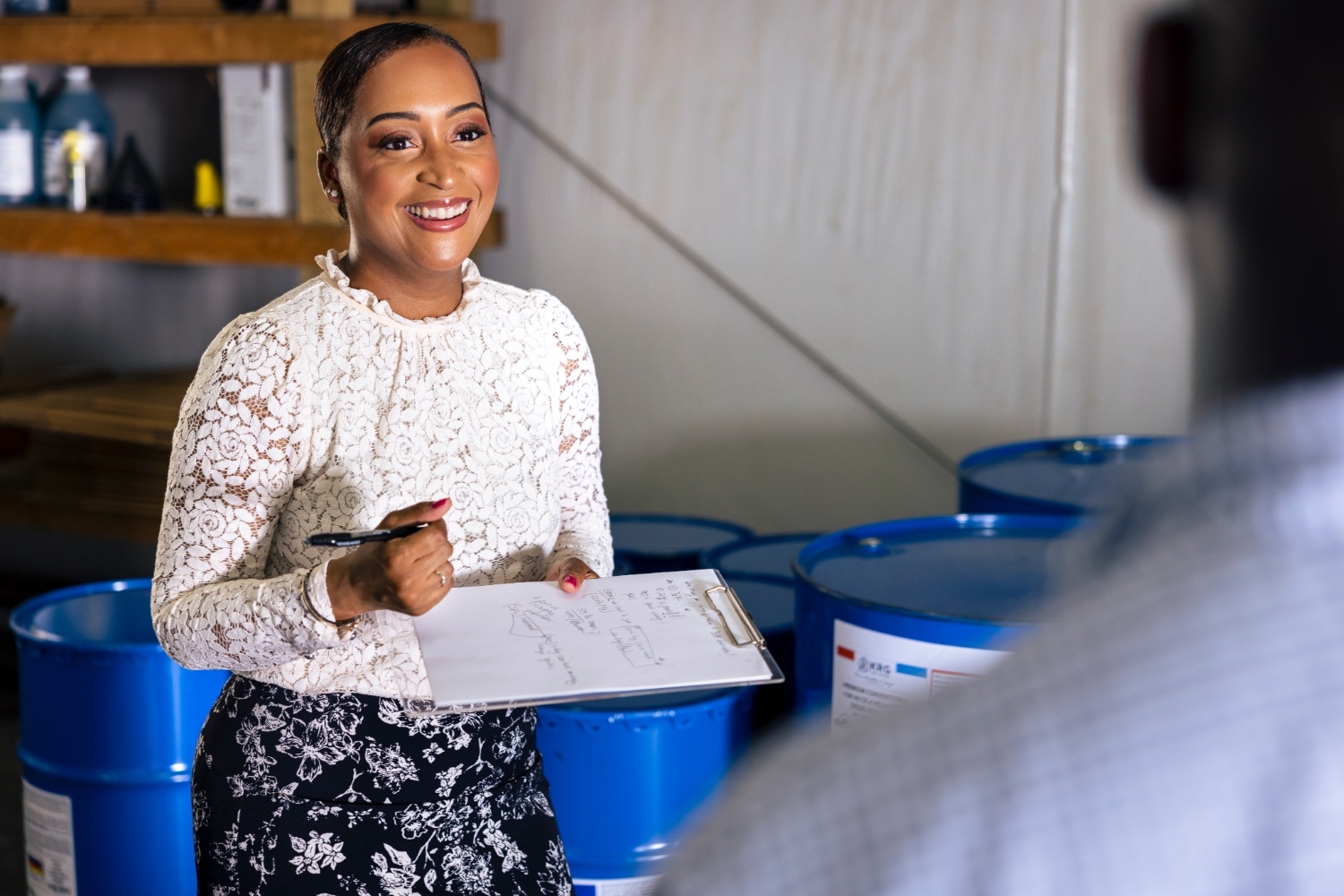
AI’s potential to illuminate unforeseen opportunities is a theme that comes up regularly among small business owners. Back in Roswell, Georgia, Marie Hunter says she has considered focusing more on her coaching business for entrepreneurs. So she gave her AI agent new instructions: to compile M&A data and prepare KRG Oil for an exit. “What does that look like, and what do I need to think about?” Hunter says. She adds that she’s ready to aspire to get her company to “the multiple it deserves.”
Survey data is based on responses from 2,473 Goldman Sachs 10,000 Small Businesses alumni who participated in the 2026 Alumni Survey, conducted by Babson College from August 10–24, 2026. The survey was sent to 14,967 program alumni.
This document has been prepared by the Goldman Sachs Executive Office and is not a product of Goldman Sachs Global Investment Research. The opinions and views expressed herein are as of the date of publication, subject to change without notice, and may not necessarily reflect the institutional views of Goldman Sachs or its affiliates. The material provided is intended for informational purposes only, and does not constitute investment, legal, or tax advice, a recommendation from any Goldman Sachs entity to take any particular action or be used as a basis for any other investment decision, or an offer or solicitation to purchase or sell any securities or financial products. Any forward-looking statements, case studies, computations or examples set forth herein are for illustrative purposes only. Past performance is not indicative of future results. Neither Goldman Sachs nor any of its affiliates make any representations or warranties, express or implied, as to the accuracy or completeness of the statements or information contained herein and disclaim any liability whatsoever for reliance on such information for any purpose. Each name of a third-party organization mentioned is the property of the company to which it relates, is used here strictly for informational and identification purposes only and is not used to imply any sponsorship, affiliation, endorsement, ownership or license rights between any such company and Goldman Sachs. This material should not be copied, distributed, published, or reproduced in whole or in part or disclosed by any recipient to any other person without the express written consent of Goldman Sachs.