
But when the heavens open after a dry spell, it can all be swept through drains and towards the Norfolk coast.
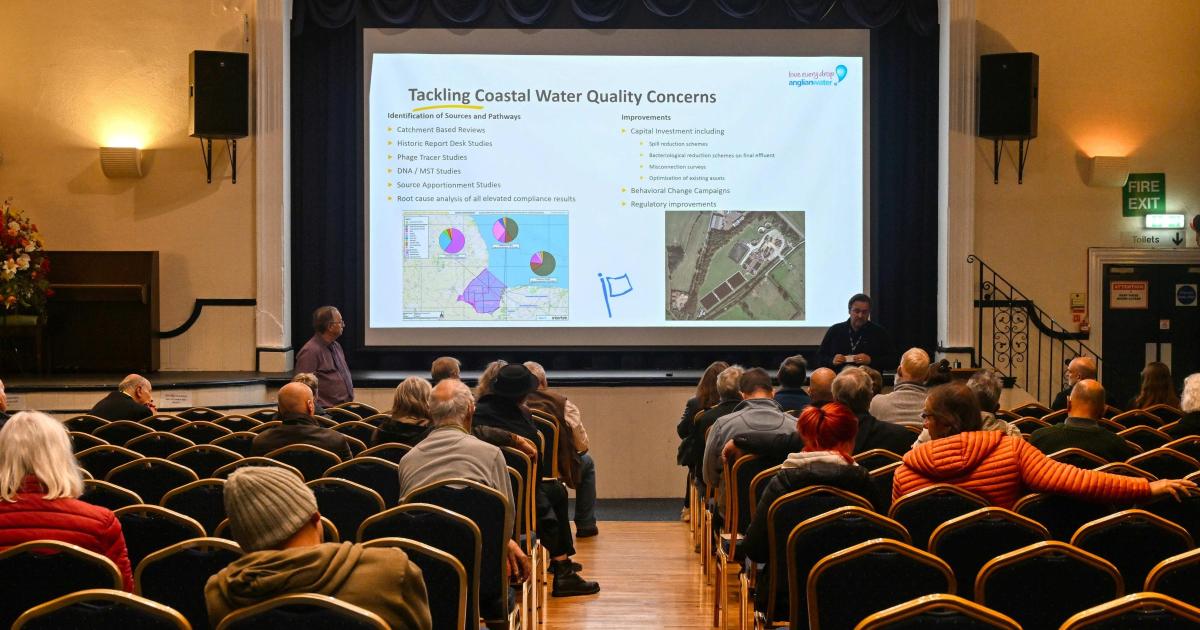
And it is among a host of pollution problems facing Hunstanton and its surrounding beaches, a recent public meeting heard.
Heacham Beach, where the water quality is now rated as ‘sufficient’ after being classed as ‘poor’ since 2019 (Image: Chris Bishop)
Around 50 attended the event organised by Hunstanton Town Council to discuss water-related issues.
Topics discussed at Hunstanton Town Hall included the causes of coastal pollution, whether Anglian Water’s treatment works at Heacham was at full capacity and the state of the sea defences.
Sandra Squire, West Norfolk Council’s cabinet member for environment and coast (Image: Chris Bishop)
Sandra Squire, West Norfolk Council’s cabinet member for the environment and coast, said tourism was affected by water quality, adding: “No-one wants a brown flag beach.”
Mrs Squire added a single dog poo could contaminate an area of the sea the size of an Olympic swimming pool.
“Every time someone is not picking up after their dog, eventually it will end up on the beach,” she said. “Not just on the beach but up here, in the town.”
A slide showing the impact of water quality on coastal communities (Image: Chris Bishop)
Mrs Squire said 38pc of pollution incidents were caused by water companies with the remainder down to other causes, adding: “We need a more holistic approach, we need everyone to take responsibility.”
Local Mick Wing asked whether seal droppings are also tested for, adding: “They cause far more waste than any dog.”
Mrs Squire said as far as she knew, they were not.
Adam Worley, Anglian Water (AW) catchment to coast manager (Image: Chris Bishop)
Waste from dogs, along with birds including gulls and Hunstanton’s burgeoning duck population is washed into the sea via drains in the town during the so-called “first flush” when heavy rain follows a dry spell.
Adam Worley, Anglian Water (AW) catchment to coast manager, said bathing water was tested around 20 times off designated beaches between May 1 and September 30 for E. coli and faecal matter.
Mr Worley said water quality had improved at Heacham, Hunstanton and Old Hunstanton, while pollution has fallen.
A slide showing the causes of coastal pollution (Image: Chris Bishop)
He said improvements had been made to sewage plants at King’s Lynn and Boston including ultraviolet systems to disinfect water discharged into the sea.
Mr Worley said a large holding tank was being built in Hunstanton to hold water during heavy rain so the “first flush” could then be pumped away to be treated rather than being discharged straight into the sea.
Terry Parish, a borough councillor for Heacham, said AW had started objecting to new housing developments in 2025 because its treatment plant in the village was close to capacity, with an upgrade not due until 2035.
A slide showing how pollution has fallen at Heacham, Hunstanton and Old Hunstanton (Image: Chris Bishop)
But earlier this year, it changed the way it calculated flows through the plant and stopped opposing new homes.
“That increases the perceived capacity for development,” said Mr Parish. “it also increases the risk of overwhelming the system.”
Mr Parish said water for the area around Hunstanton, Heacham and Docking was supplied by boreholes at Fring, Great Bircham and Osier Carr.
Heacham councillor Terry Parish at the public meeting (Image: Chris Bishop)
He said the area had a population of 12,000, which was swelled by 20,000 visitors during the summer.
He said over-extraction caused environmental problems, such as the Heacham River drying up between Fring and Sedgeford over the summer.
Mr Parish said a new “strategic pipeline” and reservoirs elsewhere in the region were expected to be in operation by 2036.
Stuart Ashworth, West Norfolk Council’s assistant director for the environment and planning (Image: Chris Bishop)
“Theoretically in 2036 there will be relieved demand for boreholes,” he said. “Ten more years of sucking the ground dry and then the answer comes.”
Stuart Ashworth, West Norfolk Council’s assistant director for the environment and planning, said the government had increased its target for the number of new homes needing to be built in the borough from 544 to 993, meaning 8,500 properties would be needed by 2044.
He said AW had stopped opposing new development because it had moved from using annual flows to calculate the capacity of its Heacham plant to a three-year rolling average to allow for unusually wet or dry years.
Jade Kite, West Norfolk Council’s flood and water management officer (Image: Chris Bishop)
But capacity would be reviewed annually, meaning there would be no “blanket guarantee” on future growth.
Jade Kite, the council’s flood and water management officer, outlined repairs due to get under way to the sea defences next year because beach erosion had washed sand away from their footings along stratch near the bottom of the Green.
She said thousands of tonnes of imported rock would be piled against the affected stretch, costing the council £2m.
The affected stretch of the sea defences at Hunstanton (Image: Chris Bishop)
Miss Kite said beach levels had fallen to levels last seen in the late 19th and early 20th centuries, with underlying rock exposed because changing tidal currents had carried sand out to sea, forming large banks offshore.
She said groynes had been removed because they no longer prevented sand from being washed away.
Jon Butler asked Miss Kite whether the groynes would be replaced as after they were taken away the erosion of the beach accelerated.
Large sandbanks have formed offshore at Hunstanton from sand washed away from the beach by changing tidal currents (Image: Chris Bishop)
“Erosion was happening while they were there,” she said. “If we were to reinstate the groynes tomorrow it wouldn’t make any difference to the beach.”
Miss Kite said longer-term an upgrade of the sea defences along much of the prom is needed, costing more than £40m, with central government likely to cover 90pc of the cost.
Planning is expected to take between a year and 18 months.