
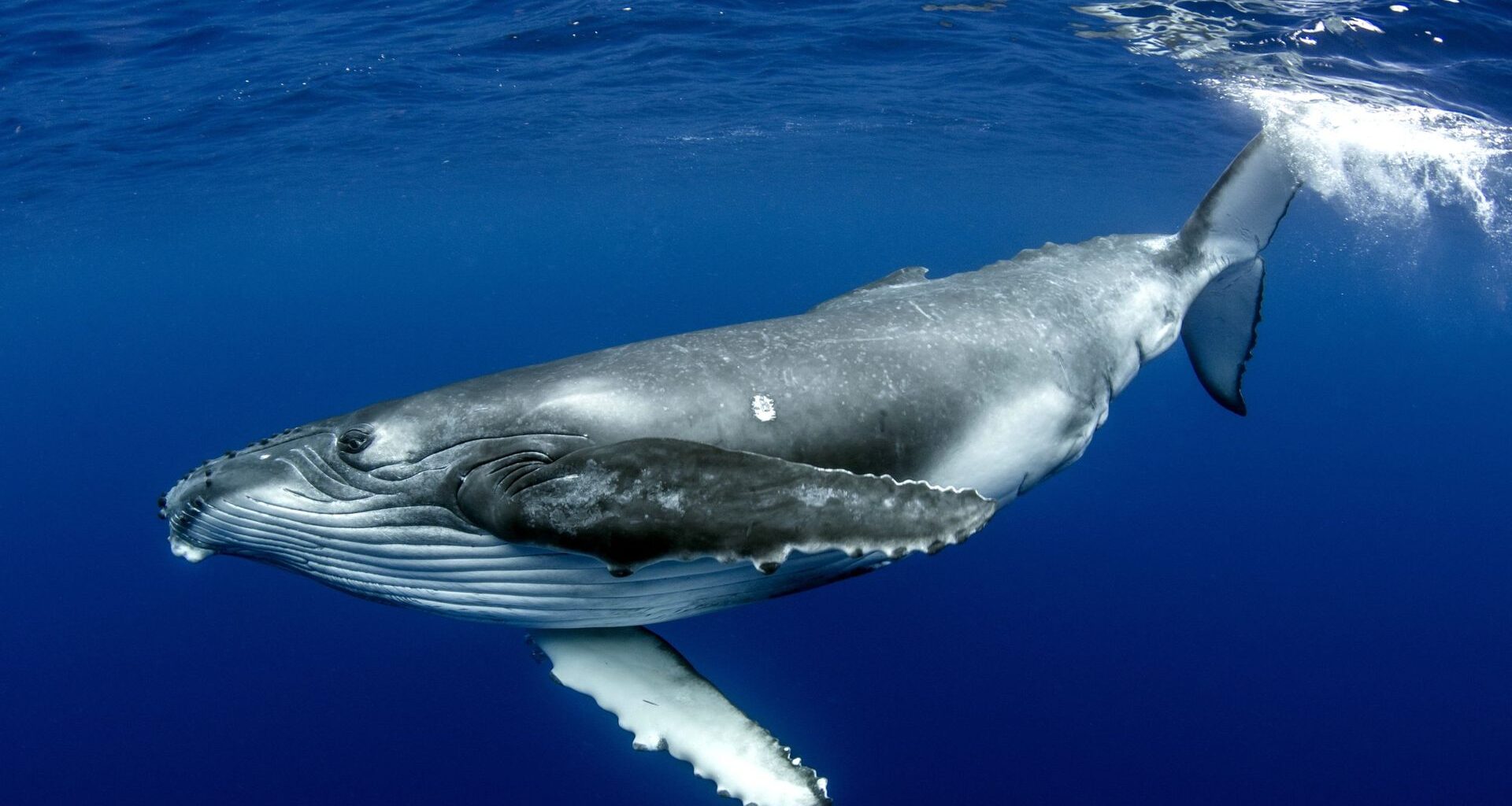
Humpback whales may slow their metabolism to conserve energy when ocean heatwaves disrupt food supplies, with pregnant females facing greater risks.
Blubber gives a humpback whale something to live on when food runs short.
During the Pacific’s 2014–2016 marine heatwave, known as the Blob, researchers expected hungry whales to burn through that fat and eventually start breaking down protein in their own bodies.
But chemical clues from three females told a different story. Their bodies appeared to slow down, using less fat and reducing how much protein they broke down and rebuilt.
Study leader Ching-Tsun Chang, a former graduate student at the University of Hawaii at Manoa, now works at National Sun Yat-sen University in Taiwan.
The findings also suggest pregnancy left whales less able to adjust to the shortage.
“We’ve known from previous reports that humpback whales declined in number and body condition during the Blob,” Chang said.
“What we show here is the physiological story behind those patterns: how whales adjust their metabolism, how nutrient use shifts, and how reproduction may be compromised.”
Baleen records a life
The team studied baleen from three female humpbacks found dead in Hawaii between 2016 and 2021. These long plates hang from the upper jaw and strain food from seawater.
Baleen grows continuously and contains keratin, the material in fingernails. As it grows, it traps chemical clues about a whale’s body that can remain stable for decades.
Researchers collected powder every 0.4 inch (1 centimeter) along the plates, which together covered nearly eight years, from May 2013 to April 2021.
They measured progesterone, a hormone that stays high during pregnancy, and amino acids, the building blocks of protein.
Kristi West, director of the university’s Health and Stranding Lab, said: “Baleen is an extraordinary archive. It lets us reconstruct an animal’s nutritional and reproductive history with fine detail.”
Whales burned less fat
The heatwave brought sharp declines in krill and small fish.
Satellite records helped the team identify a strong heatwave phase from 2015 to early 2016, followed by a lingering phase from late 2016 to mid-2018, when Gulf of Alaska krill remained scarce despite cooler water.
Nitrogen in the amino acids helped researchers track how much protein the whales broke down and rebuilt. Carbon provided clues to how much fat they used.
The results surprised them: the whales appeared to use less fat and recycle less protein during the heatwave and afterward than in normal years.
The researchers interpreted this as a slowdown in metabolism, the processes that keep a body running, and suspect poor feeding had left the animals with less blubber to draw on.
The team also built a computer model of a whale’s energy budget, assuming feeding success fell by 75%. It predicted a small initial rise in daily energy use, followed by a sharp fall below normal-year levels.
Sprinter offers another clue
DNA identified one whale as Sprinter, also known as Helleborine, from a register of more than 4,200 North Pacific humpbacks.
Photos in the Happywhale database traced her back to August 19, 1993, off Southeast Alaska and British Columbia.
Sprinter had been sighted 15 times across Alaska, British Columbia, and Hawaii, and was more than 28 years old when she died.
On March 25, 2021, photos showed her near Lahaina, Maui, in a competitive group of about six whales, with a large wound behind her blowholes.
Over the next week, photos captured plenty of surface activity, including slapping the water with her pectoral fins. Her last tail photos came on April 2, and she stranded at Waimanalo on Oahu 10 days later.
Her final baleen showed increased protein recycling, matching that active period in a normal year. Her progesterone stayed low throughout her record, showing no sign of pregnancy.
Pregnancy may limit flexibility
Another whale, a 44-foot (13.4-meter) female, stranded on Molokai in January 2020 while carrying a full-term female fetus. Her baleen held a record of that pregnancy and of what appears to have been an earlier one.
Those two pregnancies gave the team something to compare. In whales that weren’t pregnant, protein signals held fairly steady through the heatwave, even as fat use fell.
During pregnancy, protein recycling and fat use both dropped, and the energy model predicted a steeper fall in energy use for pregnant whales than for the others.
A pregnant whale normally draws on both its fat and its protein stores.
The researchers suggest that this dependence left pregnant whales with fewer ways to cope when food ran short.
The Molokai whale’s record held one more puzzle. In 2017 and 2018, her progesterone rose twice more, for about nine months and then about six.
Neither rise lasted long enough for a full-term pregnancy, and the amino acid signals from those stretches matched neither her pregnant nor her nonpregnant periods.
The researchers suggest these may have been pregnancies that ended early, or pseudopregnancies, in which the ovary keeps producing progesterone as if a pregnancy were underway.
With the data they have, they can’t yet tell which.
Recovery took much longer
Cooling water did not bring an immediate return to normal. During the lingering phase, protein signals and modeled energy use varied more widely and fell further than in normal years.
The team’s analysis suggests those lean years affected metabolism more strongly than the heatwave itself.
The researchers think the whales had not fully recovered and that their energy shortfalls built up over time.
Other monitoring found similar signs of trouble. A 2022 NOAA report noted unusual thinness in more than 10% of whales observed on Gulf of Alaska feeding grounds between 2016 and 2021.
Long-term monitoring also recorded sharp drops in calf production during and after the Blob.
Other studies found that humpback numbers and reproductive success took several years to recover after major heatwaves.
Three whales leave questions
Three whales cannot tell the story of an entire population.
Their pregnant and non-pregnant records also covered different stretches of the heatwave, making it hard to separate the heatwave’s effects from differences between individuals.
Only two whales provided the carbon measurements used to study fat use.
The energy model relied on assumptions from earlier research, and nobody directly measured what these whales ate during the heatwave, so its results are predictions rather than measurements.
All three belonged to the population that breeds around Hawaii, where whales showed signs of physical stress and had fewer calves.
Humpbacks breeding off Mexico and Central America stayed comparatively stable, and the researchers want to test baleen from other Pacific populations to understand why.
The study is published in the journal iScience.
—–
Like what you read? Subscribe to our newsletter for engaging articles, exclusive content, and the latest updates.
Check us out on EarthSnap, a free app brought to you by Eric Ralls and Earth.com.
—–