
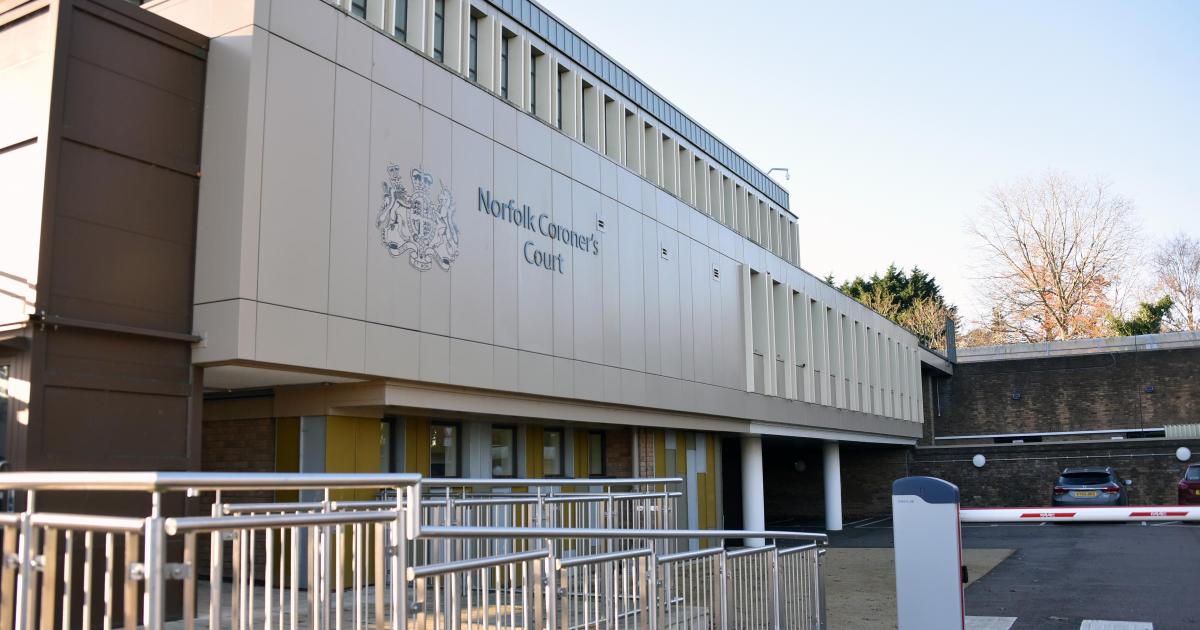
Reginald Mills, known as Reg, died at the Norfolk and Norwich University Hospital (N&N) on February 20 after an infection around his left eye developed into life-threatening sepsis.
His family told an inquest at Norfolk Coroner’s Court they sought urgent medical attention on February 9 because his eye was so badly swollen he could barely open it.
But the GP diagnosed a burst blood vessel and advised that antibiotics were unnecessary.
Four days later, Mr Mills of Scole, near Diss, was rushed to hospital, where scans revealed a serious infection affecting his eye socket and surrounding tissues.
Despite intensive treatment, he died a week later.
The family of Reg Mills raised concerns about a consultation with a locum GP days before his death (Image: Newsquest)
Months before his death, the court heard, Mr Mills had been experiencing hallucinations.
His family feared they were linked to an infection, but his GP had suggested dementia as a possible explanation.
His wife said the family left the appointment feeling their concerns had not been addressed.
By February 9, his left eye had become painful and swollen, and he could open it only around one millimetre.
His daughter arranged an urgent appointment and drove her parents to the surgery.
Mrs Mills said she specifically asked whether antibiotics would be appropriate but was told they were unnecessary. He was instead prescribed eye drops.
Over the following days, her husband’s condition deteriorated.
By February 12, he was repeatedly falling asleep and the swelling around his eye had worsened considerably.
His daughter photographed the eye and urged her mother to request a home visit.
A paramedic practitioner attended the following morning and immediately called an ambulance.
Reg Mills died at the Norfolk and Norwich Hospital (Image: Newsquest)
Hospital investigations at the N&N revealed an abscess and cellulitis around his eye, which had led to sepsis.
While there, Mr Mills suffered a cardiac arrest and was resuscitated. Although he regained consciousness, his condition continued to worsen.
On February 18, doctors told his family he was in septic shock and would not recover.
His wife and daughters agreed to withdraw active treatment in favour of palliative care. He died at around 2am on February 20.
During the inquest, his daughter challenged locum GP Dr Salah Elbishari.
She questioned whether the abscess responsible for the infection had been missed because his eye had not been properly examined.
Giving evidence, Dr Elbishari said he had checked Mr Mills’s vital signs, which were within normal ranges.
He described the eye as very red but said he had not observed significant swelling.
His assessment was that Mr Mills had a burst blood vessel, which he expected to resolve.
The consultation lasted around 10 to 15 minutes.
The family asked why he had not opened the eye or used additional equipment to examine it more thoroughly.
Dr Elbishari maintained that this had not been necessary based on the symptoms he observed.
He also explained that dementia had been one possible explanation he was considering for the hallucinations, rather than a confirmed diagnosis.
Area coroner Johanna Thompson (Image: The Coroners’ Society)
Norfolk coroner Johanna Thompson recorded a narrative conclusion, confirming that Mr Mills died from sepsis due to orbital cellulitis.
Mrs Mills described how, until her husband’s sudden deterioration, he had enjoyed an independent and active life.
He could wash, dress and care for himself, enjoyed playing the organ and had recently fitted a dishwasher and moved kitchen cupboards.