
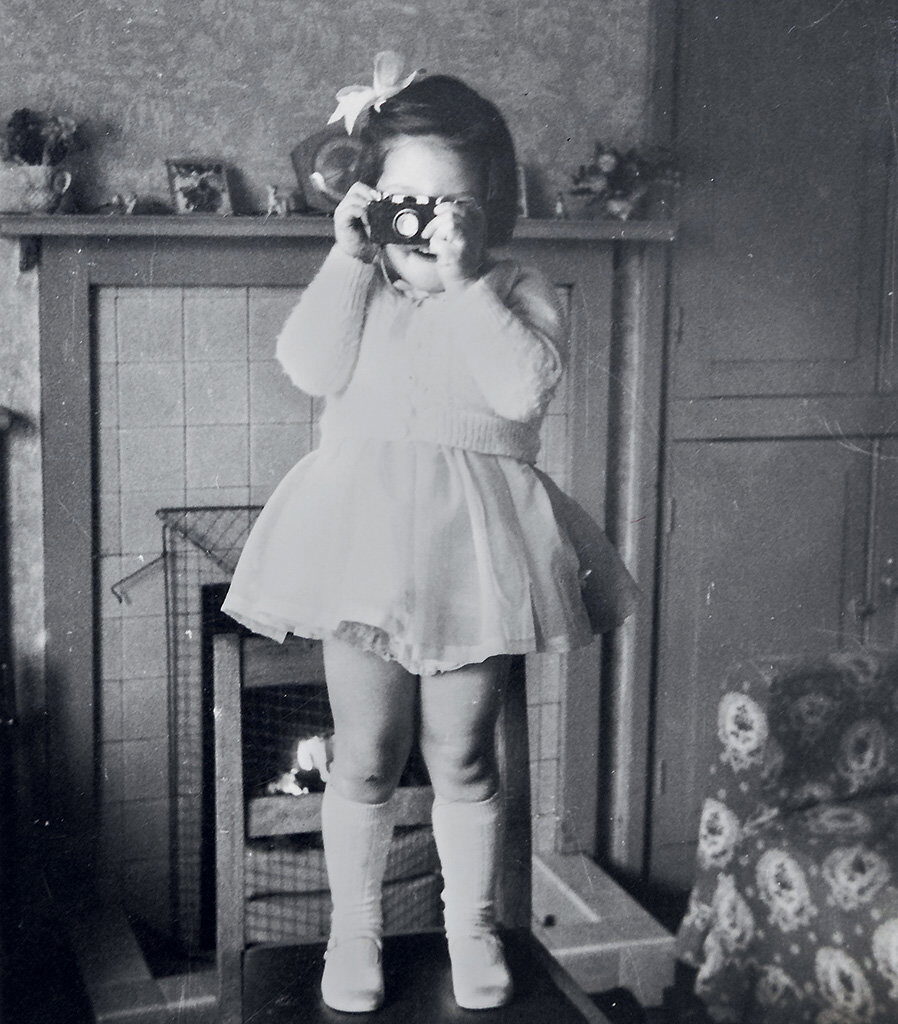
The project began when Annebella started looking for the photographs taken by children at the turn of the 20th century, after Kodak released the Box Brownie camera, which was specifically advertised and sold to children. The hunt led her to museums and school archives across the country, where she was often met by dead ends. “Museums, for the most part, have not tended to value children’s photos,” with some exceptions, she explains. “A lot of the material in the book comes from my own collection, built through decades of very cheap purchases in secondhand markets or from house clearance finds.”
Building upon this, Annebella read a lot of children’s comics and reached out to older photographers for their early images, which brought about thousands of never-before-seen childhood photos. “These offered me life stories that put photo narratives at their heart,” she says, “their photos showed me how children used cameras to express themselves as autonomous beings, separate from their parents and other adults.” With a camera, it seems that most children were left to their own devices, which granted them the space and freedom to play and make mistakes.
In 1999, children aged seven, 11 and 15 were recruited by Kodak for a research project, where they were freely given disposable cameras that they could do whatever they wanted with. “Those children spoke about the photos they took,” Annebella says, “with friends flicking V-signs and baring their bottoms; dogs dressed up in sunglasses and hats.” In this project alone, we see how children, when granted the space, positioned themselves in opposition to adults, “whose photography they found too ‘proper’,” she suggests. “The permissiveness meant that they felt enabled to dispose of planning, posing and other parental photographic norms, their excitement, spontaneity and play remain inspiring,” Annebella ends.