
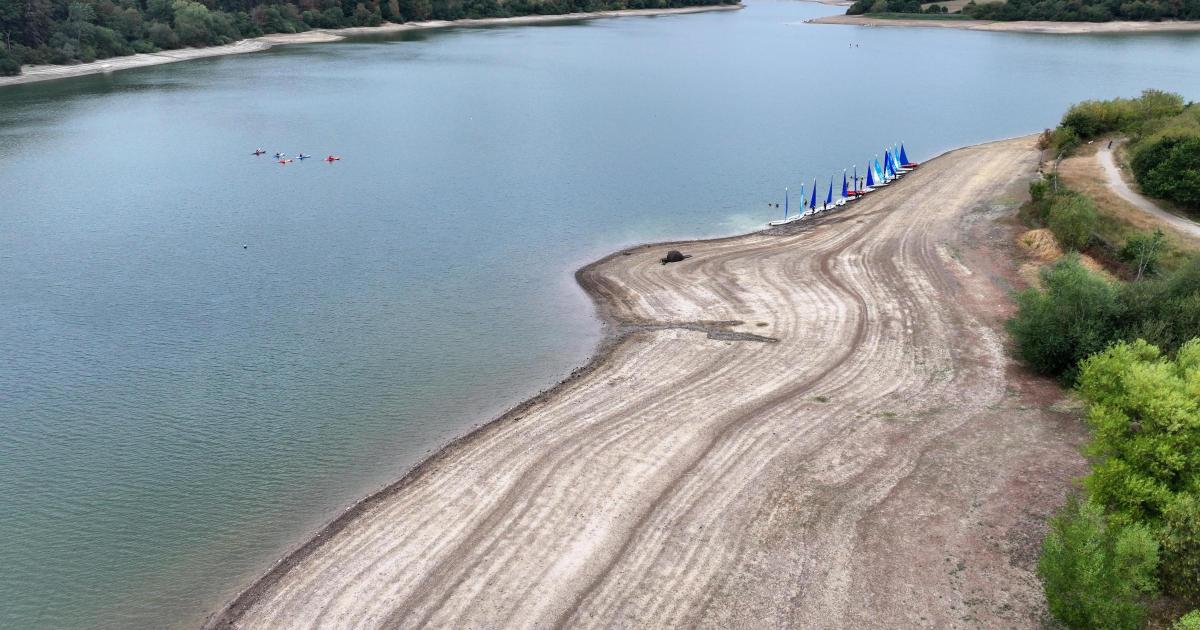
The Government’s emergency committee, known as Cobra, has been meeting up to twice a week to discuss falling water levels in Sussex and the south-west of England, according to The Times.
Ardingly Reservoir is among those at worst risk – although South East Water says that measures have been put in place to ensure it does not run dry before the festive period.
A secret “reasonable worst-case scenario” prepared for ministers suggests several reservoirs could reach zero per cent capacity within weeks.
This point, known as “day zero”, could affect water supplies to homes and disrupt the construction of Hinkley Point C nuclear power station and operations at HMP Exeter.
Ardingly Reservoir, which supplies about 280,000 customers across West Sussex, is at 17 per cent capacity. It is among the reservoirs being closely watched by officials as the country deals with the effects of summer heatwaves and drought.
Sussex and the south-west have been identified as the worst-affected areas. Half of England has been left in drought after a summer of high temperatures and low rainfall.
Water companies and ministers have taken steps to delay the possible impact of the shortages. Officials said those measures had already pushed back some predicted “day zero” dates.
South East Water has taken action which has moved Whitehall forecasts for Ardingly into next year. The company said the reservoir was not being considered for “day zero” in 2026 because of measures already in place.
Even if a reservoir were to become empty, water companies would probably be able to transfer supplies from other areas. However, ministers remain concerned about possible disruption to homes supplied by other reservoirs.
Three water companies have asked the Government for permission to introduce non-essential use bans in parts of their networks. The requests were made by Southern Water, South East Water and South West Water.
Such bans can restrict commercial car washes, the watering of sports fields and the filling of private swimming pools. The applications are being reviewed by Dame Angela Eagle, the Environment Secretary.
Last week, Dame Angela directed the Environment Agency to give priority to protecting public water supplies around Wimbleball and Ardingly reservoirs, as well as reservoirs in west Devon and Cornwall.
The agency was told to reduce some releases of reservoir water into rivers. Those releases help clean rivers and support wildlife, but ministers said reducing them could help lower the risk of interruptions to supplies.
Officials have raised concerns about the effect on salmon and other fish, which could be harmed by lower water levels and reduced river flows.
Experts from the Government’s Scientific Advisory Group for Emergencies have been asked to examine water companies’ plans and modelling. Ministers have also requested updated lists of vulnerable residents, who would receive priority if supplies were disrupted.
Rainfall from the first named storms of the season, Austen and Boelo, has raised hopes that reservoir levels will recover. However, officials said normal autumn and winter rainfall would not be enough to end the drought.
They estimate that rainfall would need to reach 120 per cent of the long-term average over the next six months for the country to recover fully.
The Government said in a comment to the Times: “Customer water supplies remain uninterrupted.”
They went on to say they have instructed water companies to transfer water to support the lowest reservoirs, as well as speed up leak detection and deliver daily monitoring of reservoir and river levels to help ease the pressure on public supplies.
South West Water said in a comment to The Times: “We are taking urgent action to protect drinking water supplies, repairing around 440 leaks a week and transferring three million litres of water a day to areas where it is needed most. We are also exploring additional water sources and working directly with households and high-using businesses to reduce consumption.”