
Where did the idea come from?
The concept of the Brew Brick was sparked when Mark Laksevics of brick company York Handmade visited Studio Egret West to deliver a CPD on brick manufacturing tradition. I’d always been interested in material innovation and finding new uses for waste, and our discussions around creative collaboration and material production led to the idea of exploring an alternative approach to brickmaking. Coffee grounds felt like a natural place to start, given the volume of waste generated daily within our own studio and across urban environments more broadly.
How did you develop the prototype?
We began with small-scale material testing, collecting a week’s worth of spent coffee grounds from our studio. I then travelled to York Handmade’s factory to explore how different ratios of coffee waste and locally sourced clay could be incorporated into a traditional brick mix.
The initial prototype’s goal was to understand whether the waste additive maintained the performance and appearance expected of a fired clay product.
Where have you used it?
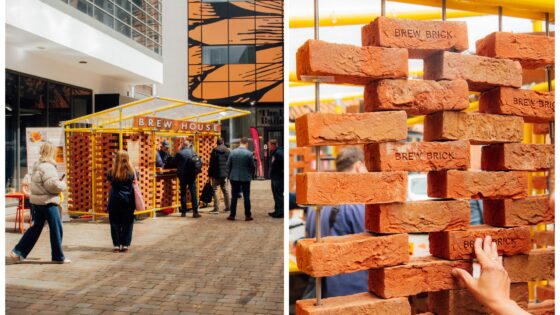
With growing confidence in the Brew Brick, we entered a competition to design and construct a pavilion for Clerkenwell Design Week. The result was Brew House, a pavilion constructed from approximately 700 Brew Bricks.
Working with local coffee shops across Clerkenwell, we collected around 300kg of spent coffee grounds in bright yellow wheelie bins over the course of a week, diverting a local waste stream into the new construction material.
What are the main benefits?
By replacing a proportion of virgin clay with spent coffee grounds, the Brew Brick is approximately 5 per cent lighter than a traditional brick. During firing, the organic material burns away, leaving microscopic air pockets within the brick and creating a more porous, aerated structure.
‘Brew Brick is about 5 per cent lighter than a traditional brick’
The reduced weight lowers transport-related carbon emissions and decreases structural loads in brick façades, while using less clay helps conserve a finite natural resource. The increased porosity also reduces the energy required during firing.
Can production be scaled up?
The Brew Brick has been developed with scalability in mind and is designed to work within existing brick manufacturing processes. Further testing is underway to refine the material mix and increase the proportion of coffee waste that can be incorporated. In principle, the process could then be adopted by other manufacturers, allowing the Brew Brick to be produced locally at a wider scale.
What happened to the Brew House pavilion?
Following Clerkenwell Design Week, the pavilion was carefully dismantled and most of its components redistributed through Tipping Point East, ensuring the materials remained in use rather than becoming waste. The Brew Bricks themselves were subsequently taken by ForsterInc and incorporated into the bar of a Fuckoffee café in Pimlico, giving the material a second life within a permanent commercial setting.
What are the next steps?
Current applications have focused primarily on interior and non-loadbearing installations. Ongoing research aims to further understand the material’s long-term performance and durability, with the ambition of expanding its use into external applications subject to successful testing and certification.
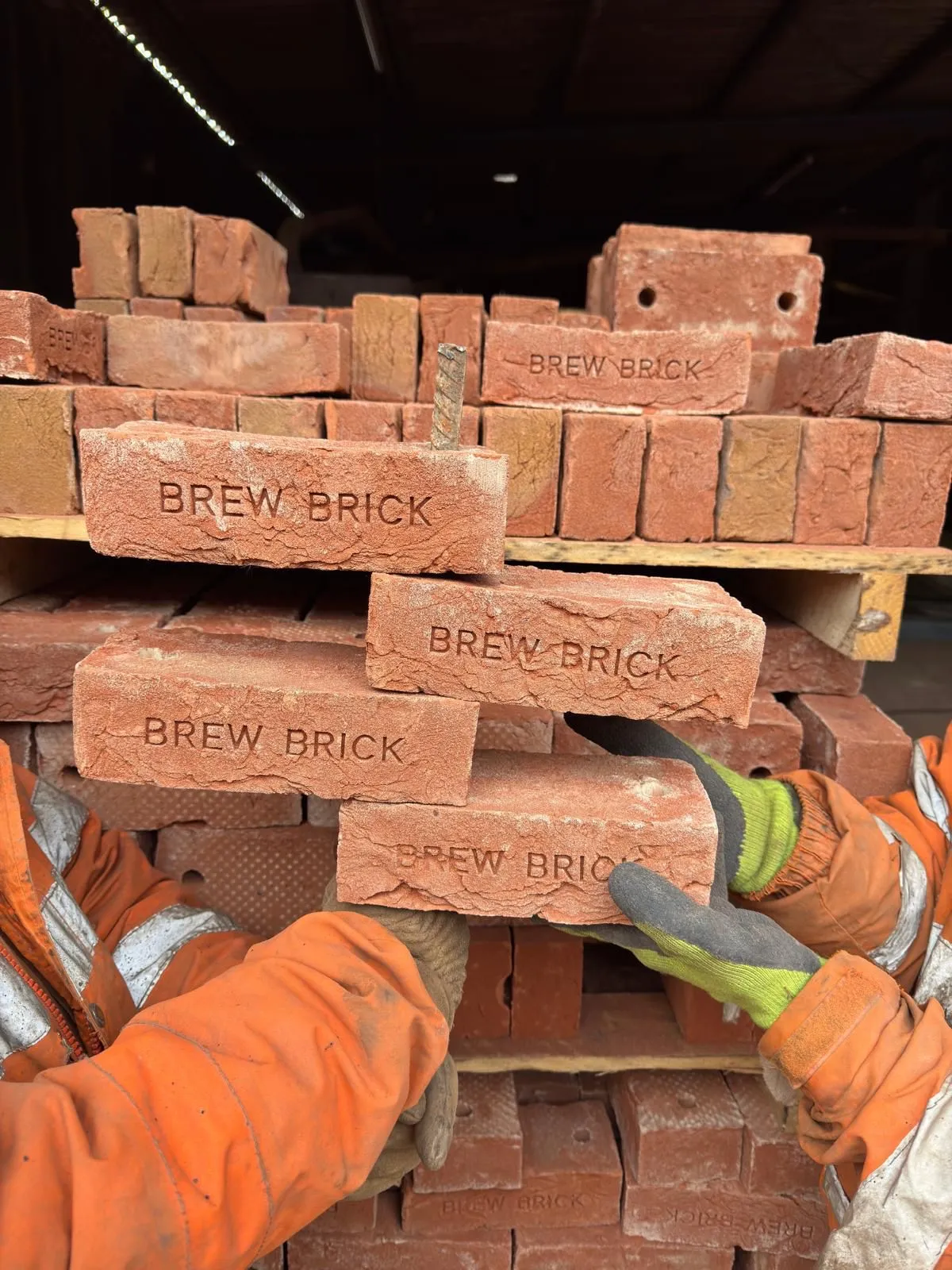
Brew Brick developed by Studio Egret West
Source: Studio Egret West
2018 predictions: Will the profession continue to be marginalised?