
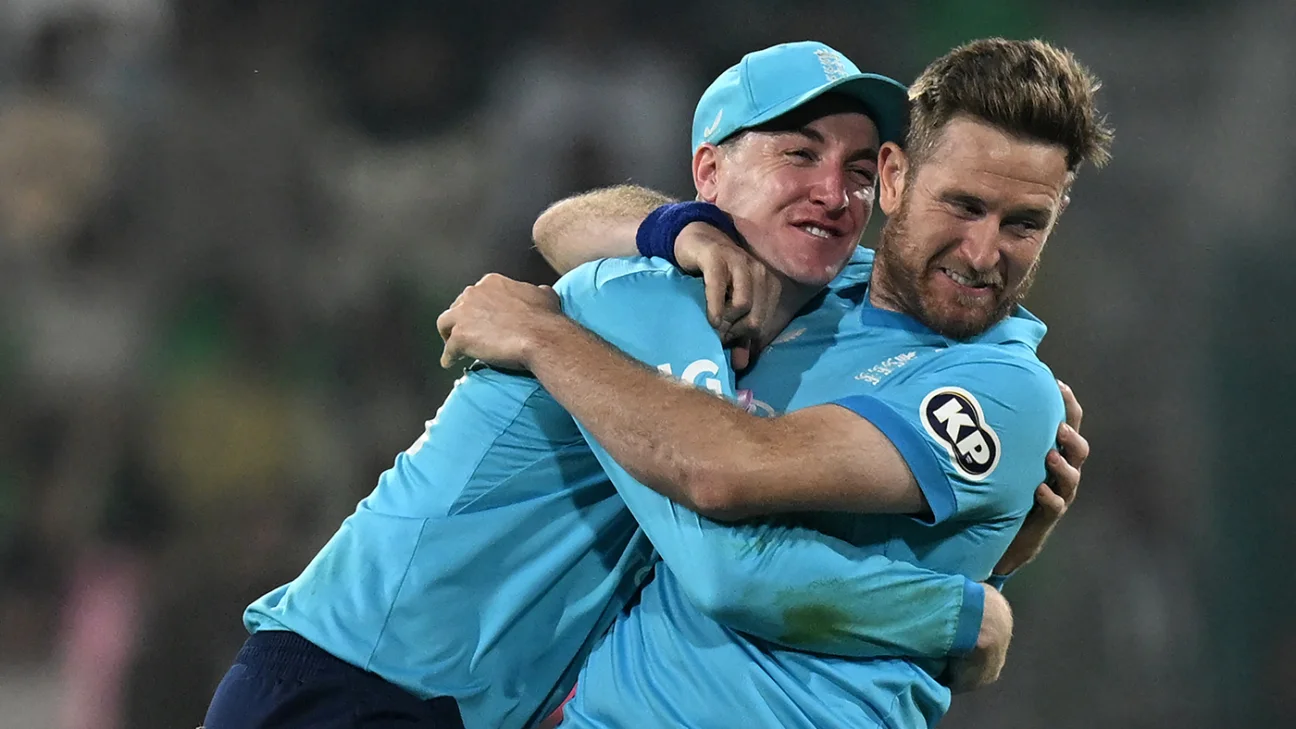
The host broadcast of England‘s tri-series in Pakistan has thrown up several weird and wonderful sights over the past two weeks. An entire block of fans eating fried chicken in sync. A team of Hawk-Eye operators dressed in shalwar kameez while sampling the local tea. And the follically challenged Mark Butcher repeatedly plugging a shampoo brand.But perhaps the strangest of all is the one that has not involved any product placement: Adil Rashid, sitting in the England dugout wearing a high-vis vest. Rashid is England’s second-highest ODI wicket-taker and has been their first-choice white-ball spinner for 11 years; he was fully fit, yet found himself running the drinks for three of England’s four games.The explanation was simple enough: England felt that Pakistan’s batting-friendly surfaces were unlikely to suit Rashid, and backed Liam Dawson‘s left-arm spin instead. “If you look at all three teams, legspin hasn’t really played too much of a role,” Brendon McCullum said. “Unfortunately for Rash, on this occasion, the conditions probably went against him.”Dawson was quietly brilliant. He was the best bowler in England’s failed defence of 429 against Sri Lanka, returning figures of 1 for 71 from 10 overs, then took 2 for 30 against Pakistan (only for Shadab Khan to deliver a miraculous win) and 4 for 49 against Sri Lanka. Along with Jamie Overton, he was one of only two England bowlers to leave the trip with his reputation enhanced.
It has been an extraordinary turnaround for a player who had assumed his international career was over. Dawson was bruised when he was told he would be in England’s squad for the 2023 World Cup squad by the selectors only to miss out, but seemed to have made his peace with never playing for his country again.

Adil Rashid has carried the drinks for each of England’s last three ODIs•Sameer Ali/Getty Images
But Harry Brook has pushed his case consistently since he took over as white-ball captain last year, insisting that Dawson should play first T20 cricket, and now ODIs for England too. After so long as the spare man in every squad, Dawson is enjoying a late-career resurgence, and has played 37 of his 57 international matches since his 35th birthday.
He has little mystery as a bowler – no doosra, no carrom ball – but is vastly experienced and knows not only his strengths, but his limitations. Brook’s instruction to his bowlers in Pakistan was simple: to keep the stumps in play as much as possible. Dawson followed it perfectly, despite bowling many of his 30 overs on the tour in heavy dew while defending scores.
The medium-term implications of England’s decision to pick him ahead of Rashid are not yet clear. It will be no surprise if Rashid plays their three ODIs in Australia next month, where Jofra Archer will also return from a rest, but the past two weeks have confirmed that he is no longer an automatic inclusion in every team.
Rashid has had a quiet year in 50-over cricket. He bowled well in Sri Lanka in January, but took a solitary wicket in three ODIs against India in July while conceding 7.20 runs per over, and missed England’s home series against Sri Lanka with a hand injury. He no longer plays much outside of internationals – only the Hundred and the ILT20 – and looks a little short of cricket.
But he has been written off prematurely before, and tends to find a way through quiet runs of form. Assuming he does, can England pick Dawson and Rashid in the same side? It might seem like the easy solution to their inability to take wickets in ODI cricket – particularly in the middle overs – but every selection decision comes with trade-offs.
There are two potential drawbacks. The first is that next year’s World Cup will be played early in the southern African season. While England will play in a wide variety of conditions, with first-round games in three different countries, they may well decide that they want the option to bowl 40 overs of seam, rather than a maximum of 30.
The second surrounds batting depth. Picking both spinners means either relying on Sam Curran as one of three seamers – which feels unlikely after his struggles in Pakistan – or batting Dawson at No. 7 and Overton at No. 8. Dawson has 22 professional hundreds and made a rearguard 68 against India in July, but England would ideally prefer him at No. 8 or below.
The reality for England is that in the absence of a genuine seam-bowling allrounder like Ben Stokes – who can bat in the top six and is a reliable fifth bowler – there is no perfect way to balance their side. World Cups can make best-laid plans go awry in any case: few would have expected England to finish the 2019 edition with Chris Woakes, not Moeen Ali, as their No. 7.
There are similar dilemmas around their best batting line-up: Jacob Bethell will return from a knee injury which required surgery in Australia, but Ben Duckett and Tom Banton‘s success as an opening partnership might demand a new role for him. In the short term, might he bat in the middle order ahead of Jordan Cox, with Banton taking the gloves?Jos Buttler appears unlikely to play another ODI until next September after hamstring surgery and is one of several England players set to miss May’s home series against Pakistan while at the IPL. It means there will be plenty of opportunities for players to demand selection, and these issues have a funny way of working themselves out in good time.
England proved in Pakistan that they remain an enigmatic 50-over side. They played well for long periods of all four games, much better than their results – a win and three losses – would suggest, but a lack of killer instinct cost them badly. They have made some progress in the format this year, but have still only won seven out of 13 ODIs in 2026.
McCullum insisted that Brook would have learned from the experience, and reiterated his desire for England to become “a team that can challenge seriously for that World Cup in 12 months’ time”. It will be a tough task given their current world ranking – eighth, between Afghanistan and Bangladesh – but Australia will provide another progress check.