
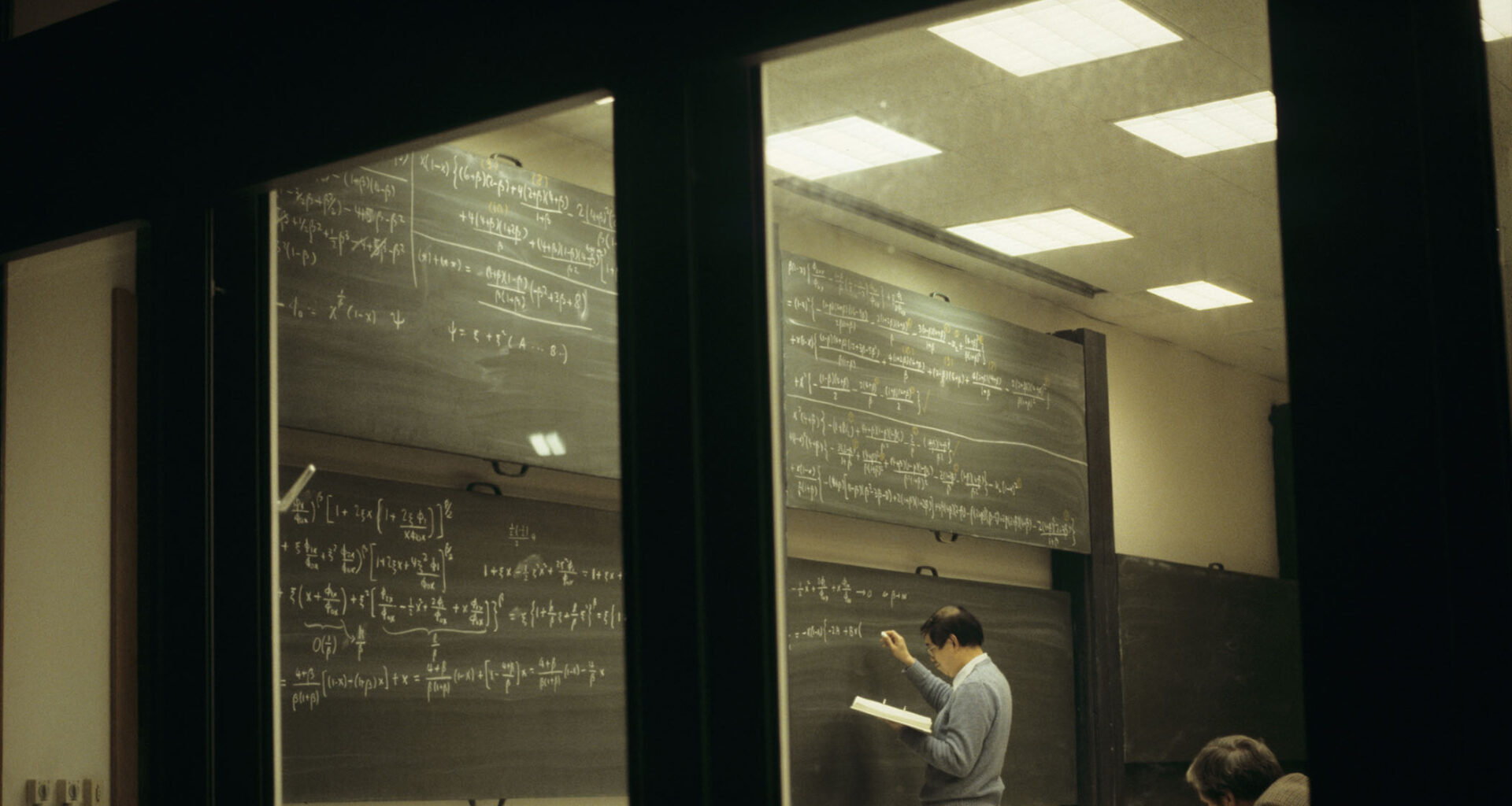
The dominance of mathematics by powerful AI firms makes the field vulnerable to being captured by private interests who keep knowledge secret, leading mathematicians have warned.
Britain’s most senior mathematicians, including three winners of the Fields medal – the Nobel prize of maths – met at the Royal Society in London last week after OpenAI published solutions last month to 377 of the hardest mathematical problems, generated by its frontier AI models.
But the possibility that OpenAI, which makes ChatGPT, or Anthropic, which is behind Claude, might keep future work secret would mean they would control access to fundamental knowledge.
Martin Bridson, president of the Clay Mathematics Institute – which sets the Millennium Prize Problems, the field’s greatest challenges – said there was a “longer-term fear that knowledge could be hoarded behind paywalls”, where the only way of understanding AI research would be to pay for access to an AI chatbot.
“The more immediate fear is access to the tools of generating that knowledge,” said Bridson, who is a professor of pure mathematics at the University of Oxford.
Last month Terence Tao, probably the world’s leading mathematician, said in an interview with The Observer that Anthropic was paying mathematicians to formalise and write up solutions to problems solved by its frontier models – the cutting-edge AI tools not available to the public.
“That causes a different problem because they get to pick who writes up the paper,” Tao said.
Similar tools do exist in other fields, such as the Large Hadron Collider at Cern in Switzerland. But at Cern access is decided through a research board, advised by committees of scientists. So far OpenAI and Anthropic have committed $5m each to a fund run by the Simons Foundation, a leading supporter of maths research, to give some researchers access to their models.
“Why should they get to say who has access to these tools, and on what basis do they choose who gets access?” Bridson said.
He said it was legitimate to keep some knowledge secret, such as developing the ability to break cryptographic encryption – something that would destroy online commerce. Similarly, intellectual property should be protected.
“But the idea of fundamental knowledge being owned by people or by entities who might hoard it – that’s… deeply objectionable,” he said.
In many eras, science and maths have not been open. The Pythagorean sect in ancient Greece was a secret society, and alchemists and Renaissance thinkers usually kept their methods to themselves.
“There are moments in history where the priestly caste has maintained its power by having secret knowledge, and mathematics has played that role through the ages,” Bridson said.
Instead of publishing their proofs, early modern mathematicians guarded them as valuable secrets, to be used as a route to jobs and patronage.
In 1535, Niccolè Fontana, known as Tartaglia, became embroiled in a dispute with Antonio Marla Fior about cubic equations that lasted more than a decade. In one duel, Tartaglia solved all 30 of Fior’s problems while his opponent struggled.
Isaac Newton worked on calculus in secret, claiming he had developed the method without publishing details. When Gottfried Leibniz published his own version, Newton accused the German of plagiarism and the British mathematicians refused to use Leibniz’s superior notation – setting them back for decades.
“[Openness] hasn’t been the norm throughout history, so it’s a very important principle to maintain,” Bridson said.
The Royal Society, where the meeting took place, was founded partly to ensure that science was open. Professor Jon Keating, vice-president of the society, said the use of AI “offers to usher in a golden era of mathematics”.
He added: “However, if the mathematical community is to check these claims, and to benefit by understanding them, they need to be set out carefully and fully, not obscured or hidden from view.”
Bridson’s concerns were echoed by others who attended the meeting. Professor Ana Caraiani from Imperial College London, a member of the Association for Human Mathematics, said that no institution in Romania, her native country, was eligible to apply for access to the frontier AI models. “Most countries in the world are in that position.”
Martin Hairer, a Fields medal winner, said that open-source AI models could not compete with the frontier models. “This is a huge problem for the community. It means that one of the main tools for mathematic research going forward is under the control of two US companies, and that’s obviously not the situation we want to be in.”
Photograph by CW Schmidt-Luchs/Ullstein Bild via Getty Images