
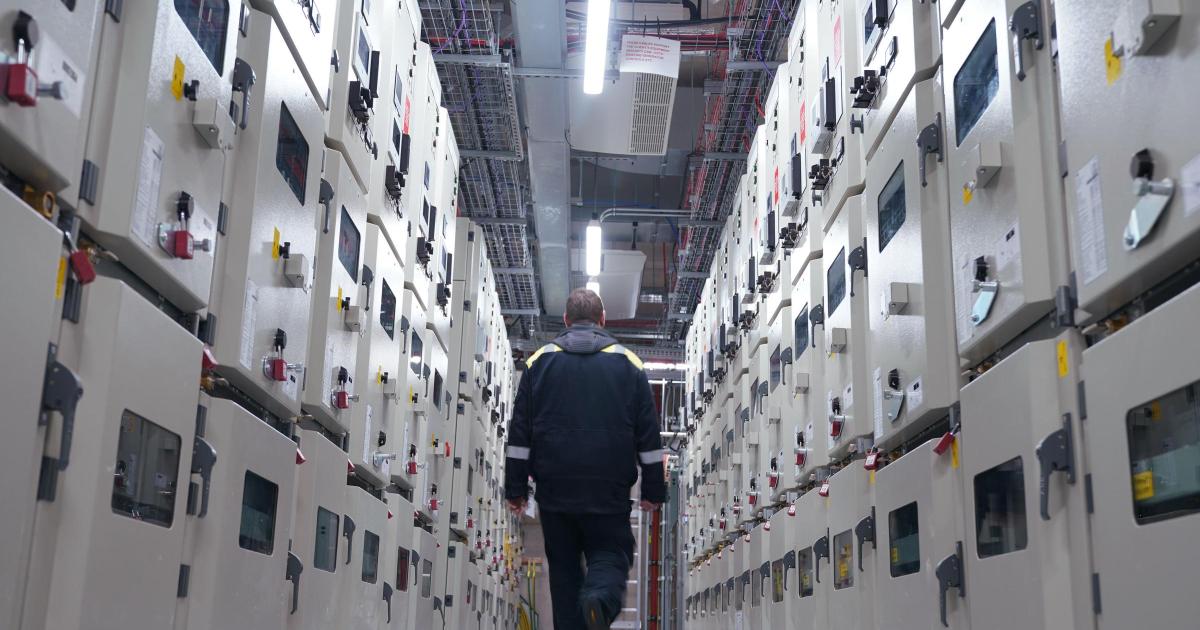
The minister also likened sceptics of artificial intelligence to people who would have dismissed the lightbulb as “a dangerous anti-candle device”.
The comment has angered environmentalists and community groups fighting a wave of proposed hyperscale data centres.
They say the minister is underplaying legitimate concerns about their environmental impact and the economic benefits they will actually deliver.
Governments across the world are currently grappling with the issue of how to attract AI investment, potentially worth billions, while facing growing opposition to the data centres that power it.
In his column, Mr Smith, the Minister for Innovation, Technology and Tertiary Education, acknowledged public unease about the technology. He said he understood the “degree of scepticism” but said “some of the loudest voices” on the technology were “problematic”.
“There’s concerns about sovereignty and who owns it, who it is accountable to, and the energy and environmental needs of the infrastructure required to make it work — and who’ll own that.
“But for all this chatter, we know something important is happening. Even before unveiling its Autumn Budget, the UK Government made it clear investment in AI would be a priority, underlining the urgency and the need for governments to work together at pace.”
John Swinney and Alyn Smith during a visit to the Deanston Distillery, near Doune (Image: Jane Barlow/PA Wire)
The minister said his challenge was to “make sure our society gets the benefit of all of this, without the potential downsides”.
He said the Government would take “a uniquely Scottish approach, not trying to reinvent the wheel but aligning as closely as we can to the model used by the EU — a citizen-centred approach to benefit humanity — while implementing confidence-building measures at home”.
Mr Smith said he had written to his UK counterpart, artificial intelligence minister Kanishka Narayan, “urging the UK Government to use the upcoming EU Summit to align with the EU legislation and keep pace with it going forward”.
The letter was sent days before Chancellor John Healey used Wednesday’s Budget to announce a “British data centre covenant”.
That will see operators need to meet tests on investing in local communities, creating local jobs and protecting local water supplies in return for faster grid connections.
While energy regulation and grid connections are reserved, planning, environmental controls and water management for new data centres are all devolved to Holyrood.
Mr Smith said: “I believe in the importance of promoting Scotland’s innovation while ensuring appropriate safeguards are in place to protect communities.
“On hard infrastructure like AI data centres — the whisky bonds of the industry — my colleague Hannah Mary Goodlad, the Public Finance Minister, is working at pace to put together new planning guidance to support only the right development in the right place.
“The planning system is well used to dealing with complex developments; this is just a new iteration of that.”
Ms Goodlad told MSPs in September that national guidance would be published by Christmas and that it was “highly unlikely” decisions would be made on large data-centre applications before then.
Hannah Mary Goodlad said national guidance on AI data centres would be published by Friday (Image: PA)
There were at least 23 data-centre projects in the planning process by June, though many are thought to be speculative.
Mr Smith said ministers were also establishing an observatory to track AI’s impact on jobs and how the technology is being used.
The minister admitted the Government “won’t get everything right” on AI but was “approaching this with a mindset of how we can harness AI’s potential for economic growth to benefit the people of Scotland”.
“While there is a lot of uncertainty in the world, those with the ability to adapt and innovate are the ones who stand the most to gain,” he argued.
“I want Scotland to be the natural place to locate, create and scale up tech businesses, creating real jobs in the real world.
“Some folk — had they been around at the invention of the lightbulb — would have called it a dangerous anti-candle device.”
Dr Kat Jones, director of Action to Protect Rural Scotland, questioned the minister’s lightbulb comment (Image: Colin Mearns)
Scottish Greens MSP Patrick Harvie, whose party has led calls in Holyrood for a pause on data-centre approvals, questioned Mr Smith’s comparison.
“I’d be shocked if the Minister honestly can’t see the difference between a technology that brought clean lighting to millions, and one which is already being widely used to generate abusive images, undermine democracy, and promote disinformation in our society,” he said.
“The various technologies generally labelled ‘artificial intelligence’ do have many positive applications, but they also have many profoundly harmful ones, yet the industry that’s pushing for adoption at breakneck speed seems utterly unconcerned about the distinction. We need to apply some real human intelligence, taking the time to get the regulation right.
“That might leave Scotland standing to gain, as the Minister puts it, but simply getting caught up with the industry’s spin could leave us facing job losses, threats to our privacy and security, and perhaps the consequences of yet another burst economic bubble.”
Dr Kat Jones, director of Action to Protect Rural Scotland, said: “Where on earth is there one jot of evidence that AI is going to bring us economic growth? The data centres employ famously few people, which is why they can plan to put them on the sea bed and in space.”
“Even the tech lobby group in Virginia’s own figures equate to almost $17m of accumulated data-centre investment being required for every operational job.”
She added: “We need our politicians to actually do the work of assessing the situation and providing a sensible thought-out approach that will benefit Scotland.
“This is why we are asking the Scottish Government to properly implement the pause on data centres so they can do some independent and in-depth research on the impacts and a strategic assessment of what we actually need in terms of data centre capacity, before they create guidance for planning authorities.”
Activists gather protesting against data centres in their local area outside the Scottish parliament (Image: Jeff J Mitchell/Getty Images)
Kathleen White, of the Save the Lammermuirs campaign, which is fighting a proposed 225MW data centre near Longformacus in the Borders, said: “Alyn Smith comes across as rather insulting in his reference to ‘loudest voices’ and ‘chatter’.
“In fact some of the smartest and most thoughtful people I’ve ever known are engaged in this debate, and that includes many of my neighbours, who are wrestling with the prospect of a monster data centre on our doorstep in the Lammermuirs.
“The subtext of Mr Smith’s column is that governments know best, and that communities should swallow what they’re told and not make a fuss.”
Sandy Begbie, chief executive of Scottish Financial Enterprise, backed the minister’s approach.
He said: “We support the AI minister highlighting the benefits of AI to businesses and Scotland’s potential to lead in innovation in this area.
“A modern digital infrastructure is a prerequisite to being a high-performing economy and will support keeping our country safe in an increasingly uncertain world. We welcome the work that is being led by Hannah Goodlad in developing a clear framework for the approval of data centres.”
He added: “However, we would suggest, as the minister says, that we do not reinvent the wheel, and instead look to learn from countries like Singapore, New Zealand or the Nordic nations, as they are years ahead of us in their thinking, planning and implementation.”