
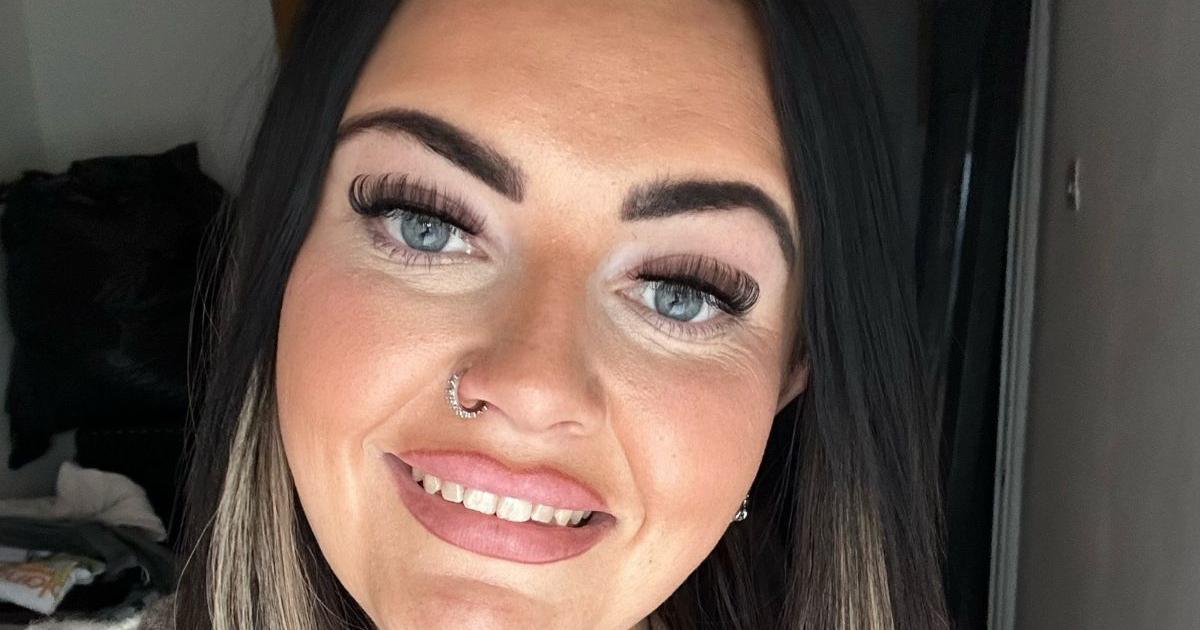
Kacey Lukins, a palliative care worker from Ebbw Vale, began suffering with heavy, painful periods when her father passed away 14 years ago.
After years of going back and forth to the doctors – and several misdiagnoses, including IBS and menorrhagia – Ms Lukins was prescribed norethindrone, and she took it on and off for years.
However, norethindrone can have side effects – particularly if you want to have a baby – and despite doctor’s telling her she shouldn’t take it for more than seven days in a row, doctors kept prescribing it to her, and there were times when she would take it for one month straight to stop her bleeding.
Ms Lukins said: “I’ve lost eight babies and I normalised this was how I am.
“I struggled with work and relationships; I was passing clots the size of my palm”.
Ms Lukins and her partner found out they were expecting a baby on Valentine’s Day this year (Image: Kacey Lukins)
So, when Ms Lukins found out she was pregnant earlier this year, on Valentine’s Day, she contacted her consultant as she is classed as a high-risk patient and needed to be prescribed cyclogest as a matter of urgency.
Ms Lukins waited 10 days for the prescription, despite phoning at least twice a day during that time and offering to drive anywhere to pick it up.
She said: “I was very stressed, [the drugs] arrived after 10 days, then I miscarried seven days later.
“If I’d had that prescription, things could have been different”.
A 28-year-old woman who miscarried for the eighth time has been left heartbroken following a series of medical failures (Image: Kacey Lukins)
After experiencing spotting, Ms Lukins went straight to The Grange University Hospital, where she waited for several hours.
She said: “I was sat there with pregnant people everywhere [which] was awful.
“[Eventually] a midwife told me [in front of other patients and staff] that they didn’t have any rooms to tell me in private, but unfortunately I had lost the baby”.
Ms Lukins was advised to go home, “rest up” and that she would “pass the baby” within a week or so.
She added: “The midwife probably thought she was being nice and sympathetic, but that was absolutely not okay.
“She told me in front of everyone, I went home and I didn’t process it for a couple of weeks.
“No one followed up with me, there was nothing – and I felt very suicidal”.
Ms Lukins added: “It’s such an awful feeling to lose a baby – it’s like my body has failed me again – but the professionals are also failing me”.
When Ms Lukins spoke to the South Wales Argus, she explained she had been bleeding non-stop for almost three months.
She visited her GP and asked if they could prescribe her tranexamic acid; however, the GP tried to get her to take a further course of norethindrone.
She said: “The GP tried to pressure me into taking norethindrone, and I said absolutely not; I want to try for a baby.
“I don’t want to fill my body with chemicals that going to affect my fertility.
“I had a full-blown panic attack on the way home, and [I realised] I’m at breaking point.
“Women [like me] are sat their thinking their doctor knows best, but we need to start advocating for ourselves
“I don’t want any woman to go through what I’ve been through – it’s isolating”.
Ms Lukins said losing another baby was an “awful” feeling – but the professionals are failing her too (Image: Kacey Lukins)
Aneurin Bevan University Health Board said they were “deeply sorry” to hear about Ms Lukins’ experience and “the distress she has endured”.
However, her most recent miscarriage comes in a long line of medical difficulties.
She eventually received a diagnosis of severe endometriosis after her family raised the funds for her to be seen privately.
Eventually, Ms Lukins’ family raised the funds for her to be seen privately, and following an internal ultrasound, she was told it was probably severe endometriosis.
Further tests revealed her right ovary was suctioned to her uterus, the opening of her cervix was pulled to the right, and there was a lot of scarring.
She explained: “[The diagnosis] was such a relief because I had normalised [what I was experiencing].
“Ultimately, I’m surviving in a rotting body”.
Ms Lukins had an operation to remove a large amount of scar tissue, however, the surgeon explained they could only do so much.
She said: “After I had my operation, I recovered quite well and after three months I was feeling marvellous.
“I was walking further than I’d been able to before and I lost weight”.
However, things then took a turn for the worse, when Ms Lukins was told to get a coil put it to help stop her endometriosis growing.
She explained: “I had the coil put in to stop the endo growing because that’s what [a doctor] recommended, but within six months I was worse than ever; the pain was horrific and I was bleeding all the time”.
Ms Lukins was told she would need another operation – but she has now been on a waiting list for over two years, and under the care of a consultant gynaecologist at The Grange University Hospital.
A spokesperson for Aneurin Bevan University Health Board told the South Wales Argus: “We are deeply sorry to hear about Kacey’s experiences and the distress she has endured.
“We recognise the profound physical and emotional impact that living with endometriosis can have, and we also understand the heartbreak and grief that can accompany pregnancy loss.
“Our thoughts are with Kacey and her family as they continue to cope with these experiences.
“We are particularly sorry to hear about the communication issues Kacey describes.
“At times when people are at their most vulnerable, they deserve to be treated with kindness, empathy and compassion.
“We understand how important clear and caring communication is, and we sincerely regret the additional upset that can be caused when someone’s experience falls short of the standards they should expect from us.
“Endometriosis is a complex condition that can be difficult to diagnose, particularly as symptoms can vary significantly between individuals and may overlap with those of other conditions.
“However, we recognise the frustration, uncertainty and impact that delays in diagnosis and treatment can have on patients’ lives.
“We remain committed to improving access to women’s health services across Gwent and ensuring patients receive the support and care they need.
“We are aware of the concerns Kacey has raised and these are currently being reviewed by our Listening to People team.
“They will be working closely with Kacey to fully understand her experience, address her concerns, and identify any learning that can help us improve the care and support we provide to patients in the future”.